

















































“Money talks can be hard. You have to have them, though."
Desi married life for British Asians comes with distinct challenges, influenced by cultural ideals, intergenerational expectations, and evolving gender roles.
Marriage is often regarded as a cornerstone in South Asian culture, deeply rooted in tradition, family values, and societal expectations.
Therefore, for those from Pakistani, Indian, and Bengali backgrounds in Britain, many challenges can arise.
Brit-Asians often face an intricate balancing act between the values of their cultural heritage and the individualistic norms present in Western society.
Accordingly, DESIblitz looks at the challenges of Desi married life for British Asians as they navigate socio-cultural expectations and the pressures and realities of modern life.
The Challenges of Family Expectations and Norms

Socio-cultural and familial norms, expectations and pressures can shape and impact married life.
Expectations regarding living arrangements, parental involvement, and adherence to traditional roles can challenge even the most harmonious relationships.
This can be particularly true when one partner’s views differ significantly from the other.
The challenge is intensified when couples live with extended family members, a typical arrangement among British Asians.
Moreover, British Asian marriages often involve managing extended family dynamics.
Twenty-nine-year-old Anisa, who has been married for four years, told DESIblitz:
“It was tricky when I first married; we lived with in-laws and still do. My mother-in-law had her way of doing things.
“She tried to accommodate me, and I tried to do the same. But there were differences in thought patterns.”
“She didn’t get me and my husband wanting solo time together.
“Her and my father-in-law have never done that. For her, her life is only around the whole family.
“Had to get her used to that idea of couples needing time together, doing things away from the family.
“It took time, but we found a balance. She and I had to both give a little. Married life isn’t just about me and the husband.”
Challenges Due to Cultural Differences

In British Asian communities, it is common for marriages to occur with individuals from the country of origin of families; these are often arranged marriages.
Such marriages can present distinct challenges, as the cultural norms and values of British Asians may conflict with those of spouses who were born and raised abroad.
Forty-nine-year-old British Pakistani Rozina reflected on her marriage to her husband, who was born and raised in Pakistan:
“There’s a lot of viewpoint clashes, there’s a mentality clash as a British Asian woman married to someone from back home.
“There’s a lot of things I’m open to, and I am progressive compared to my husband.
“When something is happening, and you’re making a decision, I believe in dealing with it yourself with your husband.
“But the way he’s been brought up, every Tom, Dick and Harry has a say.
“For him, those back home have a right to input; they carry more weight than you, the husband and wife.”
“It’s ridiculous since we’re the ones that are going to have to deal with it. But once you’re married, the pressures come with you taking on his whole family.
“The financial burdens are always there, and there’s no getting out of it.
“The way it is with my husband is that he took on a parent role; he feels responsible for them and has always financially provided for all of them.
“So the mentality is that we can do without here, but they cannot do without there. He simply cannot say no to them back home.
“There’s good and bad. He values his relationships more than some born here do.
“But there is more pressure for men from back home to provide regardless of what the couple has to deal with here.”
Rozina’s experiences highlight the complex dynamics when British Asians marry spouses from outside Britain.
These marriages often bring together contrasting cultural expectations and values, leading to challenges in decision-making, financial responsibilities, and relationship dynamics.
Financial Pressures and Tensions

British Asian couples can face financial pressures for a variety of reasons.
The financial burden can be overwhelming, from extravagant weddings to helping support extended family members to the cost of living.
Couples who differ in their financial priorities and attitudes may experience additional stress.
In turn, there can be a taboo around mentioning financial struggles that can lead to clashes.
Rozina stated: “When it comes to social settings, they [husbands] feel they have to maintain certain perceptions in front of other men, their friends, relatives.
“Like if we can’t afford something, I’m more than happy to say we can’t afford it. We need to save up.
“But they find it embarrassing; it’s also an ego thing. It’s a cultural thing not to talk about struggles that they can’t afford to do things.
“If relatives back home need something, I will say we can’t afford it right now.
“I don’t find it embarrassing; you say it as it is. That’s the point I clash with him on.”
“I do get a lot of dirty looks sometimes, but I don’t care. Someone needs to speak the truth.”
Open communication about finances is vital but often uncomfortable.
Thirty-year-old British Bengali Zeeshan told DESIblitz:
“Money talks can be hard. You have to have them, though.
“Islamically, it is my duty as the husband to provide for my wife and kid. I’m good with that, but with the cost of basics today and rent, you need honest talks and to work together.
“My wife stopped working when our little one came; we agreed that’s best.
“We had to have talks about the need to budget, though. Before, neither of us had to worry about any of this the way we do now. Kids are expensive.
“We talked about it and worked it out.
“But I know friends where it’s blown up with their wives; it might not be the cost of a kid, but there are issues sending money back home to family and other things.”
The Challenges of Co-Parenting
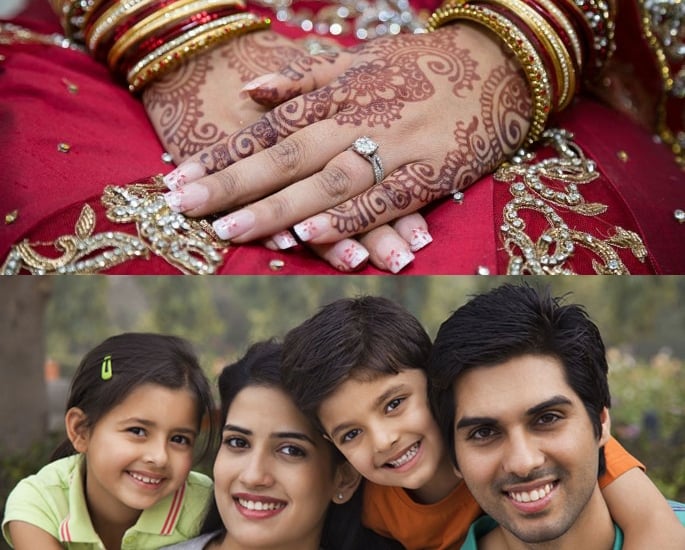
Parenting can bring another set of challenges to married life for Brit-Asians, especially when spouses have differing views on raising children or parental roles.
The influence of traditional values often conflicts with modern parenting approaches, leading to disagreements.
Couples may struggle with discipline, religious upbringing, and educational goals.
This tension can be further amplified by pressure from grandparents who may have strong opinions on raising their grandchildren.
Anisa asserted: “What annoyed me when we had my first son was my husband didn’t like to be the one telling him off.
“I automatically became the bad guy. He wanted to leave the disciplining to me. His dad had been the strict disciplinarian when he was growing up, and he didn’t like the memories.
“He didn’t want to take on what he saw as the stereotypical traditional Asian dad role, where dads are just there to tell off.
“I had to put my foot down. I definitely didn’t want him doing it like his dad, but it couldn’t be all me.”
Moreover, Zeeshan maintained:
“Grandparents play a big role, they help loads. But me and the wife didn’t want to do everything our parents did with us.
“Dealing with that was hard; our parents didn’t get it; it came across as ungrateful when that wasn’t it.”
Co-parenting within British Asian marriages often involves navigating a delicate balance between traditional values and more modern approaches.
As Anisa’s experience illustrates, these differing perspectives can lead to marital tensions, particularly regarding discipline.
The influence of traditional parenting styles, often shaped by cultural norms, can create conflict, especially when one partner resists assuming roles they associate with outdated or authoritarian practices.
The struggle is further complicated by the presence of grandparents, whose opinions on child-rearing can sometimes add additional pressure.
The Challenge of Working and Labour at Home

Traditional gender expectations and norms often impose additional burdens on women within heteronormative marriages. Consequently, unlike their male partners, working women may face pressure to manage all household and caring responsibilities.
In turn, Brit-Asian women can face themselves having the stressful experience of confronting normative ideals and expectations.
Fifty-year-old British Bengali Minaz* said:
“When I started working, the expectations of my husband were still the same; he got a bit of a rude awakening. He and the boys had to pitch in a bit more.
“The mentality is a big thing; it will change, but it takes time.
“It’s not just my marriage; I’ve seen it in a lot. Living through change forces shifts, but expectations usually put more pressure on women.”
In turn, Anisa said: “It’s frustrating and anger-inducing. My husband was always praised for working and helping with the housework and kids. Me, no one even blinked.
“It really got to me, to the stage I started to call family and friends out.”
As these experiences highlight, even when women enter the workforce, the expectation that they manage household and caring duties can remain unchanged.
Thus creating a disproportionate burden on women, who must navigate both societal norms and personal expectations within their marriages.
Minaz’s and Anisa’s reflections underscore a broader pattern in many British Asian households, where women confront and challenge normative ideals while seeking a more equitable division of responsibilities.
Navigating these changes can be stressful, but it is essential for fostering more balanced and fulfilling relationships.
Navigating married life as a British Asian can be challenging due to socio-cultural expectations, financial pressures, and evolving gender roles.
Success can come from open communication, compromise, and negotiation. Due to the dynamics of British Asian family life, wider family members can often be involved in this process.
British Asian couples will continue to navigate the complexities and challenges of culture, modern British life, and what it all means through married life. In doing so, they may help break barriers, redefine roles, and much more.