


















































"I deserve the respect of being a public partner."
Some British South Asians are quietly embracing non-monogamy, rewriting the rules of love, romance, and commitment.
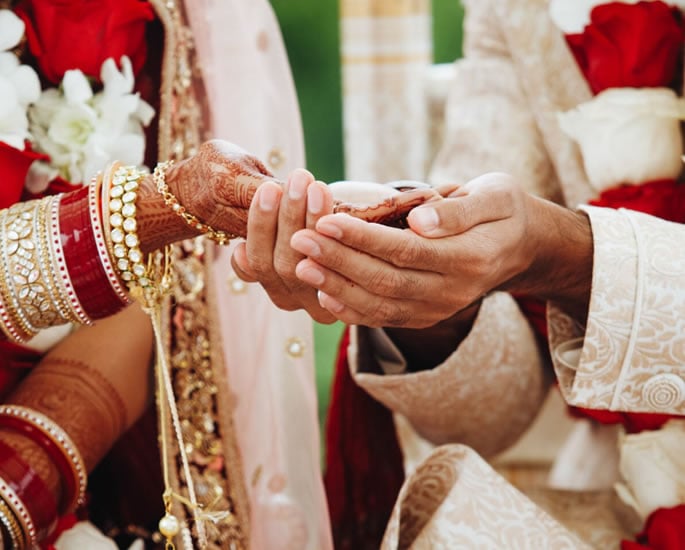
For decades, the Desi community’s cultural script has been linear: find a suitable partner, stage a grand wedding, and settle into lifelong monogamy.
However, some British Asians, especially younger generations, are exploring ethical non-monogamy (ENM), navigating a delicate balancing act against the weight of honour and intense familial expectations.
Redefining intimacy means unlearning collectivist ideals around ownership, fidelity, and sacrifice, and questioning why traditional structures must govern emotional realities.
We look at this rise, uncovering how ‘Poly-Desis’ pursue expansive love while managing the exhausting pressures of a hidden life.
Beyond the ‘Shaadi’ End Goal
The digital dating landscape has drastically transformed how British Asians approach romance and connection.
For some young South Asians, they are moving away from the assumption that a single person must fulfil every emotional, physical, and psychological need for the rest of their lives.
This shift represents a fundamental change in the diaspora’s relationship preferences.
Ethical non-monogamy encompasses a wide spectrum of relationship styles where all parties explicitly consent to having multiple romantic or sexual partners.
Rather than conforming to the heteronormative script of the traditional Asian wedding, many individuals are choosing relationship anarchy or hierarchical polyamory to build connections that genuinely serve their interpersonal needs.
Psychotherapist Pritima Kaur observes this exact cultural transition occurring in real-time.
Speaking on the changing relationship dynamics among South Asians, she noted:
“With [South Asians] getting sexually active faster and knowing what they want, why would they not get what they want?”
This direct approach to desire directly challenges the historical framing of South Asian intimacy, which has often been shrouded in modesty, restriction, and rigid familial duty.
Furthermore, ENM is frequently mischaracterised as a distinctly Western, modern concept.
Yet, historical texts and societal structures from the subcontinent are filled with non-monogamous relationship formats.
Today’s British Asian youth are not adopting a foreign trend. They are reclaiming the autonomy to define their own romantic boundaries.
By expanding their preferences beyond the rigid marriage end-goal, they are establishing a completely new baseline for what a successful, healthy, and ethical relationship looks like.
They are communicating their needs upfront, saving both themselves and potential partners the heartache of mismatched expectations down the line.
Izzat and Moral Purity

Choosing a polyamorous lifestyle introduces a severe, immediate conflict with traditional South Asian values, primarily the concept of izzat.
Honour and reputation dictate social standing within the community, and monogamy is intrinsically linked to moral purity.
To step outside the bounds of exclusive marriage is to invite heavy scrutiny, relentless gossip, and the potential alienation of your entire family network.
In collectivist cultures, a romantic relationship is rarely confined to two individuals. It operates as a union of two families.
Consequently, any deviation from the established norm reflects poorly on the parents, the grandparents, and the extended family tree.
The stigma attached to non-monogamy often forces British Asians into deep secrecy.
They fear their consensual, ethical relationship choices will be conflated with infidelity, promiscuity, or outright moral failure by elders who view anything outside of traditional marriage as disgraceful.
Meera* recalled her relationship ending due to her partner’s subtle shame over their non-monogamy, specifically how his parents would react.
She said: “I deserve the respect of being a public partner. I could not deal with my partner being ashamed of me or our relationship.
“If appearing mono is more important than my feelings and love, then we are not compatible. That hurts my feelings too much.”
This intense fear of rejection creates a massive barrier for Poly-Desis.
The necessity to protect the family’s honour means that many ethical non-monogamists must actively hide their authentic selves.
They censor their conversations, stringently monitor their social media presence, and frequently lie about their living arrangements.
Despite these massive hurdles, some find the personal payoff is worth the discretion.
Discussing their experience with non-monogamy and swinging, Maya* explained how it has benefitted her primary connection:
“It’s something we do together because it makes our sex life absolutely bonkers. It honestly helps us reconnect and has spiced things up so nicely.”
The Double Life

British Asians raised in collectivist households heavily internalise the idea of ‘ownership’ over a partner.
Unlearning this conditioning requires entirely redefining the concepts of fidelity and cheating.
In polyamory, fidelity does not equate to sexual or emotional exclusivity. Instead, it means strict adherence to the boundaries, rules, and communication agreements established by everyone involved.
Managing these multi-partner relationships while attending traditional family functions takes a significant psychological toll, resulting in the notorious ‘double life’.
A Poly-Desi might spend their Saturday negotiating complex emotional boundaries with two different partners, only to attend a crowded family dinner on Sunday where aunties relentlessly interrogate them about when they plan to settle down with a single spouse.
Ananya* described the delicate balancing act:
“It’s a funny feeling having a boyfriend and another lover that nobody knows about.
“You share this warm and fuzzy magnetic energy, yet are conscious not to do certain things like kiss or touch each other romantically in case a relative sees.
“The mutuality is nice, it feels like teamwork.”
However, this teamwork does not erase the persistent anxiety of concealment.
Haasan* highlighted why hiding these relationships is uniquely difficult within tight-knit Desi households:
“Some White households are ‘uninvolved’ with their parents and siblings, so they can live a double life and present themselves as ‘normal’ to their families.”
“Whereas in my family, we all talk to each other every day, we all know where the others are all the time, and this is culturally normal, so the idea of not doing this would be taken as ‘not being a family’.
“I think the closeness is a good thing overall but it makes relationship conversations so complicated.”
Living a double life demands exhausting hyper-vigilance.
The constant code-switching between a progressive, non-monogamous identity and a traditional, dutiful child persona can lead to severe mental burnout.
The fear of being ‘found out’ looms large over every family gathering, religious festival, or community wedding.
Yet, many choose to endure this psychological strain rather than risk losing their familial ties entirely.
They compartmentalise their lives to protect the people they love, even if it means hiding a core part of themselves.
Digital Safe Spaces

As the dialogue around relationship diversity steadily grows, digital safe spaces are proving crucial for British South Asians.
Social media platforms, private Discord servers, and Reddit communities offer an anonymous sanctuary where Poly-Desis can find much-needed solidarity.
These online ecosystems are providing a brand new vocabulary for intimacy that actively dismantles the restrictive binary labels of married or single.
Through these online communities, individuals learn the practical mechanics of non-monogamy.
They learn how to set firm boundaries, manage inevitable jealousy, and practice compersion, the feeling of genuine joy when a partner experiences pleasure or love with someone else.
Most importantly, they find culturally specific advice on how to navigate the intersection of South Asian guilt and non-monogamy.
The internet has successfully democratised access to relationship therapists who specialise in marginalised identities, allowing British Asians to seek guidance that validates their dual cultural realities.
Pritima Kaur captures the core philosophy driving this movement toward openness and relationship expansion:
“Some people just want to expand the purview of their lives.”
“That doesn’t mean there’s something wrong – sometimes, something is so right, and you trust your partner so much that you are willing to let them explore.”
This mindset reflects a profound shift from a model of restriction to one of abundance.
By utilising these digital resources, young British Asians are dismantling the stigma surrounding their desires and constructing relationship frameworks built on transparency rather than tradition.
The quiet rise of ethical non-monogamy among British South Asians represents a vital reclamation of bodily and emotional autonomy.
Stepping away from the rigid expectations of the ‘Shaadi’ end-goal means untangling generations of conditioning around izzat, ownership, and moral purity.
While the psychological burden of the double life remains a heavy toll for many Poly-Desis trying to appease their families, the growing availability of digital safe spaces is forging a healthier path forward.
By cultivating a specialised vocabulary for intimacy that respects both their cultural realities and their personal boundaries, these individuals are proving that love and commitment do not have to be a monolith.
Ultimately, redefining relationships means bravely expanding their South Asian heritage so they can finally exist within it authentically.