

















































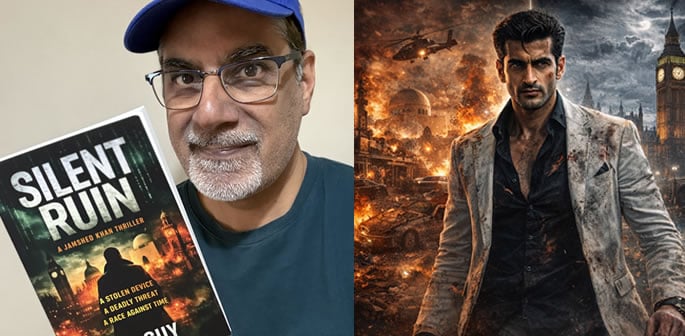
"There’s tension, moral ambiguity, political commentary"
Shahzad Sheikh, writing under the pen name BC Guy, returns with Silent Ruin, the opening instalment of a new international espionage series centred on intelligence operative Jamshed Khan.
The novel moves between Karachi and London, building a high-stakes narrative shaped by espionage networks, shifting loyalties and a mission with global consequences.
It marks an expansion of Sheikh’s creative work beyond his established reputation in automotive journalism and digital storytelling, where he has built a career spanning more than 30 years.
With Silent Ruin, he turns to long-form fiction that blends action-driven plotting with questions of identity, power and perspective in the spy genre.
In an interview with DESIblitz, Shahzad Sheikh reflects on the evolution of the character, the intent behind the series, and the ideas shaping this new phase of his writing.
From Storyteller to Espionage Fiction
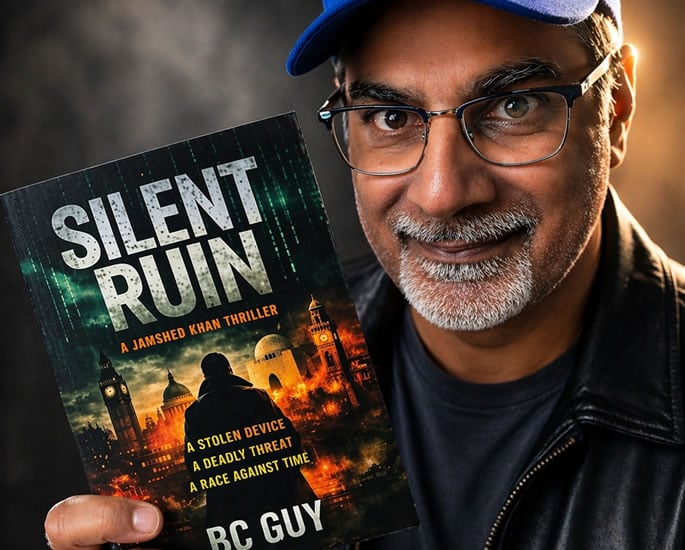
Shahzad Sheikh has always worked within storytelling, whether in journalism or fiction.
Silent Ruin marks his shift into espionage while maintaining a fast, grounded narrative style shaped by years of writing across formats.
He says: “I’ve always been a storyteller – as far back as I can remember, as soon as I knew how to write, I was writing stories.
“Even in my day job as a motoring journalist and content creator, I’m still telling stories, just grounded in real-world subjects and factual information rather than fiction.”
His literary interest lies mainly in thrillers and science fiction, both of which inform his approach to pacing and structure:
“Over the years, I’ve explored different genres, but two have always stayed with me: science fiction and thrillers.
“Science fiction, because of the endless possibilities for metaphor and exploring big ideas. And thrillers, because I’ve always loved and enjoyed action movies.”
That crossover between entertainment and ideas defines his approach to espionage fiction, as he explains:
“My first novel, The ULEZ Files, which I published in 2023, was also a thriller, and I had a lot of positive feedback on it. Readers described it as a page-turner, and that fast, dynamic style is something I really enjoy writing.”
He sees the genre as a space where narrative momentum and political subtext can coexist.
“An espionage novel lends itself perfectly to that while also allowing me to combine the fun stuff with something deeper.
“There’s tension, moral ambiguity, political commentary; you get to tell stories that aren’t just entertaining but are also layered and challenging, with characters navigating complex scenarios where right and wrong aren’t always clear-cut.”
Jamshed Khan’s Transformation

At the centre of Silent Ruin is Jamshed Khan, a character Sheikh has developed over three decades.
Originally created in Let’s Jam, Jamshed Khan functioned as both parody and tribute to the spy genre.
Shahzad Sheikh says: “Jamshed Khan was originally envisioned as a comic book character, featured in Let’s Jam.
“He was both a spoof and a tribute to the world’s most famous superspy, James Bond. So he was slightly exaggerated, a little tongue-in-cheek, and not meant to be taken entirely seriously.
“In Silent Ruin, he’s no longer just a two-dimensional caricature; he’s grown and evolved into a fully realised character with a past, with emotional weight, with flaws and contradictions.”
His development also reflects Sheikh’s intention to create a recognisable South Asian presence within the spy genre.
“So Jamshed originally started as a way of creating that kind of hero, someone who could exist in that world, but from our cultural perspective – we could see ourselves in him, aspire to be him.
“JK may have started out as a “Brown Bond”, but over time, he’s grown into his own man, with his own identity, his own voice, and his own way of doing things. He’s no longer just a parody.”
Moving between Karachi and London

The novel’s structure uses Karachi and London as contrasting environments that shape tone and character perception.
Sheikh says: “I’ve said that Silent Ruin is loosely based on the original Let’s Jam comic, and if you read both, you’ll definitely recognise sequences, certain bits of dialogue, and even find a few Easter eggs, including nods to 007.”
Set in 1996, Silent Ruin also returns to the period in which the original concept was created.
“It’s also set in 1996, the same year I originally published Let’s Jam, so there’s a deliberate sense of going back to where it all began. If you were around in the mid-90s, you’ll recognise the world Silent Ruin exists in.”
Jamshed’s perspective reshapes how both cities are experienced, as Sheikh elaborates:
“And in my head, he stopped being just black-and-white line art on flat paper and became someone far more tangible, almost like a real person who could quite possibly be living, and spying, amongst us!”
Rather than following the conventional Western-hero-abroad model, Sheikh reverses the dynamic:
“So here you have a brown hero coming from the chaos and vibrancy of Karachi and landing in the wet and dreary dull grey of the UK – and actually finding it refreshingly different!”
That contrast extends into character relationships, including the dynamic between Jamshed and an Indian intelligence operative, where rivalry is avoided in favour of layered interaction.
Sheikh adds: “I didn’t want it to be the obvious thing, which would be rivalry and conflict.
“Of course, the tension and suspicions are there, but with such highly trained and skilled professionals, it was interesting to explore what might sit just below the hostility on the surface.”
Reworking the Spy Archetype

Silent Ruin is shaped by questions of identity, particularly within a genre dominated by Western protagonists. Shahzad Sheikh uses Jamshed to challenge and reinterpret familiar spy conventions.
He says: “Bond beds just about every woman he meets, for example.
“It would be an easy cheat to replicate that with JK – we establish early on that he’s young and good-looking.”
“But in our cultures, we’re brought up in extended family environments where we’re taught to respect women as mothers, aunts, daughters and sisters.
“When JK does fall in love in the book, he finds himself conflicted, embarrassed and humbled, rather than treating it as just another conquest.”
Sheikh is also explicit about the limitations of applying the Bond archetype outside its original context:
“I actually believe he cannot. And the reason for that is that Ian Fleming’s James Bond is undeniably a construct of white privilege – he lives in a world where he can stride into any place and do as he pleases with little objection.”
That critique informs Jamshed’s construction:
“You imagine a brown Bond travelling across the world, it would take him twice as long because he’d keep getting stopped at airports due to racial profiling!
“But at the same time, I didn’t want JK to be too realistic, because that would make him boring.”
As a result, Jamshed operates within action-genre conventions while retaining cultural specificity.
“Thus, somewhat unrealistically, but in keeping with the tropes of most action heroes, he prefers to tackle objectives visibly head-on rather than from the shadows, which makes for a more dynamic narrative.”
Craft, Detail and Long-Term Vision
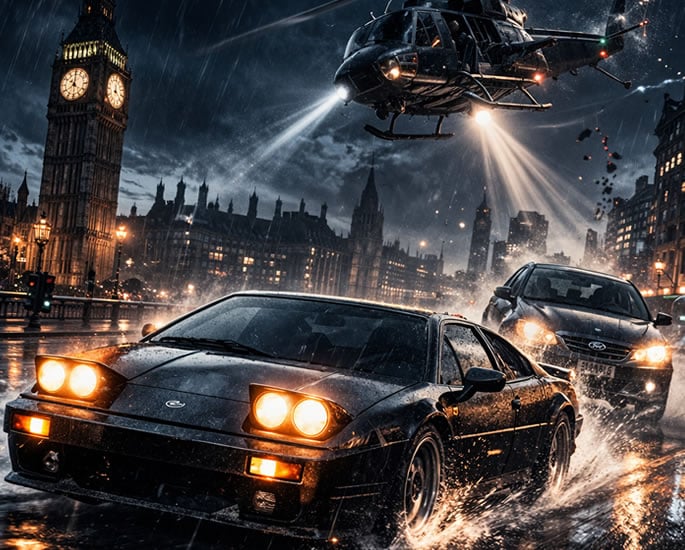
Shahzad Sheikh’s automotive journalism background informs his attention to detail, particularly in how characters are constructed beyond dialogue and action, as he says:
“As most authors do, I created in-depth histories and profiles for all the main characters while planning the novel, but probably unlike most writers, I also gave them cars.
“If you think back to classic films and particularly TV shows, lead characters often had signature cars that helped define them. Sometimes those cars became as memorable as the characters themselves.”
Each vehicle reflects personality and narrative role.
“So yes, Jamshed’s Lotus Esprit deliberately echoes the Roger Moore-era Bond, immediately establishing him as a ‘secret agent’.
“The Indian operative’s black Jaguar XK8 reflects a more understated, controlled presence, while Linda’s BMW 3 Series Touring balances a sense of edge with practicality, fitting her life as an artist and photographer.
“The cars are there to support the characters, not overshadow them. They’re woven into the narrative and used when relevant to the story, rather than being inserted for the sake of it.”
Looking ahead, Shahzad Sheikh is building Silent Ruin as the foundation of a long-term series that follows Jamshed across time and geopolitical change.
He says: “The plan is to follow Jamshed across time and really allow him to grow.
“Each instalment will jump forward a few years, allowing the character to evolve, shaped by experience, loss and changing circumstances.
“I’ll be upping the stakes dramatically, and the stories will begin to intersect more with significant real-world events.”
Jamshed’s arc has already been broadly mapped, with Sheikh adding:
“Frankly speaking, I’ve already loosely plotted out his arc over the course of several books, and it’s fair to say he’s going to be put through the mill.
“The possibilities are endless!”
For now, however, the focus remains on building a grounded espionage series anchored in the present version of Jamshed Khan.
“That’s something I may return to, but for now, the focus is firmly on building a compelling, grounded modern thriller series around the contemporary version of Jamshed Khan.”
Silent Ruin lays the groundwork for a wider series that expands on Jamshed Khan’s story.
Across its narrative, the novel establishes a protagonist shaped by cultural duality, professional conflict and the evolving demands of a dangerous world.
Shahzad Sheikh uses espionage to explore identity, loyalty and perspective, while also challenging familiar conventions within the genre through a South Asian lens.
As the first chapter in a long-term narrative arc, it signals both a creative return to an early character and a clear intent to expand his fictional universe over time.