












































“My hope for us is that we can look beyond the colour of our skin"
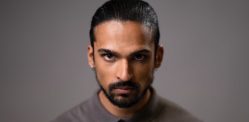
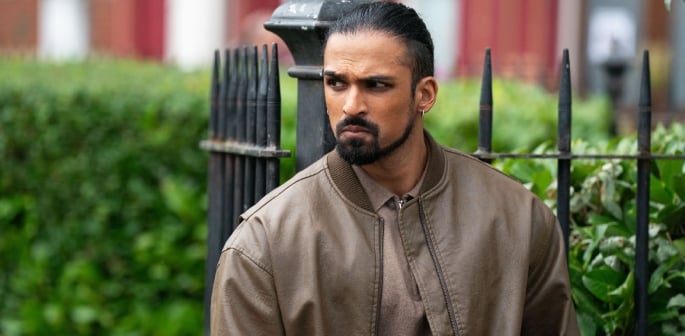
EastEnders star Aaron Thiara said his character’s recent mental health storyline is about more than just representation for South Asian audiences.
The 32-year-old actor, who plays Ravi Gulati, has been at the centre of one of the soap’s most serious recent plots, as Ravi is diagnosed with Complex PTSD (CPTSD) after years of childhood trauma and abuse.
Speaking to BBC Newsbeat, Aaron said he understands the expectations that come with being a South Asian actor handling such a sensitive storyline:
“Because of the colour of my skin, people will identify themselves through that.
“You can’t help but think [about those expectations]. Your mind goes in certain directions, but first and foremost, I have a job to do.”
While he recognises that many viewers from South Asian communities may see themselves reflected in Ravi’s journey, Aaron stressed the storyline is not limited to one group.
He said it is “universally for everyone and anyone”.
According to the NHS, CPTSD can develop after long-term trauma such as child abuse. Symptoms can include risk-taking behaviour, feelings of emptiness and suicidal thoughts.
After a series of breakdowns and an attempt to end his life, Ravi is now being treated in a mental health facility. His family supports him, but they are also determined to keep his struggles hidden from outsiders.
Aaron said that reflects a long-standing issue in many South Asian families, where mental health is often treated as taboo.
He explained: “There is a rich history over many, many years of what our South Asian community want to [show] to the outside world.
“And that is strength, honour, culture.
“By any means necessary, get the job done on a day-to-day basis.”
He believes Ravi’s story still resonates far beyond that cultural context.
According to PTSD UK, around 6.6 million people are expected to develop PTSD or CPTSD at some point in their lives.
Aaron said: “My hope for us is that we can look beyond the colour of our skin and support one another.
“And we can seek help and be delicate and empathise with anyone and everyone who may be going through certain problematic issues.”
His character has often been defined by violence, crime and time in prison. But the soap has also revealed the abuse and trauma that shaped him.
Aaron said one of the storyline’s main goals was to help audiences see the person behind the past.
“The hope that I had from it was that people can look beyond and just see the human being.
“As people, we can grow from that in terms of empathy and love.”
EastEnders‘ writers sought advice from mental health charities Samaritans, Mind and Rethink Mental Illness. And while it is a sensitive topic which required “months and months of preparation”, there was also a question of keeping the audience engaged.
Despite the responsibility of portraying such a serious illness, Aaron said he tried not to let that pressure overwhelm him.
“The responsibility is just to be in a place where I can spiritually, mentally, emotionally give myself to the story in service of Ravi’s illness.”
Aaron also chose not to over-research CPTSD, instead allowing himself to experience the role with the same uncertainty as Ravi.
He said: “I haven’t experienced the illness, I didn’t know much about it.
“Not only is Ravi not knowing what’s happening, I don’t know what’s happening.
“So I can allow myself to just go moment to moment.”
Still, major scenes showing Ravi’s decline required careful planning. These included holding people hostage in a pharmacy, admitting he had become a police informant and attempting to take his own life after a car crash.
Aaron Thiara said tackling difficult subjects is one of EastEnders’ greatest strengths and pointed to past storylines involving Mark Fowler’s HIV diagnosis, Stacey Slater’s bipolar disorder and Phil Mitchell’s psychosis.
In his view, telling these stories through different characters and perspectives is where the soap continues to stand out.
He added: “Given what Ravi had done previously on the Square, his history has been one that’s probably not the best.
“The hope that I had from it was that people can look beyond and just see the human being.”