
















































He describes AI-enhanced employees as “superworkers”.
Digital twins are moving from an experimental AI concept into an active workplace infrastructure.
But what happens when a version of you can answer emails, attend meetings, and make decisions while you are offline?
In simple terms, a digital twin is an AI system trained on a person’s data and behaviour patterns. It can replicate knowledge, reasoning style, and communication approach in a usable interface.
The result is a tool that can act and respond like its human counterpart, with growing accuracy.
That shift is already changing how organisations think about productivity, ownership and work itself.
How Digital Twins are Changing Daily Work
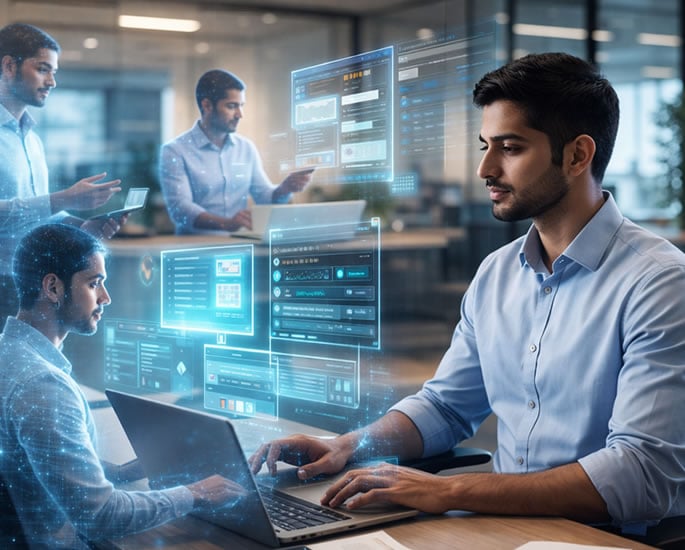
‘Digital Richard’ has served as a blueprint for the creation of digital twins.
It is the AI counterpart of Richard Skellett. Bound within the confines of a screen, Digital Richard looks largely two-dimensional, but he’s no ordinary chatbot.
Digital Richard knows everything Skellett knows.
He was built as a small language model which used ChatGPT to digest all of Richard’s meetings, calls, documents, presentations and more. It was then refined to follow Skellett’s way of thinking and problem-solving.
The system operates as a text-based interface that Skellett can consult throughout his working day.
He uses it to support business decisions and client presentations in his role as chief analyst for research and design at Bloor Research.
Digital Richard even extends beyond work tasks. It includes tabs labelled “family” and “admin” that remain off-limits to colleagues.
The approach has scaled across the organisation. Digital twin systems are now being built for Bloor Research’s 50-strong team across the UK, Europe, the US and India.
The practical impact is already visible.
An analyst planning to retire has phased out their role while their digital twin continues handling parts of their workload. A marketing team member on maternity leave was also partially replaced by their digital counterpart rather than a temporary hire.
Bloor Research now offers a “Digital Me” as standard for new employees. Another 20 companies are already testing the technology, with wider rollout planned later this year.
Skellett said:
“In this environment, having a Digital Me is not optional if you want to operate effectively. It becomes part of how you work.”
Interest is also being reinforced by industry forecasts.
According to technology analysts Gartner, digital replicas of knowledge workers are expected to enter the mainstream in 2026.
That follows wider AI trends, including systems trained to mimic artists’ styles and voices. Reports that Meta is developing an AI version of chief executive Mark Zuckerberg have added further momentum.
The Legal Grey Area
The business case for digital twins is clear.
Companies see higher output, faster decision-making and reduced hiring pressure. But the model introduces difficult questions around ownership, control and responsibility.
One central issue is who owns the twin itself.
If it is trained on personal work history, does it belong to the employee or the employer? Another is compensation. If a worker becomes significantly more productive through an AI replica, should pay increase accordingly?
Kaelyn Lowmaster, research director in Gartner’s HR practice, said:
“There are real potential benefits for sure, but it depends on getting the governance right, the direction of free time right, the autonomy of these agents right, and making sure that my name, image and likeness still stays mine, even if my employer is benefiting from it.
“I think we will probably see the negative side of this coin before we see the positive side.”
Skellett argues ownership should remain with individuals:
“That is why compensation now reflects outcomes, measurable commercial impact, and value creation, rather than simply salary plus bonus.
“AI changes time and speed, so there’s little future in the hourly rate.”
Other industry leaders are testing similar ideas.
Josh Bersin, founder and CEO of The Josh Bersin Company, has been building digital twins using technology from San Francisco-based startup Viven.
He describes AI-enhanced employees as “superworkers”.
The productivity gains are already measurable in some firms.
Bersin’s company is growing at around 30% per year while hiring only a small number of additional staff. He has also increased annual staff bonuses as output rises.
However, he said: “I’m pretty sure the way employment contracts work in most countries is that the IP or the information that you’re creating is the property of the business, not yours personally.
“But if you think about it logically, if somebody leaves a company, their twin’s going to decay in value over time, because the things going on keep changing and they don’t.
“So after a while, I don’t know if the twin would be that useful.”
Legal experts say the framework is still forming.
Employment law has not yet adapted to AI systems embedded so deeply in workplace relationships.
Bellevue Law associate Anjali Malik said:
“The moment an AI tool is trained on an individual’s emails, meetings and work product, you’re dealing with issues that sit right at the heart of the employment relationship: consent, control of personal data, performance, substitution of labour, and what happens when someone leaves.”
Meanwhile, Chloe Themistocleous, partner in employment law at Eversheds Sutherland, argued that “clear statutory guidance” will be essential, or organisations will face growing legal uncertainty.
She added: “There are so many other changes in employment law at the moment, it is unlikely that changes to cater for AI will be any time soon, and it is likely to be left to the tribunals to grapple with in the meantime.”
Digital twins are already shifting how organisations distribute work, expertise and decision-making. They are also challenging long-standing assumptions about labour, identity and value creation.
Companies are moving faster than regulation, which is leaving key questions unresolved. Ownership, accountability and pay structures now sit at the centre of the debate.
What happens next will depend on how quickly law, business and workers align around a model that is still being defined.