











































"my memory of the night the Berlin Wall fell has never left me."
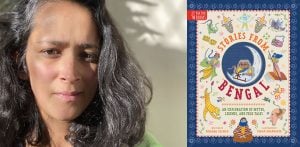
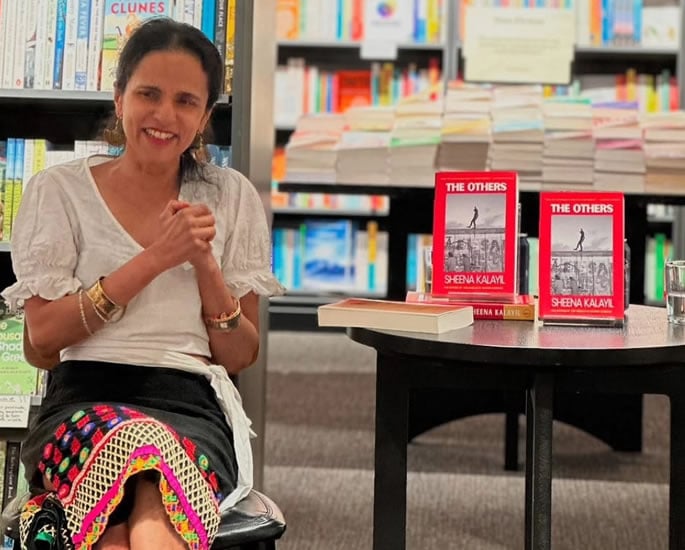
Manchester-based author and teacher Sheena Kalayil has long been known for her ability to illuminate untold stories at the crossroads of history and human experience.
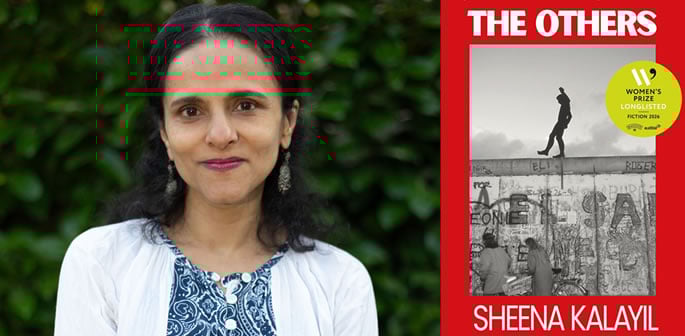
Her fourth novel, The Others, is set in East Germany in 1989, as the Berlin Wall teeters and a quiet revolution sweeps through the region.
The story follows Armando, a Mozambican factory worker, Lolita, an Indian medical student, and Theo, an East Berliner dreaming of escape, as their lives become entwined in a tense love triangle.
Through their perspectives, Kalayil explores migration, belonging, and the personal dilemmas that arise when the world order shifts beneath your feet.
In an interview with DESIblitz, she reflects on the historical research, multilingual storytelling, and global perspectives that shaped The Others, as well as the recognition it has received with a Women’s Prize 2026 longlisting.
What Inspired The Others

The Others emerges from a long-held fascination with history, migration, and personal memory.
Sheena Kalayil explains: “I’ve been looking back quite a lot recently, probably a symptom of being middle-aged!
“I was an engineering student in Budapest in 1989 and my memory of the night the Berlin Wall fell has never left me.”
Later experiences in post-civil war Mozambique added depth to her understanding of migration, as she continues:
“I met some of the Madgermanes, those Mozambicans who had spent formative years in the DDR (East Germany) and had to leave.
“I had these two strong memories, and wanted to connect them in some way.”
The book is set in 1989 East Germany during a profound global change.
Kalayil elaborates: “The collapse of the Soviet Union, the reunification of Germany, and the expansion of the European project has been seen mostly through a positive lens in the West.
“But these events had profound effects on the lives of people from what we now call the Global South.
“It was this different perspective, an untold story of migration that I wanted to explore and I wanted to explore this through the messiness of a love triangle.”
Set in a small city on the Baltic Sea, The Others follows three young people navigating love and uncertainty amid political upheaval.
Armando and Lolita choose to live, study, and work in the Deutsche Demokratische Republik (DDR), while the East German Theo dreams of escape.
Kalayil highlights the overlooked stories of migration:
“While it has been well-documented that East Germans often tried to escape over or under the Berlin Wall, it is less well known that more than 5,000 tried to swim or sail across the Baltic Sea to Denmark.
“In this way, The Others speaks to current discourses on migration and belonging, through the personal dilemmas we will all recognise.”
Exploring Migration and Belonging
Migration forms a central theme of Sheena Kalayil’s narrative.
She draws a parallel between human mobility and the natural world:
“We love watching penguins migrate to find food and better environments for their families. There is less love for human beings who do the same!
“Migration is not a new phenomenon, and is not a phenomenon or problem, which only happens in the West.
“And there are so many reasons why people move and or are displaced.
“I wanted to highlight the humanity behind the migrant, not least because I have been an immigrant several times in my life, and I am an immigrant to the UK.”
Her characters’ experiences reflect both historical and contemporary migration struggles.
Armando, Lolita, and Theo confront the challenges of nationality, borders, and belonging.
Kalayil explains:
“I drew on my personal experiences, as well as research and imagination.”
“I have never had a love affair which was not in some way impacted by questions about borders and nationality and permits!
“In this way, the quandaries that Lolita, Armando and Theo face are very familiar to my younger self.”
Voices, Languages, and Historical Context
The multilingual and multicultural lives of her characters are central to Kalayil’s storytelling.
She says: “In all my writing, it’s very important to me to show the multilingual repertoires of my characters.
“This is the first novel I have written where I do not transcribe Malayalam because Lolita is of the social class where she would communicate with her mother in English, and growing up in Manipur, she would also be conversant in Hindi.
“I lived in Mozambique for three years and speak Portuguese.”
Writing in German, a language unfamiliar to her, required both technology and collaboration:
“I used Google Translate for the phrases and then asked a German-speaking colleague to check them to ensure they rang true for the time and place.”
Researching East Germany in 1989 involved a mixture of academic sources, narrative studies, and visual cues.
Kalayil reveals: “Academic articles and books are helpful for evidence-based details, such as demographics and architecture.
“Tanja Müller’s research on the Madgermanes was a rich source of detail, which I could weave into the story.”
“Narrative studies often include verbatim data, such as interview excerpts or diary extracts. These can help you ‘hear’ the voices of the people from that period/era and can help you with your dialogue.”
Sheena Kalayil also read widely in non-academic works, drawing on Red Love by Maxim Leo and Anna Funder’s Stasiland for insights into life under authoritarian rule.
She notes a cautious approach to visual media: “I have a strong visual sense when I am writing but, counter-intuitively, I don’t find watching films that helpful.
“But I do look at photographs and these can give you a few clues to play with.
“However, photos from the past are often in black-and-white, even photos of East Germany from the 1980s, and this can exacerbate a sense of detachment from the present.
“Yet your characters are living in their present, and do not know what lies ahead. The trick is to maintain that sense of ‘this is normal’ in their lives.”
Recognised by the Women’s Prize 2026
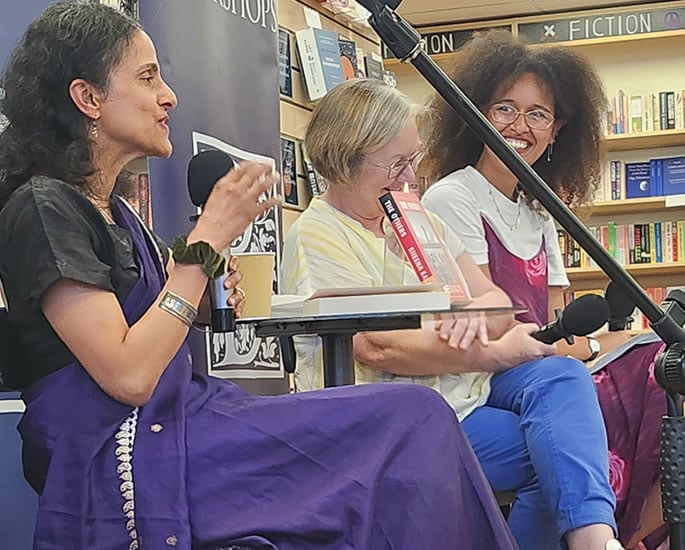
The Others has now received recognition as it has been longlisted for the Women’s Prize 2026.
On how she reacted, the author confesses: “I felt like someone had called the wrong number but it was truly my editor on the other end of the phone call!
“It took many days for the news to sink in.”
At this stage of her career, the acknowledgement carries added significance:
“I was 47 years old when my first novel was published. By then, I had survived neglect, abuse, estrangement, loss as well as found love and joy.
“My writing does not define me but this does not mean I am any less eager for the successes!
“Being longlisted and joining the ranks of such brilliant women and thinkers brings a wonderful, inescapable feeling of validation.”
She hopes the prize will broaden her readership and support her future projects.
Kalayil adds: “I have always stayed true to what I want to write about – my novels don’t fall easily into the ‘South Asian’ category in UK publishing.
“This has meant many rejections and little exposure.
“The recognition from the Women’s Prize has galvanised me to continue writing in my way, and to trust the reader.”
“I hope this recognition will open my work to new readers who want to read strong character-led stories, showing diversity of experience and perspective.”
For Sheena Kalayil, The Others is both a personal and universal story, revealing the complexities of migration, love, and human connection amid political upheaval.
Her careful blending of history, research, and imagination brings her characters vividly to life, showing how global events ripple through individual lives.
Recognition from the Women’s Prize 2026 has amplified her voice and validated her approach to storytelling, but the author remains focused on writing with honesty and authenticity.
Through Armando, Lolita, and Theo, readers encounter not just a moment in history but the enduring challenges and resilience of those navigating new worlds.
The novel leaves a lasting impression, prompting reflection on the ways we belong, move, and love in an ever-changing global landscape.