
















































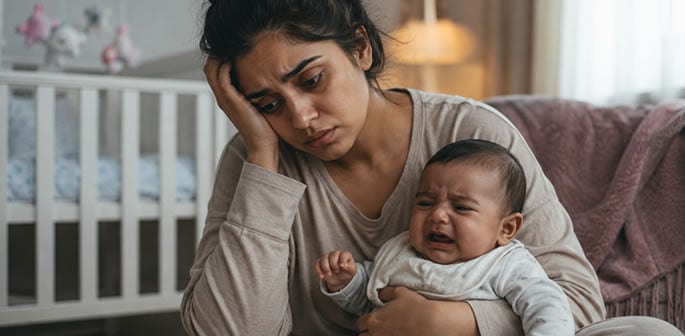
"I may have been surrounded by family but I felt so alone."
Motherhood is a significant life moment for British South Asian women but for some, they are affected by postpartum depression, a topic that remains shrouded in silence.
While postpartum depression is a medical condition experienced worldwide, cultural pressures within South Asian households can make it even harder to acknowledge.
Many women are expected to embody the “superwoman” role, caring for a newborn while maintaining the appearance of emotional resilience.
The fear of Log Kya Kahenge, or “what will people say?”, also continues to shape conversations around maternal mental health, often discouraging women from seeking support.
This silence has left many mothers caught between modern clinical understanding and deeply rooted generational attitudes.
As conversations around mental health slowly evolve within the diaspora, questions remain about why traditional support systems are failing new mothers and what change is needed to bridge the gap between cultural expectations and genuine care.
Remaining Silent
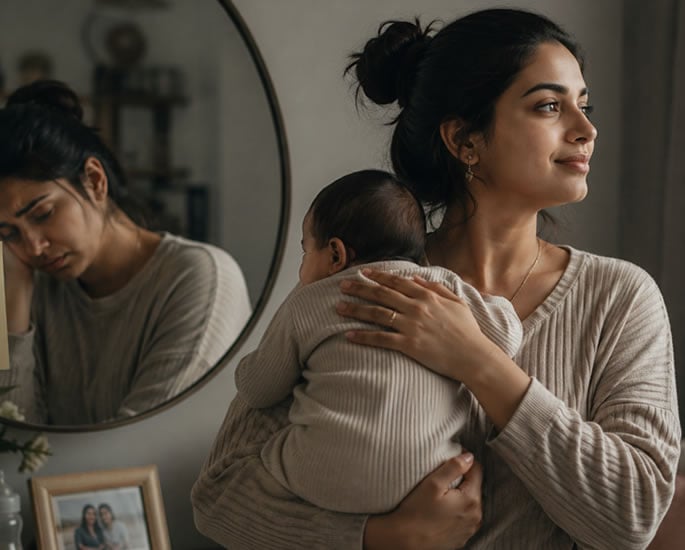
Postpartum depression is often hidden beneath the pressure placed on women in British South Asian communities to appear strong, composed and self-sacrificing at all times.
Some British Asian women are asked to balance high-pressure careers with the role of a dutiful, traditional daughter-in-law, where emotional endurance is quietly assumed.
When postpartum depression emerges, it is rarely recognised as a medical condition triggered by what Dr Aninda Sidhana, a specialist in women’s mental health, describes as a “major neuroendocrine event”.
Instead, it is often misread as ingratitude, weakness, or a failure to appreciate motherhood.
Across the UK, expressing a persistent low mood after giving birth to a healthy child can be framed as disrespectful to family sacrifice and effort.
This creates a culture where emotional distress is absorbed into the idea of “mother’s sacrifice” rather than being treated as a health concern.
Symptoms of clinical depression are frequently reduced to tiredness or dismissed as “drama”, leaving many women feeling unable to speak openly.
Maya*, who struggled after having her first child, said:
“I began questioning myself constantly, whether I was even made for motherhood at all.”
“The people around me kept telling me how lucky I was, which only made the guilt heavier. I was acting like a happy mother but inside, I felt so low.”
The expectation to maintain visible joy becomes another layer of pressure, reinforcing silence rather than breaking it.
That pressure is often intensified by generational attitudes within households.
Older relatives, shaped by migration, hardship and survival, may view postpartum depression as a sign of a “softer” generation. This disconnect can delay or prevent women from seeking help.
Instead, distress is often expressed physically, through chronic pain, headaches or fatigue that feel more culturally acceptable than emotional disclosure.
However, as Dr Sidhana warns, untreated emotional distress can escalate into more severe psychiatric conditions, including postpartum psychosis.
The absence of expression, she argues, is not strength but a risk. In communities where silence is equated with resilience, many women are left navigating postpartum depression without the language, or permission, to speak about it.
When Tradition causes Isolation
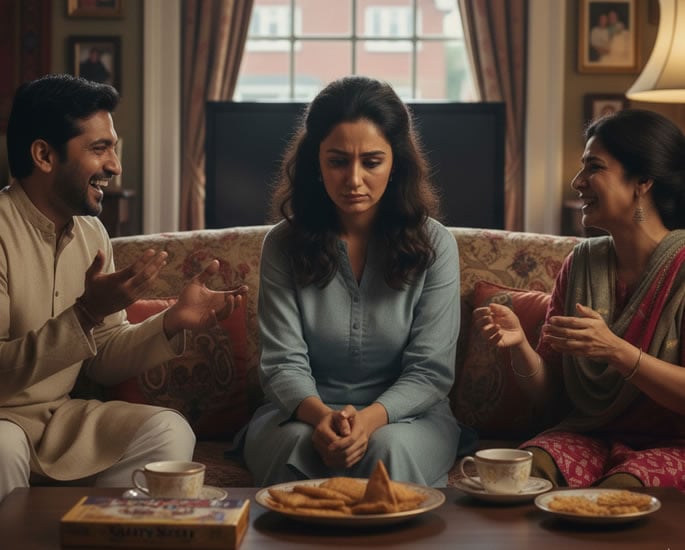
Traditionally, some South Asian cultures observe a 40-day postpartum confinement period known as Chilla, Sawa Mahina or Sutak.
Designed as a “golden month” of recovery, it was intended to protect the new mother, relieve her of household duties, and surround her with support from extended female relatives.
In its original rural context, where communal living was the norm, this “village-raised-child” model often worked as a structured form of care.
However, in the UK’s reality of nuclear families, small flats and fragmented support networks, the same tradition can have unintended consequences.
What was meant to be restorative can instead intensify isolation.
When the “village” is reduced to just one or two relatives, often loving but overbearing, the confinement period can feel less like recovery and more like restriction.
For many British South Asian women, the physical rules that sometimes accompany this period begin to mirror their internal emotional experience.
Kiran* recalls: “I was told to avoid going outside often and to only eat bland foods to ‘heat’ the body’.
“I may have been surrounded by family but I felt so alone.
“No one was asking how I was; they were only asking if the baby had been fed.”
Her experience reflects a wider pattern, where attention is overwhelmingly centred on the newborn while the mother’s emotional state is overlooked.
Practices such as breastfeeding, often framed as a cultural duty and measure of good motherhood, can become a source of immense pressure when difficulties arise.
What is meant to symbolise care can, in some cases, deepen feelings of inadequacy and distress if feeding does not go as expected.
Vinita Sivaramakrishnan, who explores maternal stories in her work, notes that women are often more prepared for the physical reality of birth than the emotional complexity that follows.
In the UK, this gap is widened further by the influence of social media and “Pinterest Mom” culture, where curated images of effortless motherhood collide with lived experiences of exhaustion, pain and emotional fog.
When traditional support systems focus primarily on physical recovery, emotional recovery is often left unsupported, with lasting implications for maternal wellbeing and the early mother–infant bond.
The Clinical and Cultural Divide
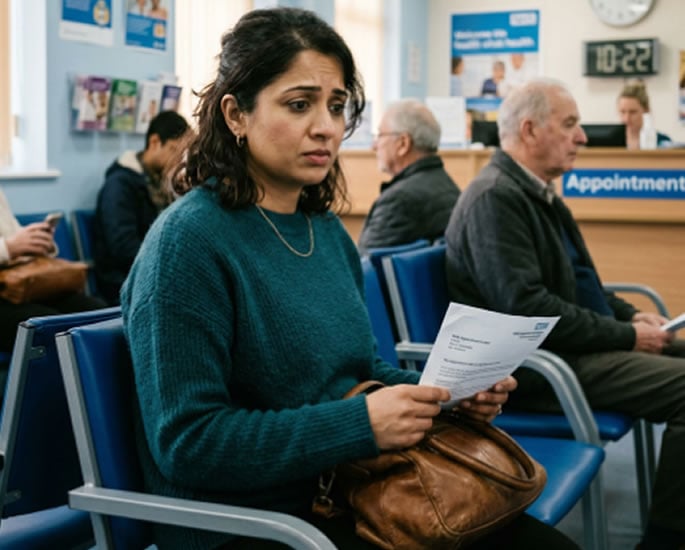
While the NHS has established pathways for maternal mental health support, some South Asian women in the UK still face significant barriers when trying to access care for postpartum depression.
A key issue is mistrust of statutory services, driven by the fear that disclosing intrusive thoughts or difficulty bonding with a baby could trigger intervention from social services and even lead to the child being removed.
While this anxiety is rooted in both community narratives and broader experiences of systemic bias, it often prevents women from speaking openly to GPs until they reach a crisis point.
Language barriers can also be an issue.
Mental health terminology used within the NHS is largely clinical and Western-framed, while many South Asian languages do not have a direct, destigmatised equivalent for “depression”.
As a result, emotional distress is often expressed in physical terms that can be easily missed in short medical consultations.
Fatima*, who struggled to articulate her postpartum depression, said:
“The doctor turned and started speaking to my husband instead.”
“That was the first time I saw my situation through someone else’s eyes. It took a professional to validate that I wasn’t just ‘tired’, I was ill.”
Addressing this gap requires a shift towards genuine cultural competency within healthcare.
That includes involving wider family structures in education around postpartum depression, particularly husbands and mothers-in-law, who often act as informal gatekeepers to medical support.
Without their understanding, many women remain unable to seek help freely.
Support also needs to move beyond general advice into active, shared responsibility for maternal wellbeing, with greater emphasis on emotional validation rather than dismissal.
Recognising early warning signs, such as persistent low mood, unexplained crying, disrupted sleep even when the baby rests, and a loss of interest in daily life, depends on communities learning to look at the mother as well as the child.
Ultimately, tackling postpartum depression in South Asian communities requires a collective shift, not just clinical intervention, to break the long-standing stigma that has kept so many women silent.
The experience of postpartum depression within the UK’s South Asian community reflects the complex reality of women navigating two worlds at once.
It sits at the intersection of inherited expectations and modern understandings of mental health, where cultural duty and psychological need do not always align.
Many women find themselves negotiating these tensions quietly, often without the language or space to fully articulate what they are going through.
As awareness slowly enters public and private conversations, the focus is not on abandoning tradition, but on understanding how it has evolved in a different social context.
In that space between expectation and experience, postpartum depression remains largely unseen but deeply felt. And for many, it is within that silence that the most honest parts of motherhood exist.