














































""zerOclassikal was established to address this gap"
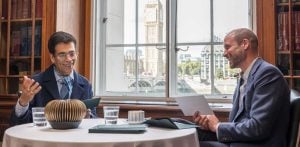
UK South Asian classical music is being pulled in new directions, and Jonathan Mayer is one of the names driving that shift.
Through zerOclassikal, the sitarist has helped turn what was once treated as a fixed tradition into something more restless, experimental and outward-looking.
That approach comes into sharp focus with This Is Not Random…, a zerOclassikal series arriving at the Southbank Centre on May 24, 2026.
The performance strips back assumptions around South Asian classical music, focusing instead on its structure, intention and divergence.
It sets the tone for a wider touring programme that continues across the UK, where the boundaries of the form are tested in real time.
Mayer chats to DESIblitz about how zerOclassikal is reshaping the genre from within, and why that process matters now more than ever.
Defining Identity in a Shifting Musical Landscape
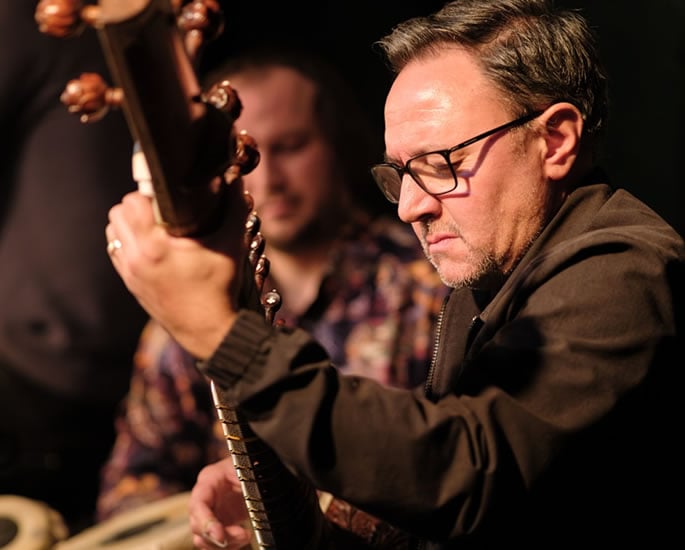
Within the British South Asian music landscape, Jonathan Mayer’s work sits at the intersection of performance, composition and institutional development.
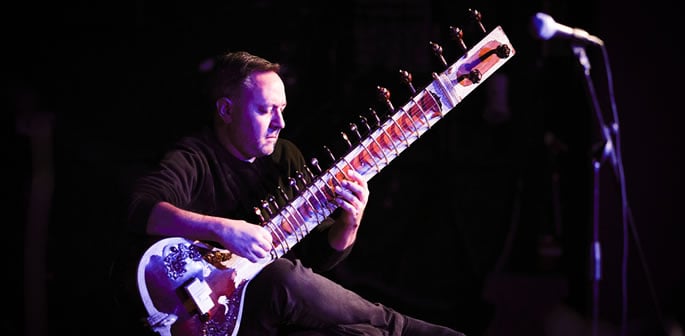
As a sitarist and Artistic Director of zerOclassikal, Mayer’s role extends beyond individual musicianship into shaping how South Asian classical (SAC) music is positioned within UK cultural life.
zerOclassikal has been central to that shift, working to widen public perception of SAC music and challenge long-standing assumptions that it is purely spiritual, background or niche.
Instead, it is presented within contemporary artistic frameworks that place it firmly inside the UK’s broader cultural and creative economy.
That positioning directly informs how artists are commissioned, supported and presented.
Mayer recalls:
“I grew up in an environment where music was part of everyday life.”
“So I started training at a young age, learning violin from my grandfather Albert Hepton, piano from James Methuen-Campbell and composition from my later father John Mayer, and later mastered the sitar.”
That training developed across Western and South Asian systems in parallel, shaping a practice that moves between orchestral, classical Indian and contemporary composition contexts.
He continues: “And over the years I’ve worked across a range of musical contexts including Indian classical performance, orchestral projects, contemporary composition and collaborative work with artists from different genres.
“Being able to read and work within both Western notation and South Asian classical systems has also meant I’ve naturally moved between different musical worlds throughout my career.”
That dual fluency feeds directly into zerOclassikal’s wider approach to artistic development and mentorship.
Building zerOclassikal
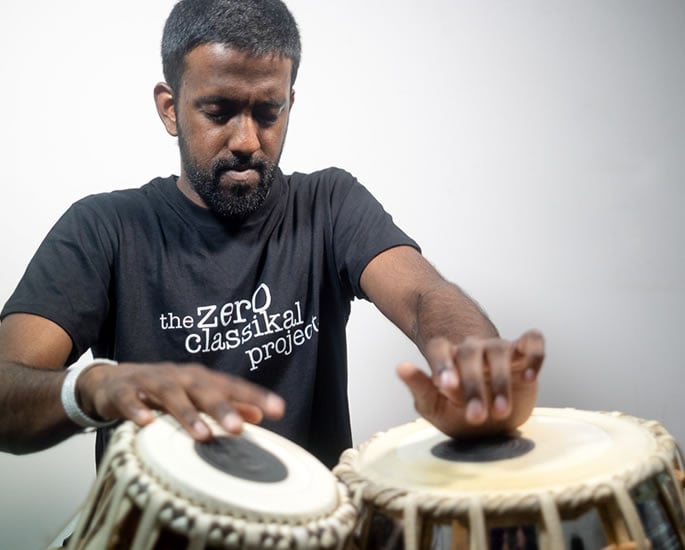
zerOclassikal emerged in 2013 at a moment when British SAC music was undergoing significant change.
A new generation of trained musicians was forming through formal study, but the infrastructure required to support sustainable careers had not developed at the same pace.
Jonathan Mayer describes that gap as the catalyst for the organisation’s creation:
“zerOclassikal was launched in 2013 in response to a significant shift within the UK’s South Asian Classical (SAC) music sector.
“Although a new generation of British-trained SAC musicians has emerged through rigorous training, we saw it lacked the professional infrastructure and industry support needed to sustain long-term careers.
“zerOclassikal was established to address this gap and has since become a pioneering initiative within its genre.”
From its early stages, the organisation focused on commissioning, mentorship and long-term artistic development, aiming to build continuity in a sector often defined by fragmented opportunities.
“We are proud of the fact that we have been able to create professional pathways for the next generation of South Asian classical musicians.
“We currently support dozens of emerging artists by commissioning new work, offering tailored mentorship to help them develop singular artistic ideas, and providing opportunities to record, release and tour their music nationally.”
Alongside this, zerOclassikal has expanded its infrastructure through initiatives such as its own record label, zerOclassikal reKords, and the UK’s first fully equipped recording studio dedicated to SAC music, designed specifically to give artists access to professional recording and release environments within their own genre ecosystem.
That infrastructure sits alongside live programming and touring support, creating a system where artists can move from development into production and performance without relying entirely on external industry structures.
Progression over Fusion
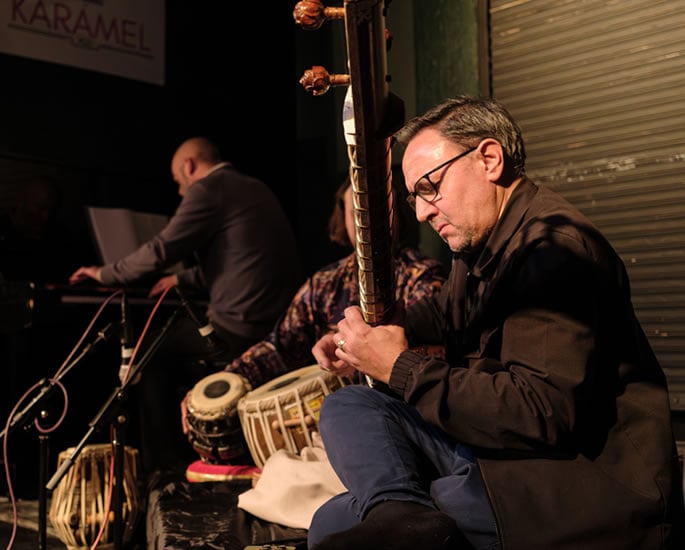
Although zerOclassikal frequently works across stylistic boundaries, Mayer is clear about avoiding the language of “fusion”.
For him, the term suggests separation rather than continuity, implying that distinct traditions are being artificially combined.
“We don’t necessarily describe the work as ‘fusion’ because that can imply separate forms being contrived to mix or artificially combined.
“What interests us more is the natural intersection and progression of influences that already exist within the lived experiences of British South Asian musicians today.”
The emphasis instead sits on progression rooted in lived musical reality, where multiple systems already coexist within the same artistic identity.
That approach shapes how works are developed, commissioned and presented.
Mayer explains: “zerOclassikal creates space for artists to explore where South Asian classical music can move next, while still remaining deeply connected to its roots.
“That process of progression is important because it reflects the reality of contemporary British South Asian identity and keeps the music dynamic, relevant and forward-looking.
“It also helps expand how audiences engage with the form, challenging assumptions about what South Asian classical music can be within contemporary culture.”
That philosophy runs through the organisation’s programming, where experimentation is treated as a structural principle rather than an aesthetic choice.
It is also visible in its upcoming work, This Is Not Random…, which will be held at the Southbank Centre on May 24.
The performance explores internal structures of SAC music through new compositional frameworks, including Mayer’s Shift Octatonic, which brings the Octatonic scale into contact with raag structures, alongside William Rees Hofmann’s BeachFront, which explores migration, transformation and musical change through sound.
The programme is built around musical systems in motion rather than fixed presentation formats, with each work positioned as part of a wider investigation into how SAC music can evolve in contemporary contexts.
Innovation, Collaboration & Shifting Audience Expectations
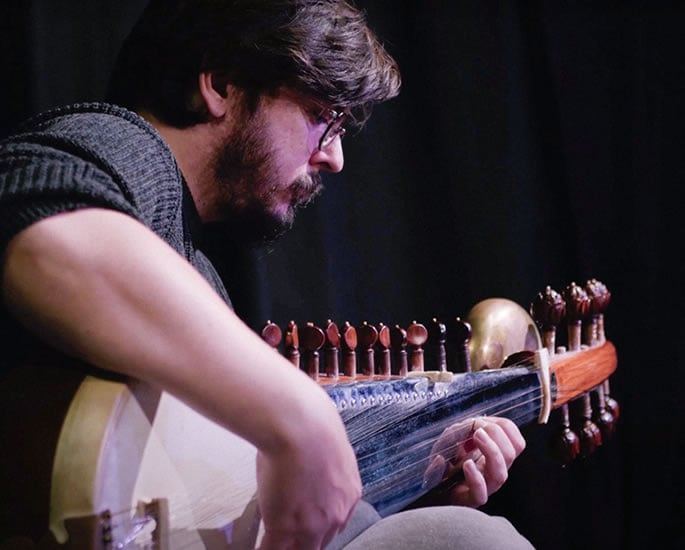
Innovation within SAC music, for Mayer, is not about stylistic disruption but about maintaining relevance to the time and environment the music exists within.
The form, he argues, has always evolved, even if it is often presented today as static.
“Innovation is essential, not simply to attract younger audiences, but to allow the music to remain truthful to the time and society it exists within.
“South Asian classical music has always evolved historically, yet it is often presented today as something fixed or untouchable.
“We’re interested in creating environments where artists can engage with the form as a contemporary practice rather than solely as heritage preservation.”
That approach includes experimentation with structure, presentation and collaborative process, but always grounded in technical depth.
He says:
“For us, experimentation only becomes meaningful when it is grounded in a strong understanding of the music itself.”
“Technical mastery provides the vocabulary and depth needed to push the form somewhere new with intention rather than novelty for its own sake.”
Collaboration sits at the centre of that process, as Mayer elaborates:
“Yes, collaborations are very important to us as they let us bring together different musical languages, perspectives and artistic experiences into dialogue with one another.
“Many of the artists we work with come from backgrounds spanning South Asian classical music, contemporary classical, improvisation, electronic music, and jazz, and each artist brings a distinct way of thinking about sound, structure, rhythm and performance.”
That cross-disciplinary approach is reflected in live programming, including This Is Not Random…, where distinct musical languages are placed in structured interaction rather than blended into a single aesthetic.
Audience engagement has shifted alongside these developments.
“Audiences are increasingly open to experiencing South Asian classical music in different contexts and formats, especially when it is presented with confidence as contemporary work rather than something niche or culturally exclusive.”
That shift is also shaped by alternative performance environments that reframe how SAC music is experienced.
Mayer adds: “Part of that openness has come from creating different kinds of listening environments.
“For example, our Mehfil-a-Rose-Hill series in Brighton focuses on a more intimate and informal way of presenting music, giving emerging artists space to experiment and connect with audiences in a setting that feels closer and more conversational than a traditional concert hall format.
“Similarly, our Free Flow Classikal series at Karamel London explores South Asian classical music through the medium of free improvisation.”
These formats sit alongside larger institutional ambitions, including recording infrastructure and artist-led production systems, which collectively expand how SAC music is created, presented and sustained in the UK context.
This Is Not Random… carries zerOclassikal’s approach into a live setting where structure, collaboration and experimentation sit in constant tension.
As the series moves beyond its Southbank Centre debut and continues its UK tour, it reinforces a clear shift in how South Asian classical music is being presented and experienced.