

















































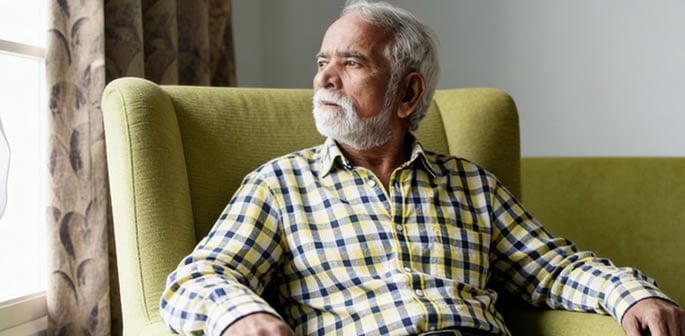
"This lack of understanding made me feel very alone"
Why do so many British South Asian families keep dementia locked behind closed doors?
The answer lies in a complex mix of cultural pride, language barriers, and a fierce duty to protect family honour.
Across the UK, cognitive diseases such as Alzheimer’s strike without prejudice, yet British Asian communities face unique pressures that make confronting such diseases intensely stressful.
Elders and their exhausted carers often suffer in silence, fearful of gossip or spiritual judgement. This denial delays vital medical care and traps families in isolation.
The resilient men and women who migrated to Britain in the mid-20th century built thriving communities and businesses while overcoming immense adversity.
For their descendants, witnessing severe cognitive decline feels like betraying that legacy.
Dementia is often hidden, transforming a medical reality into a closely guarded secret and leaving those affected cut off from the support they desperately need.
Language Barriers
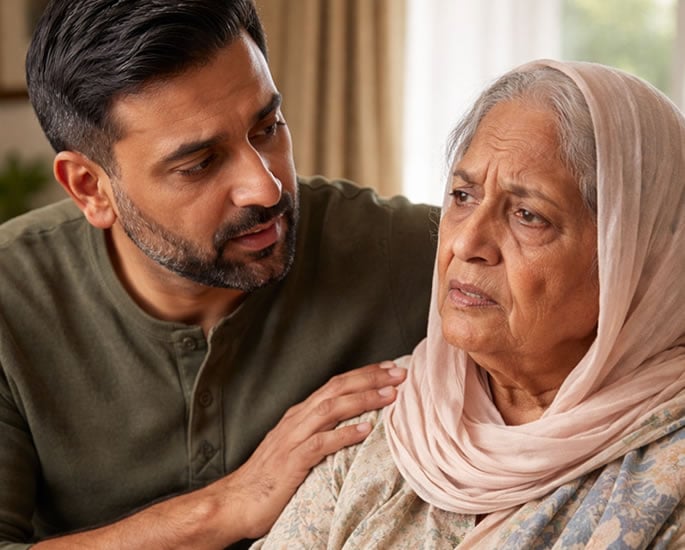
Language shapes how people understand illness.
In Urdu, Punjabi, Gujarati, Hindi, and Bengali, there is no direct clinical equivalent for “dementia”. This absence creates an immediate barrier to diagnosis.
When elders show memory loss, confusion, or personality changes, families often lack the language to describe what is happening. As a result, these symptoms are dismissed as a normal part of ageing.
Sania* described how this misunderstanding affected her own family when her grandfather developed Alzheimer’s:
“He started to forget things and his behaviour changed. He was an outgoing, active and kind man but became withdrawn and reclusive.
“For over a decade, we thought it was a natural part of his ageing. We supported and cared for him the best way we could.”
Her experience reflects a wider pattern across the diaspora. Cognitive decline is often described using phrases like ‘sathiya jana’, loosely meaning losing one’s senses after 60.
The lack of clinical language also leads to harmful mislabelling.
Terms such as ‘pagal’ (mad) are frequently used, reducing a neurological condition to perceived mental instability.
Dr Karan Jutlla recalls facing this stigma when her father developed alcohol-related dementia:
“His illness was not understood by members of our family and our community and were often interpreted as a ‘loss of mind’ or ‘madness’.
“This lack of understanding made me feel very alone in my experiences, just like dementia, alcoholism was not a recognised condition amongst the community.”
This linguistic gap deepens isolation. Without the words to name the condition, families struggle to seek help. The result is delayed treatment, growing stigma, and patients left without the support they need.
Spiritual Misconceptions

Faith plays a central role in many South Asian communities. It offers comfort, structure, and a strong sense of belonging.
However, it can also complicate how neurological conditions are understood.
Dementia is often filtered through a spiritual lens, where medical symptoms are misread as supernatural events.
Hallucinations, erratic behaviour, or sudden aggression, common in advanced dementia, may be attributed to black magic or possession by ‘Jinns’.
Faced with these distressing changes, families may turn to religious figures instead of medical professionals.
Imams and spiritual healers are approached in search of answers. Amulets are worn, prayers are repeated, and costly rituals are performed to remove what is seen as a spiritual affliction.
Framing dementia in this way isolates the individual. They are treated as cursed rather than ill. The stigma is intense, and families often conceal the condition to avoid community judgment.
This reluctance to seek medical help is closely tied to the migrant experience.
First-generation South Asian migrants in the UK were shaped by hardship and discrimination, which reinforced a culture of endurance. Admitting cognitive decline in a respected elder can feel like a loss of dignity.
Families close ranks. Elders are kept at home and shielded from public view, while the condition progresses unchecked.
This spiritual framing delays access to medical care. Without intervention, patients miss out on treatments and support that could ease symptoms and improve quality of life.
The Pressure of ‘Log Kya Kahenge’
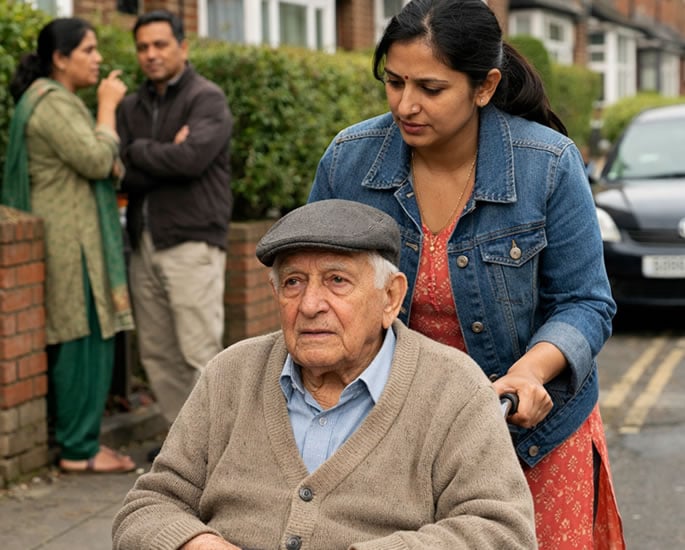
The South Asian family structure is built on respect and duty towards elders. Caring for ageing parents is seen as a moral and religious responsibility.
Placing a parent in residential care, or hiring outside help, is often stigmatised.
This expectation places intense pressure on families, particularly women.
Daughters and daughters-in-law are expected to manage the physical and emotional demands of full-time dementia care without complaint.
Nimisha*, who is caring for her father, described the toll:
“Despite how much we cared for him, he never got better. You see your loved one slowly slipping away.”
Caregivers often face burnout, isolation, and depression, yet speaking openly about these struggles remains taboo.
Alongside this pressure is the fear of ‘Log kya kahenge’ (what will people say?)
Tight-knit community networks can amplify gossip and judgment. A dementia diagnosis can bring scrutiny that families would rather avoid.
Rohan* described the emotional strain: “We didn’t tell many people at first.
“In our community, people talk. You worry about being judged or misunderstood.
“Even within the family, it was hard to accept what was happening. It felt easier to keep it private than explain it to others.”
Sometimes, there is also a belief that dementia can hinder marriage prospects.
In communities where arranged marriages remain common, a diagnosis can be seen as damaging to a family’s reputation. Some fear it will affect their children’s marriage prospects.
As a result, families may hide the condition to protect their social standing, even as the reality of the illness worsens.
Demanding Culturally Competent Care

Dementia stigma is not confined to the South Asian community. The British healthcare system can unintentionally reinforce it.
Many providers lack the cultural awareness needed to support British Asian families through diagnosis.
A persistent myth, that “Asians look after their own”, can lead to clinical complacency.
As a result, families are often offered less post-diagnostic support, fewer specialist referrals, and limited guidance compared to others.
Even when support is available, it often overlooks cultural needs.
Services may not consider expectations around modesty or the need for bilingual support. This disconnect makes the system feel inaccessible. Many families disengage rather than navigate a service that does not reflect their realities.
However, a generational shift is emerging. Younger British Asians are challenging the silence around dementia. They are rejecting the idea that cultural pride should come before medical care.
Usman*, whose grandfather had Alzheimer’s disease, said:
“As time went on, his memory began to fade and I watched as a young man as he slowly forgot about me as a little boy. He gradually got worse and it became harder to care for him.
“Soon, he couldn’t remember me at all and looked at me as a stranger in his room. It hurt.”
He now uses that experience to challenge stigma within his community:
“Coming from a Pakistani background, I often find it very difficult to speak to people of a similar origin due to the cultural stigma attached to mental illness and neurological disorders.
“Talking about dementia shouldn’t be embarrassing and shouldn’t affect your standing within the community.”
These voices reflect a growing push for change. There is increasing demand for culturally competent care, alongside efforts to educate communities and break the cycle of silence.
Dementia does not respect family honour, faith, or fear of gossip. Yet the stigma surrounding it in South Asian communities continues to harm those most in need of care.
Denial leaves elders confused and isolated, while caregivers are pushed to exhaustion.
Breaking this stigma means confronting long-held beliefs and reshaping how care is understood.
Supporting elders is not about silence or sacrifice at any cost. It is about recognising when help is needed.
Seeking medical support, involving professionals, or speaking openly about a diagnosis are not betrayals. They are responsible and necessary choices.
As the first generation of South Asian migrants grows older, this issue can no longer be avoided. Families must move beyond secrecy and face the reality of dementia with clarity and honesty.
Only then can communities begin to replace stigma with understanding and ensure that those affected receive the care and dignity they deserve.