

















































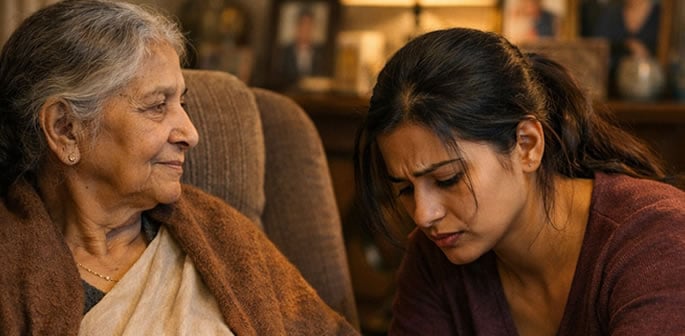
"in our community, care home is like a forbidden term."
For generations, British South Asian communities have held the sacred duty of caring for elderly or ill relatives at home.
But this deeply ingrained tradition is quietly pushing some young caregivers to the brink of psychological collapse.
Why do so many families adamantly refuse professional elderly care, even when domestic life deteriorates into a clinical nightmare?
The answer lies in a complex web of cultural conditioning, the intense fear of societal judgment, and a profound sense of inherited guilt.
Young adults are routinely thrust into 24-hour medicalised roles without any structural support, leading to unprecedented levels of psychological burnout.
The taboo around professional elderly care hides the cracks in the home-palliative system and the toll it takes when young caregivers reach their breaking point.
The Virtue of the ‘Good Child’
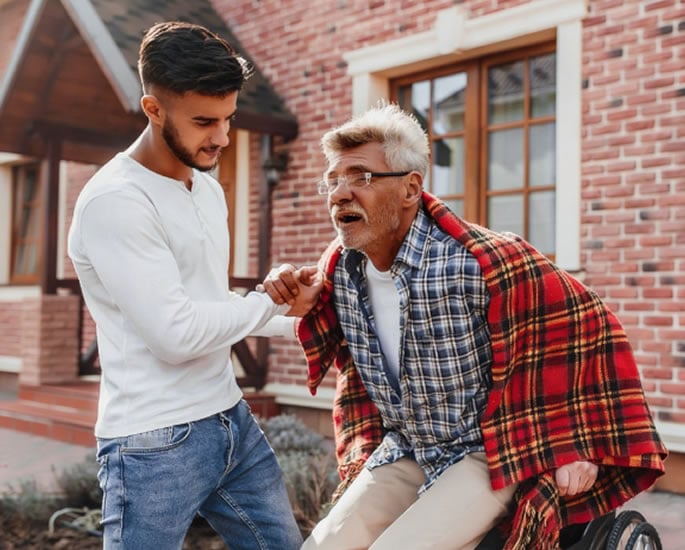
Filial piety, respecting and caring for one’s parents, is seen as an unshakable duty in the South Asian diaspora.
From a young age, children are conditioned to revere the virtue of the ‘good child’, an archetype defined by an unwavering willingness to look after one’s own family members at any cost.
This inherent expectation is deeply rooted in the spiritual practice of sewa (selfless service) and bound tightly by the sacrifices made by first-generation immigrants.
Because parents endured severe racial hostility and immense economic hardship to build a secure foundation in the UK, cultural logic dictates that children must surrender their adulthood to provide care.
“That is how it is in South Asian families; we look after each other,” explains Sania*, who became a primary carer at a young age.
While this sentiment stems from deep affection, it traps families in an unspoken mandate demanding ultimate personal sacrifice.
Seeking external help is culturally synonymous with extreme neglect.
The spectre of ‘log kya kahenge‘ haunts every exhausted caregiver, dictating domestic decisions through the fear of community gossip.
Care homes are frequently, and incorrectly, framed as dumping grounds for abandoned elders.
When Faiza* finally placed her elderly father in a care home, the community backlash was swift and unforgiving, illustrating the intense stigma attached to seeking help.
She revealed: “The news quickly spread and people didn’t think it was good.
“The community began treating me like an outcast, pretending that they hadn’t seen me in the street.”
“My personal business seems to affect everyone else and I’m judged for it.”
Families would rather project an illusion of perfect domestic harmony than admit they are crumbling under the weight of a challenging task.
Illnesses are routinely viewed as a private embarrassment to be hidden from the public eye, ensuring the duty of care becomes a silent, lifelong sentence rather than a shared medical responsibility.
The Medicalisation of the Home
Ageing today rarely resembles the gentle, natural decline depicted in stories.
The reality of modern medicine means that people are living far longer, but frequently with highly complex, degenerative conditions like Alzheimer’s or Parkinson’s disease.
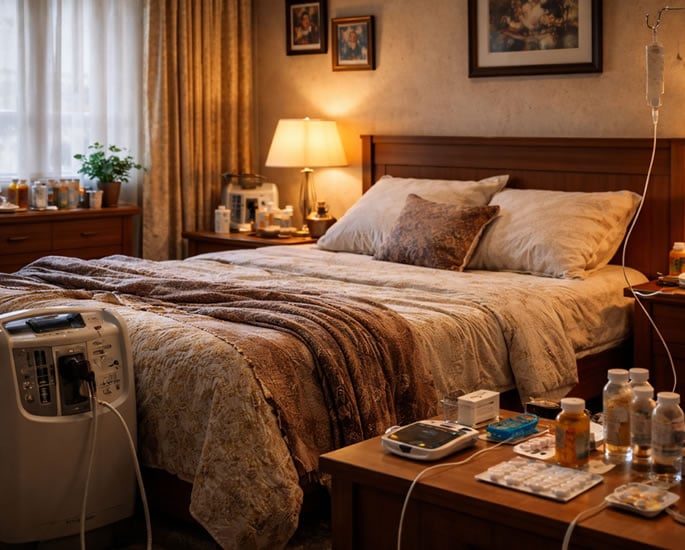
When terminal illness enters the domestic sphere, the home undergoes a brutal medicalisation.
Bedrooms become makeshift hospital wards filled with commodes, mechanical hoists, and oxygen tanks.
Despite being completely devoid of formal medical training, people are abruptly forced to perform intricate nursing tasks.
They must administer strict medication regimes, manage severe incontinence, dress pressure sores, and navigate the unpredictable, aggressive behavioural changes associated with cognitive decline.
This creates a severe conflict between cultural expectations and medical reality. The home-palliative care model is collapsing under the weight of these intense clinical demands.
Recalling dementia’s brutal progression on his mother, Rohan* said:
“It was sad to see how this joyful woman struggled to recognise me and my siblings.”
And in some cases, institutional neglect leaves South Asian families to navigate this challenge alone.
Ayesha* explained the response she got from a doctor when her husband’s diabetes and heart condition worsened:
“He just joked and said to me, ‘You are still young, you have no problem, you can look after your husband’. He never offered me any help.”
Carers find themselves trapped in a terrifying void, managing severe medical crises without any necessary safety nets.
The Erasure of Self

The transition from a child or grandchild to an unpaid, full-time nurse triggers a devastating erasure of personal identity.
The cultural pressure to be the flawless caregiver leaves zero room for personal boundaries.
Young adults are forced to abandon their fundamental life goals, stepping away from burgeoning careers, romantic relationships, and social networks to provide relentless supervision.
The financial hit is substantial, yet the emotional cost remains catastrophic.
This results in caregivers experiencing a profound sense of grief, mourning not just their own hijacked futures but the complete loss of their familial dynamic.
They are no longer interacting with their loved one as a child seeking guidance, but as an exhausted warden managing physical decay.
Ishan* said: “To be honest with you, for me it was a huge learning curve and there was a role reversal going on, which I had heard about but never experienced.”
Crucially, this heavy burden disproportionately targets women.
Daughters and daughters-in-law are inherently expected to shoulder the most demanding domestic responsibilities, managing households, raising their own children, and providing round-the-clock elder care.
The expectation spans generations, entirely stripping carers of their individual personhood, often reducing them to sheer domestic utility.
Priya* admitted: “I used to think… I’m their daughter-in-law, and they’re keeping me like a servant.”
Meena recalls how her mother moved in with her as she began to age and get ill. This added an unexpected expectation on her and her son, with whom she lived prior to this change:
“I’ve had to literally put my own life on hold to ensure my mother and her needs are met. This was not out of choice but out of expectation put on me by my mother. Who in addition does not really appreciate how much I sacrifice for her.
“Despite having brothers who do not equally participate in the care of my mother and just play the ‘son’ cameo role, I feel I am the one with the sole carer for her who has to accommodate her literally 24/7 along with the medical care support she gets.
From providing a roof over her head, making sure she has her meals, she is comfortable and dealing with her mental and physical health issues all mounts up into a lot of pressure.
“This had put tremendous strain on my relationship with my son, my work and my own life – eating up time which I would otherwise spend on looking after myself.”
The absolute lack of an exit strategy causes intensified psychological burnout, resentfulness and a bitter outlook.
The cage is locked from the inside by cultural guilt, resulting in severe sleep deprivation, hyper-vigilance, and an environment where the caregiver’s own health is completely sacrificed to maintain the facade of perfect coping.
Reaching Breaking Point
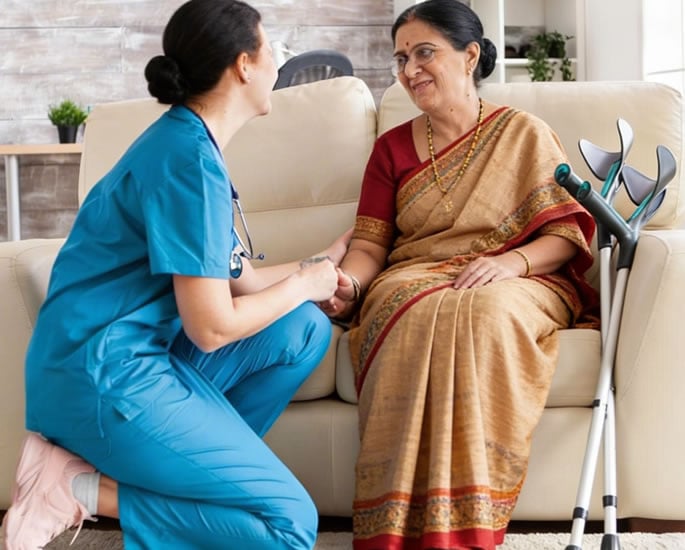
The breaking point inevitably arrives, often triggered by a sudden medical emergency or a caregiver’s physical collapse, making home care physically impossible.
Families reach a desperate stage where love and dedication can no longer compensate for a lack of professional medical expertise.
Yet, the decision to finally opt for residential or hospice care is heavily shrouded in community shame.
When families cross the taboo threshold and place their loved ones in care homes, the immediate reaction is overwhelming guilt.
They agonise over community judgment and genuinely fear they have committed the ultimate betrayal.
The depth of this cultural resistance is profound; as Kiran* says:
“I don’t have a problem with it but in our community, care home is like a forbidden term.
“If someone we know put a relative in a care home, they would be gossiped about in the street.”
However, this narrative shifts dramatically as some facilities are offering safe environments where South Asian languages are spoken, and culturally appropriate diets are rigorously maintained.
Once integrated into a supportive, professional environment, caregivers experience profound relief. They finally reclaim their roles as children or grandchildren.
Shreya* reflected on her grandfather’s eventual move into a care home after her family struggled to cope with his dementia:
“On my lunch break, I would visit him, and we would eat together. He would eat his lunch and then try to get his hands on my sandwiches.
“We would laugh together; it was the best part of the day for me.”
By utilising professional care, she was able to make the most of her time with him, sharing meaningful, affectionate conversations rather than battling over exhaustive medical duties.
The expectation that British South Asians must bear the full weight of elderly care is no longer sustainable.
As ageing bodies demand increasingly complex support, relying on untrained, emotionally drained family members fails everyone involved.
Refusing professional help out of pride does not honour tradition; it endangers both caregivers and their loved ones.
Shifting this mindset requires courage: destigmatising professional care and recognising it as an essential health intervention, not a betrayal.
Understanding the limits of home care and seeking specialist support is not a weakness; it is a deliberate, compassionate choice.
True respect for an ageing parent lies in balancing their comfort with the well-being of those who care for them. Sometimes, the greatest act of love is knowing when to ask for help.