































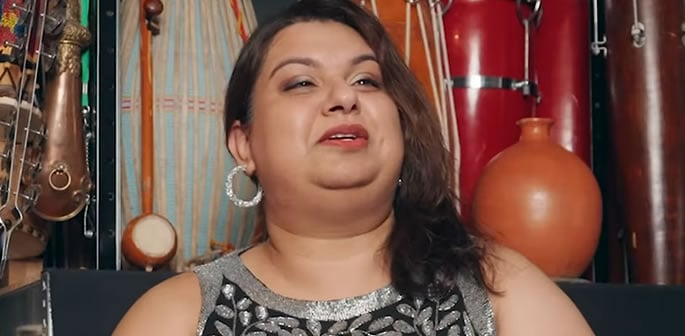
"I'm completely honoured to be on this album."
Sonia Panesar has spent years building a name as one of the UK’s most respected Punjabi female vocalists, connecting traditional sounds with modern production.
Her latest feature on Kuljit Bhamra’s album DESI – The Soul of Punjab places her alongside some of the most established names in Punjabi music.
It is a project that brings together generations of artists, all tied by a shared language and musical heritage.
Performing ‘Mainu Nach Lehn De’ on the album, it is another milestone in Panesar’s career, which has been shaped by consistency rather than spotlight moments.
In an exclusive interview with DESIblitz, Sonia Panesar reflects on what it means to be part of the album as well as the barriers that female Punjabi artists continue to face.
Working with Kuljit Bhamra

Sonia Panesar’s involvement in DESI – The Soul of Punjab came through a long-standing working relationship with producer Kuljit Bhamra, who is also her uncle.
The process was familiar, but the scale of the project made it stand out.
She explained: “To be honest, I’m completely honoured to be on this album.
“I’ve been working with Kuljit Bhamra, who is my uncle. I’ve been working with him for, ‘decades’, is the right phrase. To be honest, whatever he says, just come along, sing.”
Despite the familiarity, Panesar confessed that there were elements of surprise:
“I worked on so many projects. So, I turn up at the studio and find out where I’m kind of singing a song, lead vocals on this album, and when I found out which other artists were on it, I was like, ‘Wow, what am I doing on it? It’s all legends‘.
“So, he said, ‘Well, you’re a legendary vocalist’. And I was like, ‘Oh my gosh’. Okay, it hit home. I’ve been singing for a while.”
The project sits within a wider tradition of Punjabi music, bringing together different generations and styles. For Panesar, that mix is part of what makes it meaningful.
“So, I feel genuinely really honoured. One of the younger ones on the album, I’m sure. But it’s a real pleasure and honour to be on it.”
What Makes a Strong Vocalist?

Sonia Panesar is clear about what she believes matters most in singing. For her, everything starts with basic pitch control.
“First of all, I believe strongly that you need to be able to sing in tune.
“If you can’t sing in tune, you don’t recognise the notes on the keys, be it a keyboard, a piano, a guitar, a harmonium; if you can’t attune your voice to that instrument, you’re not going to be able to sing.
“And that sounds quite harsh for some people.
“A lot of people sing freely in the bathroom. You’re not hearing anything. You’re not hearing a frequency.
“But when you sing to a piano, to a harmonium, and you can actually match that sound, first of all, that’s the basic rule of singing in my opinion.”
Technique alone is not enough, though.
“Secondly, training is not necessarily the thing, but I think it’s kind of establishing your style, being unique with your voice, not trying to duplicate someone else.”
That balance between influence and originality is something she sees as central to long-term relevance in Punjabi music.
Her musical influences reflect that variety.
Panesar points to early folk singers like Surinder Kaur and Parkash Kaur, Pakistani vocalist Musarrat Nazir, UK bhangra artists like Malkit Singh, and modern global Punjabi acts including Diljit Dosanjh and Karan Aujla.
She said: “The trends keep changing but I love that the Punjabi language is there.
“So, which is my favourite song? I don’t have one particular. There are different ones from different artists from different phases of time.”
For her, Punjabi music is defined less by eras and more by continuity of language and sound.
Female Artists and Industry Barriers

Panesar is direct when discussing challenges faced by female Punjabi artists. She points first to access rather than talent.
She said: “I get asked a lot about why and how it’s so difficult for a female artist to make it out there.
“I think a lot of it is opportunity, lack of opportunity, lack of platforms that kind of encourage women to be there.
“I think there’s this perception from audiences generally public and maybe the way the media portrays a female artist to be looking a certain way, sounding a certain way, dressing a certain way, having a certain flair, a certain kind of way of everything really.”
Those expectations, she says, often restrict who gets taken seriously.
“So age is a factor. So if you’re an older artist, they might not consider you; they might think you’ve been around for a long time. Why sing now?”
She also highlights how women are frequently categorised in ways that limit their perceived scope.
“Oh, she’s just a wedding singer. She’s just this thing, just that singer, she’s not singing the dance floor hit, she hasn’t made a hit.”
For Panesar, the issue becomes cyclical when opportunity is withheld at the start:
“But if you don’t allow for a woman, Punjabi especially, to be given that opportunity, if you don’t give her that stage, being on a radio station, even being interviewed by media on different platforms, if you don’t give them the opportunity, how will they ever be heard in the first place?”
She does, however, recognise a shift in how artists can now build visibility independently.
“With the power of social media and the internet nowadays, you can make it happen yourself.”
Outside of music, Sonia Panesar defines “Desi” through everyday cultural markers rather than abstract identity.
“Desi means a lot of things. So, I’m Sikh, I’m Punjabi.”
It is expressed through clothing, food, language, and shared habits.
She said: “Wearing a bit of bling like today. Wearing the jhumkas, the culture, food, outfits. I’m a big fan of desi cha.
“And it’s not chai, it’s cha.”
And the use of respectful terms in everyday speech, adding:
“We say the word ji after everything as well. So Hanji or we refer to mummy ji, Daddy ji. I like that. It’s our little signature of respect.”
Sonia Panesar’s feature on DESI – The Soul of Punjab sits within a much wider story of experience, identity and persistence in an industry that continues to evolve.
Her reflections on singing underline a grounded approach shaped by years in the studio rather than trends.
At the same time, her views on female representation highlight structural issues that still define parts of the Punjabi music landscape, even as new platforms begin to shift access and visibility.
Taken together, her perspective offers a clear view of an artist who remains connected to both heritage and change, while continuing to carve out her own space within it.
Watch the Full Interview