















































"they would look at me with pity"
The stigma surrounding learning disabilities and autism in British Asian communities creates a layered barrier that causes a reluctance to seek clinical support.
This silence is fuelled by the cultural concepts of ‘Izzat’ (honour), the fear of social judgement, and a lack of vocabulary for neurodiversity in South Asian languages.
Many families view a neurodivergent diagnosis as a social threat or a reflection of poor parenting rather than a biological reality.
By examining the intersection of these traditional beliefs and the reliance on ‘somatisation’, it becomes clear why these conditions often remain a hidden struggle.
We look at the stigma surrounding learning disabilities and autism within British Asian communities.
The Linguistic Void

In many British Asian households, perceptions of a child’s development are inseparable from the family’s standing in the community.
The absence of specific terms for autism or dyslexia in languages such as Urdu, Punjabi, or Gujarati often forces families to rely on binary labels: a person is either ‘normal’ or ‘mad’.
This lack of nuance creates a linguistic void where neurodivergence is dismissed as laziness or a lack of discipline.
Researchers at the University of Manchester found that patients often avoid terms like “mentally ill” or “disabled”, opting instead for safer descriptors such as “tension” or “weakness” to describe cognitive struggles.
Social pressure is a major driver of this silence.
Parul described the isolation that comes with a diagnosis.
She said: “There is no word for ‘autism’ in Gujarati. When I told people about my son, they would look at me with pity, as if I had done something wrong in a past life.
“The community sees it as a ‘curse’ or a ‘parenting failure’ rather than a neurological difference.”
For many families, a diagnosis is seen not as an individual trait but as a threat to the family’s reputation, potentially affecting siblings’ marriage prospects or the social standing of the wider kinship group.
Dr Rakhi Chand highlights the collective nature of this challenge:
“In South Asian communities, there’s a massive emphasis on the collective and the family. If one person is struggling, it’s seen as a reflection on the whole family.
“There’s a lot of shame and stigma attached to any kind of diagnosis that isn’t physical.”
The fear of ‘Log Kya Kahenge’ acts as a cultural filter, often delaying early intervention during crucial developmental years.
Somatisation

Somatisation, the manifestation of psychological or neurological distress as physical symptoms, is common in South Asian healthcare.
In cultures where emotional expression is constrained or viewed as weakness, the body becomes the socially acceptable way to communicate suffering.
A child with an undiagnosed learning disability may experience chronic stomach aches or insomnia, symptoms of anxiety caused by their unsupported condition.
Families often consult a general physician for these tangible problems, bypassing psychological services entirely.
In Delhi, clinical observation revealed consistent use of physical metaphors for distress.
One patient described a feeling of weight, saying, “it feels like my body is giving up”, rather than acknowledging a cognitive or emotional breakdown.
This pattern appears in the UK, where British Asian families frequently navigate multiple medical tests for physical symptoms before a neurological cause is even considered.
Dr Amir Khan has documented how these cultural nuances affect clinical outcomes.
He explained that South Asian patients may present with physical symptoms for essentially psychological or neurological issues.
Without cultural awareness, clinicians may overlook the neurodivergence entirely, treating only the physical manifestations.
This often produces a reactive model of care, where diagnoses are made only after a crisis, such as a public breakdown or school refusal, because physical symptoms can no longer mask the underlying condition.
A Double-Edged Sword

In South Asian cultures, the family is central to decisions about health and illness. While extended family can provide crucial support during medical crises, it can also enforce silence.
Decisions about a child’s care are often influenced by elders or relatives abroad, for whom a diagnosis like autism threatens family honour.
This pressure can push parents into denial, even when a child’s needs are obvious.
British Asian parents often face a conflict between a child’s well-being and social survival.
Seema, who has an autistic son, described being forced to keep the condition hidden:
“My mother-in-law told me not to tell anyone. She said it would ruin my daughter’s chances of getting married.”
“I was told to just keep him at home and pray. It was like I had to choose between my son’s needs and my family’s reputation.”
Neurodivergence thus becomes a family issue, with the individual’s needs subordinated to the group’s social capital.
Families are usually caught between helping their child and community expectations.
The fear of being “found out” by the community can be more terrifying than the disability itself.
Faith and Clinical Science
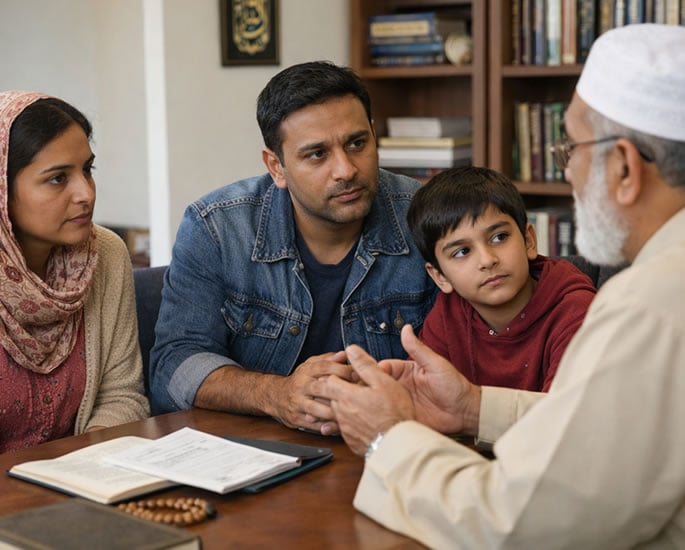
Many British Asian families interpret neurodivergent behaviours through spiritual frameworks.
Non-verbal communication, repetitive movements, or sensory meltdowns are often attributed to the evil eye, ancestral influences, or spiritual tests.
Families frequently consult religious leaders or traditional healers before engaging NHS services.
These explanations provide a coherent narrative for a child’s difference in cultures that prize conformity.
Relying on spiritual interpretations often delays clinical intervention.
Arshia*, diagnosed with autism later in life, shared:
“For years, my family thought I was just ‘sensitive’ or that someone had put a ‘bad eye’ on me. We spent thousands on religious ceremonies to ‘cure’ me.
“It wasn’t until I reached a breaking point in university that I realised I wasn’t cursed; I was autistic.”
Years of potential support were lost to spiritual ‘cleansing’ that could not address her neurological needs.
Dr Naureen Chohan advocates bridging faith and science to reduce stigma:
“For many South Asian families, faith is a huge part of their lives. We can’t just dismiss it.”
“We have to work with it to show that clinical support is not a rejection of their faith, but a necessary tool for their child’s quality of life.”
Integrating cultural beliefs into practice helps families understand that a diagnosis is a biological reality, not a spiritual failing.
Stigma around learning disabilities and autism in British Asian communities runs deep, shaped by centuries of cultural expectations and a silence around difference.
Families navigate a delicate balance between protecting social reputation and caring for children whose needs may go unseen.
For many, neurodivergence remains hidden, understood only through the body, faith, or whispered explanations.
The stories of parents and individuals who quietly carry this burden reveal how complex and enduring these cultural pressures are.
Until the weight of tradition eases, and families can acknowledge difference without fear, these challenges will continue to unfold quietly behind closed doors.