
















































“I was inspired to write a longer history of migration"
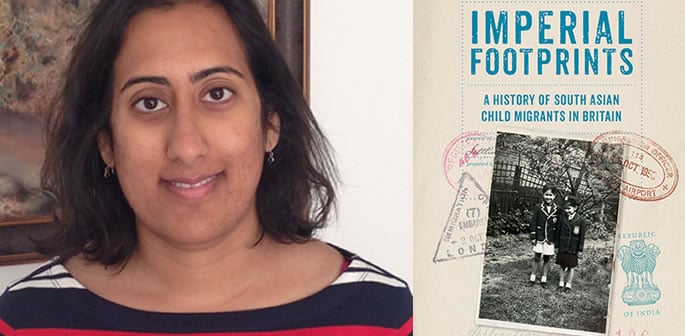
Imperial Footprints: A History of South Asian Child Migrants in Britain by Sumita Mukherjee is a groundbreaking book that repositions South Asian child migrants at the centre of Britain’s imperial history.
Covering the 1830s to the 1950s, it reveals how children shaped British ideas of race and nation while influencing Indian nationalism, socialism and suffrage.
Between 1857 and 1947, over 28 million Indians left the subcontinent, yet the experiences of children have largely been overlooked in historical narratives.
Mukherjee, Professor of Modern History at the University of Bristol, draws on archival records, photographs and firsthand accounts to reconstruct these lives with scholarly rigour.
The book explores a wide spectrum of childhood experiences, from beggars and sailor children in docklands to pupils at elite boarding schools and refugees of war or Partition.
Her research challenges conventional timelines and provides fresh insight into the Indian diaspora, now the largest in the world, with roughly 18 million people living overseas.
Sumita Mukherjee talks to DESIblitz about the key themes of Imperial Footprints and the new perspectives it brings to migration, empire and childhood.
Writing Children Back Into Imperial History

Imperial Footprints grows out of Sumita Mukherjee’s long engagement with South Asian migration.
Her past research examined Indian students at British universities and Indian suffragettes. That work exposed a consistent absence, as she explains:
“I’m a historian of South Asian migration and have written previously about the history of Indian students at British universities and the history of Indian suffragettes.
“While writing about Indian suffragettes, I was struck not only by how little is written about women but also children in the histories of migration to Britain.”
The omission became more visible in classrooms.
Mukherjee says: “I often give talks to school children about these histories and realised that when I started mentioning children’s experiences of migration, how much it resonated with them but also with me and the histories I want to tell.”
The subject was also personal.
She says: “My own mother came to Britain from India when she was four years old in the 1950s and I realised that very little was written historically about these kinds of experiences.”
That recognition shaped the book’s scope. Rather than anchoring the story in the post-war period, Mukherjee traces migration back to the early 19th century.
She elaborates: “I was inspired to write a longer history of migration back to the 1830s through the perspective of children.”
By doing so, she positions children as central to imperial and national history across more than a century of movement between South Asia and Britain.
Rethinking Britishness and the Imperial Timeline

Sumita Mukherjee challenges established chronologies that frame South Asian migration as a post-1947 development.
Her study spans the height of the British Empire, from the 1830s to 1947, and reframes the terms of debate.
She says: “Imperial Footprints challenges conventional historical narratives around migration from the Indian subcontinent to Britain in two fundamental ways.
“Firstly, by foregrounding children, it emphasises the total life cycle experience of migration and how important children are, and have been, to social and political change.
“Secondly, by covering the period when the British Empire was at its height (1830s to 1947), it showcases the longer history of migration from the Indian subcontinent and emphasises that the presence of children of South Asian heritage in Britain is not a new phenomenon.”
During this period, people from India were British subjects with the right to live in Britain. Contemporary immigration controls did not apply in the same way.
She explains: “The very presence of children of South Asian heritage in Britain from at least the 1830s complicates our perceptions of Britishness.
“During the time of empire, people from India were technically British subjects and had a right to live in Britain, and so were not subject to the harsh immigration controls of the present day.”
Their visibility demanded engagement. Race and empire were not distant abstractions. They were part of everyday life.
Mukherjee says: “While they had that freedom of movement, their presence meant that wide sections of British society had to consider issues of race and empire in their everyday life.”
The World Wars further embedded South Asian children within national narratives. They were present as evacuees and, in some cases, as combatants.
Mukherjee explains: “During the World Wars, South Asian children were also involved as combatants or evacuees and so were integral parts of British history and narratives of Britishness.”
This history unsettles any claim that South Asian heritage sits outside the story of Britain. It has long been woven into it.
Inequality, Education and Political Formation

Sumita Mukherjee resists flattening these histories into a single narrative.
She elaborates: “There was a huge variety in experience for South Asian children in Britain based on their class, religion, gender and other markers of social status.”
For some, poverty defined childhood.
She says: “Some children lived in poverty, sometimes working in domestic service or at other times begging and finding themselves in the workhouse in Victorian Britain.
“Some children worked on ships or were the children of sailors and lived in dockland areas.
“Their lives were full of hardships and while for some communities faith became an important way to come together, some children and their families soon retained very little contact with other people of South Asian heritage.”
Elite pathways created different pressures. Boarding schools and aristocratic households placed some children firmly within imperial culture.
“Upper middle-class pupils sent to British boarding schools were educated much more into the ideologies of empire.”
“While aristocratic families’ experiences varied from debauchery to privileged lives of leisure. I discuss the full spectrum of experiences in my book!
“Their very distance away from British India allowed them the freedom to imagine new political futures for the subcontinent.
“Their education and connections with other political ideas in Britain were really important in shaping them. Their experiences of discrimination as children also encouraged them to seek better futures.”
Several figures later central to Indian political life spent formative years in Britain:
“For example, the first Indian Prime Minister Jawaharlal Nehru famously attended Harrow School from the age of 15 and prominent Indian suffragette Rajkumari Amrit Kaur attended Sherborne School in Dorset from the age of around 11.”
Political engagement extended beyond elite institutions as young South Asians joined anti-fascist marches and socialist reading circles in interwar Britain.
Mukherjee adds: “Other children were attending anti-fascist marches or joining socialist reading circles.
“Imperial Footprints highlights how vibrant these movements were in the interwar period and the crucial role South Asian child migrants played in them.”
These experiences fed into nationalist, socialist and suffragist movements, demonstrating that political formation often began in childhood.
Archives, Identity and Diasporic Legacies

Writing this history required working against the grain of the archive. Children’s voices are frequently mediated by adults.
According to Sumita Mukherjee:
“Inevitably, many of the archival records of this period were written by adults. While some adults have reflected on their childhood, we have to take into account issues of memory.
“On the other hand, accounts by colonial observers, teachers or the media do little to showcase the voices of South Asian migrants themselves.”
Mukherjee pieced together fragments from institutional and personal records.
“I’ve had to reconstruct the lives of these children through school records and newspaper reports which highlight achievements (and failures), alongside genealogical and migration records which offer names, ages and locations but often little else.”
Photographs and letters offered additional texture:
“I’ve been able to use photographs to offer some insight into their lives, alongside some accounts written by children themselves, such as letters.
“While there are obvious limitations, I’ve painstakingly engaged in multiple archival records to offer new insights into these children.”
Her analysis foregrounds the intersections of age, race and gender.
These factors shaped how children were treated and how they understood themselves. The range is broad.
She said: “If we think about age, I discuss everyone from babies of South Asian heritage born in Britain and put on display in colonial exhibitions to older teenagers who worked in labouring roles.”
Imperial Footprints also contrasts their experiences with those of white children born in British India who later moved to Britain.
“My book also starts off with a discussion of white children born in British India who migrated to Britain, such as the novelist Rudyard Kipling, to showcase the different experiences for child migrants based on their race and status.”
Mukherjee links this longer history to the present, as she explains:
“Children of South Asian heritage continue to shape world history, from Malala Yousafzai to Mya-Rose Craig. And the Indian diaspora remains the largest in the world.”
Recent memoirs about growing up South Asian sit within a much longer trajectory.
She says: “There have been some really powerful recent memoirs around growing up South Asian in recent years.
“Looking even more historically allows us to understand that the diaspora is not just a new feature of modern life.
“The South Asian diaspora has been moving around the world and shaping so many countries and communities for hundreds of years.”
“Issues of identity strongly resonate with children and are shaped by their experiences as young people.
“The image of the child migrant in contemporary politics is often an object of pity and of victimhood and we should rightly advocate for their protection, but we should also recognise their active role in society.”
Mukherjee is clear about the stakes as she concludes:
“We need to consider all marginalised people in society and centring children allows us to do this.”
“If we don’t centre children in historical narratives, then we can’t truly understand social and political change and the whole life experience.”
Imperial Footprints confirms that South Asian child migrants were far from peripheral to Britain’s imperial story.
From workhouses and docklands to boarding schools and political movements, their experiences shaped British understandings of race, citizenship and belonging.
By exploring the intersections of age, race and status, Mukherjee shows that childhood was a site of negotiation within the empire.
Her meticulous use of archival sources restores the voices of young migrants often filtered through adult narratives.
The book demonstrates that children were active participants in history, not passive bystanders.
They helped form diasporic communities, engaged with political ideas, and left lasting legacies in both Britain and India.
Placing them at the centre of historical study deepens our understanding of imperial and post-colonial histories and offers crucial lessons for contemporary debates on migration, identity and belonging.