














































"in the worst cases, collapse of the nasal framework.”
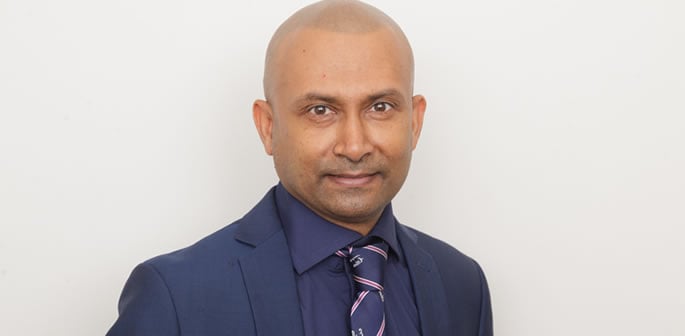
Anil Joshi is witnessing a troubling rise in severe nasal damage linked to cocaine use, while also navigating changing demands in cosmetic surgery.
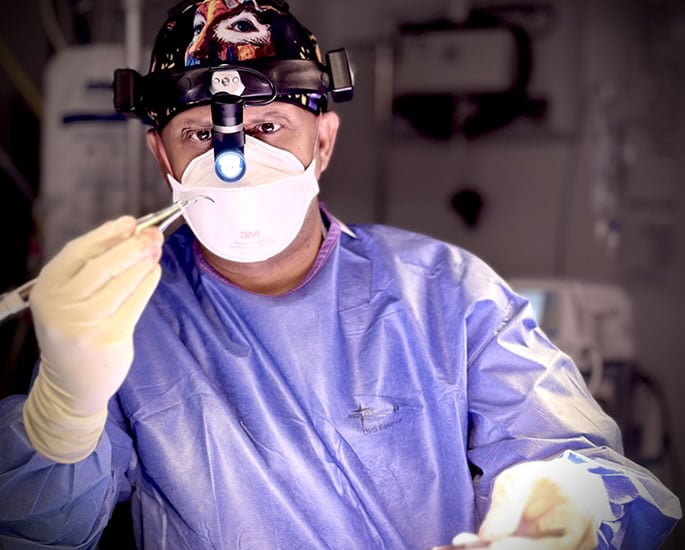
As a Consultant ENT and Facial Plastic Surgeon practising in London, his work spans complex reconstruction and refined aesthetic procedures.
He specialises in rhinoplasty and facial plastic surgery, where restoring breathing is often as important as restoring appearance.
Joshi has previously spoken about the dangers of cocaine use due to the increasing rhinoplasty surgeries he has conducted to deal with the effects.
From severe structural collapse requiring rib graft reconstruction to a growing preference for natural-looking results among South Asian patients, Anil Joshi talks to DESIblitz about how facial plastic surgery is evolving in Britain today.
A Growing Clinical Reality of Cocaine-Related Nasal Damage

Across the UK, cocaine-related nasal injury is no longer rare in specialist clinics.
Anil Joshi says: “Across the UK, cocaine use remains common, and the harms we see in clinic are increasingly severe.
“While not everyone who uses cocaine develops major nasal injury, the combination of wider availability and higher-potency supply means we are seeing more people presenting with crusting, bleeding, chronic blockage, septal perforations and in the worst cases, collapse of the nasal framework.”
In the last 12 months for the year ending March 2025, nearly three million people in England and Wales reported using any drug.
When it comes to cocaine-related harm, Joshi is seeing patients later in the disease process.
“A pattern I notice is that patients often present late, after months or years of symptoms, and some have mixed problems such as infection, inflammation and tissue loss, rather than a single, clean-cut defect.”
This complicates surgical planning. Scarred tissue, active infection and ongoing inflammation reduce the chances of straightforward repair.
Many cases are therefore complex reconstructions rather than simple corrections.
Why Cocaine Damage Can Be Permanent
Understanding the biology explains why outcomes can be so severe.
Cocaine is a powerful vasoconstrictor, which dramatically narrows blood vessels.
Joshi explains: “Cocaine causes intense narrowing of blood vessels.
“Inside the nose, the lining and the cartilage rely on a good blood supply. Repeated exposure can starve tissues of oxygen, leading to ulcers, infection and, eventually, death of cartilage and even bone.
And once destroyed, cartilage does not regenerate in any meaningful way, “so the damage can be permanent”.
Some cases are accelerated by immune complications.
“Some cases are also complicated by an immune reaction (a vasculitis-like process), sometimes linked to contaminants mixed into cocaine, which can accelerate tissue destruction.”
This overlap with vasculitis-like syndromes means the condition can resemble autoimmune disease. That similarity is clinically important, both diagnostically and medico-legally.
From Assessment to Reconstruction

Before surgery is even discussed, Anil Joshi prioritises careful assessment and stabilisation:
“First, I focus on safety and diagnosis: a careful history (including honest discussion about drug use), examination that also includes using a small nasal camera, and usually CT scans to map what’s been lost and any other associated conditions.”
Imaging clarifies the extent of cartilage and bone loss. It also identifies sinus disease or other anatomical concerns.
Joshi elaborates: “Blood tests are often needed to exclude other conditions that can mimic this picture, such as autoimmune vasculitis or certain infections, and sometimes a biopsy is required.”
This investigative phase prevents misdiagnosis. It also ensures reconstruction is not attempted on unstable or mischaracterised disease.
On what’s next, Joshi continues: “Second, we stabilise the nose: saline rinses, ointments, treating infection, and reducing crusting and bleeding.
“Third, and this is very crucial, we need sustained abstinence.”
“Reconstructive surgery has a high failure risk if cocaine use continues, so support for stopping (through GP/addiction services) is part of the treatment plan before any major reconstruction is considered.”
Where structural collapse is severe, operations can last six hours or more. Rib cartilage grafts are often required to rebuild support.
“The biggest challenge is rebuilding support in an area where the tissues are scarred and the blood supply may be compromised.
“We often have to reconstruct both form and function: creating a stable internal framework to keep the airway open, while restoring the external shape.”
Rib cartilage provides strength but demands precision, as Joshi explains:
“Rib cartilage is strong and can replace missing structural pieces, but it must be sliced and carved precisely, secured reliably and shaped to look natural.
“Another challenge is lining – if the inner lining is badly damaged, getting healthy coverage over grafts is essential for healing.”
Extended operating time increases surgical risk, therefore, planning and infection control are central.
“Finally, because these are long operations, meticulous planning, infection prevention and careful aftercare matter just as much as what happens in theatre.”
Cosmetic Procedures among British South Asians

Beyond reconstructive work, Anil Joshi has observed evolving cosmetic preferences among British South Asian patients.
He reveals: “The strongest trend is a move towards natural-looking refinement rather than an ‘obvious change’.”
In rhinoplasty consultations, identity remains crucial because “many patients want improved balance and definition while still looking like themselves”.
Another priority is skin health, as Joshi says:
“I also see growing interest in treatments that improve skin quality.
“For example, addressing pigmentation, acne scarring and texture, because those concerns can be particularly common and impactful.”
Explaining the rapid rise in non-surgical procedures, Joshi says:
“Non-surgical treatments have become more popular overall in the UK, and that includes South Asian communities.
“The appeal is convenience: less downtime and a more gradual, adjustable change.
“The key is choosing the right treatment for the right problem and making sure it’s performed safely by properly trained clinicians, because ‘non-surgical’ does not mean ‘risk-free’.
“Many people are looking for harmony and proportion rather than a single ‘ideal’ template.”
On ethnic identity, he says: “For some, that means refining the nose while keeping an ethnic identity. For others, it’s improving definition of the jawline or chin in a way that still fits their facial structure.”
For patients with darker skin complexions, skin treatments require extra care.
Joshi elaborates: “Skin requests are often about an even tone and healthy glow, but it’s important to use methods that respect the higher risk of pigmentation changes in darker skin types.”
Within South Asian communities, there has been stigma associated with cosmetic surgery. Joshi reveals that it is changing but not uniformly:
“Attitudes are generally becoming more open, particularly among younger adults, but stigma can still exist in some families.
“What helps is the shift from ‘vanity’ to ‘wellbeing’: people talk more openly about confidence, feeling refreshed, and looking like the best version of themselves, as long as the approach is sensible and safe.”
The plastic surgeon also discusses the different approach male patients have to cosmetic surgery:
“Men often ask for very subtle, ‘undetectable’ changes and usually prioritise recovery time and privacy.”
“In my experience, interest among men is increasing, especially for treatments that look like self-care rather than surgery, such as skin optimisation, hair restoration options, and small refinements to the nose or eyelids when it affects how tired they look.”
Looking ahead, Joshi anticipates three clear developments:
“I expect three shifts. First, more preventative and skin-focused care, investing in skin health earlier to reduce the need for heavier interventions later.
“Second, more combination plans where small, well-judged procedures and non-surgical treatments are used together for a natural result.
“Third, greater demand for safety, regulation and surgeon-led decision-making, particularly as the UK tightens oversight of higher-risk non-surgical procedures.”
Taken together, his observations reflect a field shaped by public health trends, cultural nuance and a growing emphasis on measured, medically led care.
Anil Joshi’s work reflects two sides of modern facial surgery.
One is corrective and urgent, shaped by preventable harm and late presentation. The other is elective and measured, guided by proportion, identity and safety.
Across both, the principles remain consistent: careful diagnosis, realistic planning and sustained patient commitment.
As oversight of higher-risk procedures tightens in the UK, surgeon-led decision-making and evidence-based care are likely to become even more central.
For patients, the message is clear.
Whether addressing drug-related injury or aesthetic goals, informed choices and properly trained specialists make the difference between temporary change and lasting outcomes.