


















































“The musical culture of Bengal influenced me."
Sanchita Pandey has built her career on precision, persistence and a deep respect for Indian Classical music.
Trained rigorously and shaped by years of disciplined Riyaaz, she has built a career that moves confidently between tradition and contemporary sound.
Alongside her work as a singer-songwriter, Pandey has developed a global music academy that now connects students across the UK, USA, India and beyond through structured online learning.
Her London-shot song ‘Aa Bhi Jaa’ represents the latest evolution of that journey.
The track blends Indian Classical foundations with contemporary South Asian pop, evoking the emotional tone of 90s Bollywood while speaking to a modern diaspora audience.
Filmed across London, the music video reflects migration, memory and the layered identity of South Asians living abroad.
Sanchita Pandey chats to DESIblitz about her early life, her multidisciplinary academic path, the growth of her academy, and the creative vision behind a song that bridges classical tradition with contemporary global storytelling.
Bengali Roots

Sanchita Pandey traces her musical journey to her childhood in Durgapur and Haldia, near Kolkata.
She recalls: “The musical culture of Bengal influenced me. You could hear the sound of ‘vocal Riyaaz’ as you walked in the colony.”
Festivals and school competitions became early platforms for her to perform, while teachers like Mr Mandal at St Xavier’s encouraged her to sing despite her shyness.
Her passion carried her to Delhi, where she sang for All India Radio and Delhi Doordarshan, performing across major auditoriums, including Siri Fort.
Pandey says: “While in Delhi, I sang for All India Radio, Delhi and also in Delhi Doordarshan.
“I have given singing performances in almost all auditoriums in Delhi including the Siri Fort Auditorium.”
Her mother, the late Asha Saxena, trained her in diverse songs, shaping her into a versatile singer capable of navigating genres from ghazals and bhajans to Bollywood and semi-classical pieces.
Pandey’s discipline was evident even in daily life, as she explains:
“I would keep honing my singing skills by humming during morning walk or in the bus or even while in the kitchen.
“While going for vacations, even as an adult, I took out the bag of gold ornaments and hid them under the pillow while my music diaries and papers would be locked safely inside the locker!”
Balancing Studies and Music

Parallel to her music career, Sanchita Pandey pursued multiple degrees, from Music to Law, Information Technology, and Human Rights.
She says: “I have imbibed the attitude of going into the depth of any subject while studying Law. Knowledge in IT gave me the freedom to build up my profile as an artist and singer on the internet.”
Her multidisciplinary learning shaped both her artistic and teaching methods.
She developed what she calls “Sanchita’s Parts Method”, breaking down complex songs into manageable segments for students.
She continues: “From studying Music to English (Honours) and working in a school or as a content writer, I was learning skills which would come in handy when I wrote books or taught difficult semi-classical songs.”
This approach also strengthened her personal confidence as a professional musician.
After the pandemic, Sanchita Pandey embraced her identity fully: “The day I got the clarity that you do not ‘become a singer’… If you sing and learn and practice every day, ‘You ARE a singer!’”
Achievements, Inspirations and Musical Style

Sanchita Pandey’s published works and performances define her career.
Her Sanchita’s Bollywood Song Notations Books Part 1, in English and Hindi, reached best-seller status on Amazon, while Parts 2 and 3 focus on Bollywood bhajans.
She says: “The uniqueness about my books is that they are handwritten for clarity and give a personalised feeling to the learner.”
Her books were also featured at the 2023 World Book Fair in New Delhi.
Pandey’s YouTube channel, with over 128,000 subscribers, combines original indie compositions, Bollywood covers, and simplified tutorials.
Beyond teaching, she has nurtured new talent, including her daughter Anandita Pandey, known as Andi Star.
Pandey’s style draws on classical training and Bollywood influences.
She elaborates:
“Every song came as a challenge – the perfect modulations, emotions, pronunciation and style.”
“Old retro songs were raag-based and new film songs are more experimental in nature, which leaves room for learning.”
Guided by her mother’s mentorship, Pandey developed versatility, able to adapt across genres and evolve with contemporary trends.
Pandey has also been compared to iconic singers: “I was told that my voice resembles that of Geeta Dutt.”
Expanding a Global Music Academy

Sanchita Pandey transformed her in-person music school in Vasant Kunj, Delhi, into a worldwide online platform during the pandemic.
She says: “YouTube as a platform has connected me with music students from all around the world: USA, UK, India, Canada, Australia, Sri Lanka and Switzerland.”
Her teaching methodology adapts to students’ varying aptitudes and cultural backgrounds, blending live lessons with pre-recorded tutorials.
She explains: “My music lessons are tailor-made for each student.
“My music classes are more about passion and energy that the students absorb.”
Students frequently reference her handwritten notations in books during lessons, combining structured guidance with self-paced learning.
Pandey plans to continue expanding her academy while producing original content:
“Online classes give me the freedom to work from anywhere as I travel. After taking classes, I am free to compose and record my own songs or create videos for YouTube.
“My next music book is almost ready to go for print!”
‘Aa Bhi Jaa’
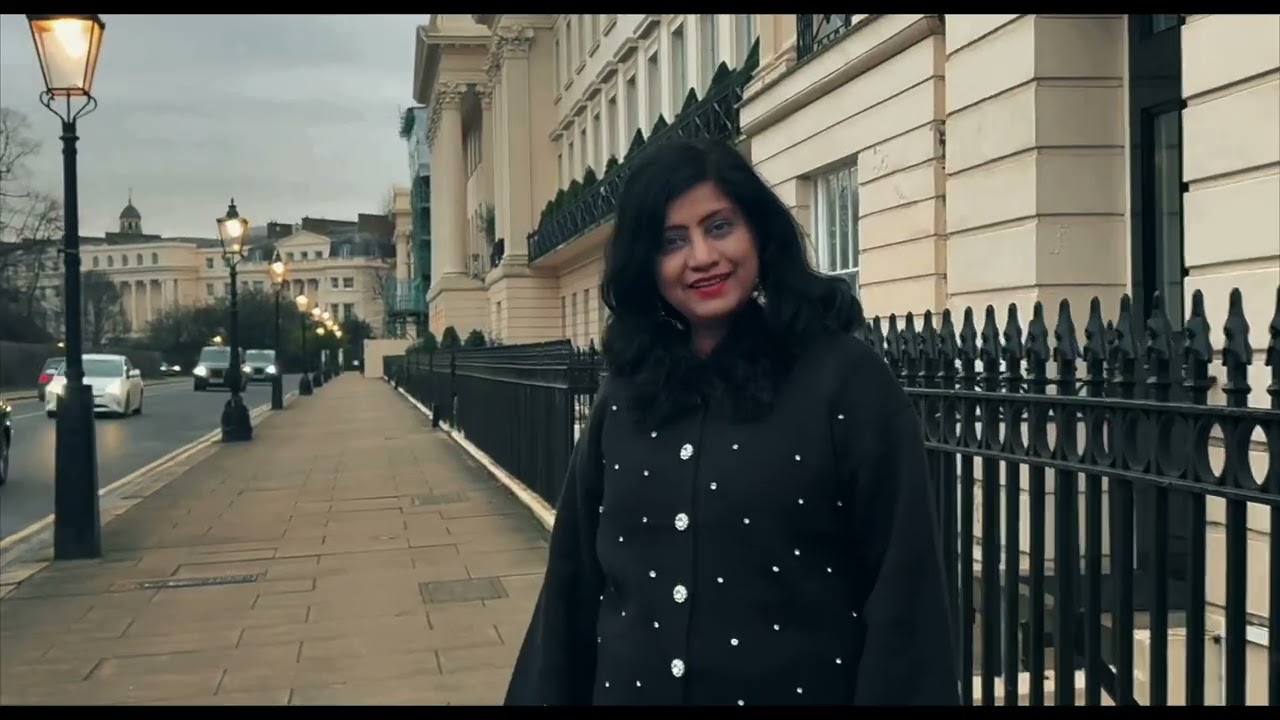
Sanchita Pandey’s single ‘Aa Bhi Jaa’ merges Indian Classical techniques with contemporary South Asian pop.
“I visualised a protagonist driving in a car and this song was playing as he drove.
“The next stanza comes from the perspective of the beloved, lovelorn female reminiscing the beautiful days spent together.”
Produced by Mayyank Solanki with album artwork by Sangeet Pandey, the track was set against London’s multicultural backdrop.
On why London was chosen, Pandey says:
“Travelling between London and Mumbai, we were inspired by the multicultural diaspora of London, its cinematic beauty, architecture and cultural vibrancy.
“As a South Asian singer and songwriter, this seemed like an opportunity to bring memories of 90s Bollywood music, an Indian classical music flavour served with a tinge of pop – an amalgamation of familiar with the new!
“This song would connect with the older South Asian population residing here along with the new generation who would recognise a familiar pop sound in ‘Aa Bhi Jaa’.”
The video intentionally connects with the UK South Asian diaspora, as Pandey adds:
“London as the backdrop brings in familiar places that individuals residing here have visited and enhances their curiosity for the song!
“Aa Bhi Jaa revives memories, creates conversations about places visited in London and brings solace to South Asian communities that their music follows them wherever they may reside.”
Sanchita Pandey’s trajectory is defined by continuity rather than reinvention.
Her grounding in Indian Classical music informs her songwriting, her teaching methodology and her published notation books.
The expansion of her academy into a global online platform reflects the same clarity of purpose that shaped her early performances.
With ‘Aa Bhi Jaa’, she situates classical phrasing within a modern South Asian pop framework while placing the UK diaspora at the centre of its visual language.
The London setting reinforces a wider cultural truth: South Asian music travels, adapts and remains rooted at the same time.
As she prepares to release another music book and continue mentoring students worldwide, Pandey’s direction remains consistent.
The discipline is classical, the sound is contemporary, and the reach is international.