
















































"this kind of story just isn’t making sense."
An article by The Guardian caused controversy by questioning the depth of India’s engagement with reading.
The article, originally titled ‘Most Indians don’t read for pleasure – so why does the country have 100 literature festivals?’, suggested that despite hosting over 100 literature festivals, India suffers from a lack of “reading for pleasure” and lacks a “great book-reading tradition”.
These claims immediately drew a sharp rebuke from historian William Dalrymple, who labelled the article “irritating and ignorant”.
The controversy highlights a recurring disconnect between Western analytical frameworks and the nuanced reality of Indian cultural consumption.
By examining the commercial data, regional diversity, and the sheer scale of Indian literary gatherings, it becomes clear that the narrative of a “non-reading” India is not only flawed but also fundamentally overlooks the world’s fastest-growing publishing market.
Spectacle vs Substance
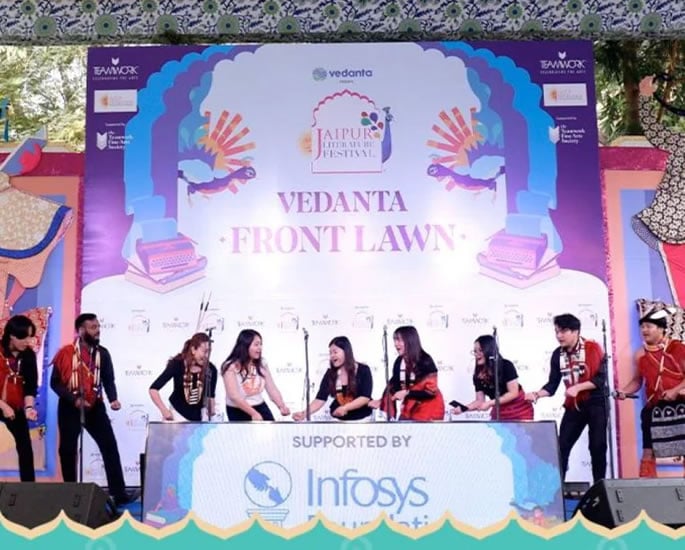
The article says India does not have a great book-reading tradition, with author Parsa Venkateshwar Rao Jr calling it a mystery:
“Maybe it’s because of the strong oral storytelling tradition? The epics are well known and passed down the generations and taken very seriously. I’m baffled by why so few Indians buy books and read.”
And when it comes to Indian literature festivals, Full Circle Publishing CEO Priyanka Malhotra suggests that they are social events where books are relegated to the background.
She added that buying books is “still a luxury for the middle and lower-middle class”.
However, actual sales figures and attendee behaviour suggest otherwise.
William Dalrymple, co-founder of the Jaipur Literature Festival (JLF), said the 2026 edition alone saw the sale of over 44,000 books in five days.
These are not decorative purchases; they represent a “passionate, nerdy” demographic of young readers who queue for hours to engage with complex intellectual discourse.
The scale of this engagement extends far beyond the “glamour” of Jaipur.
The 2025 Pune Book Festival recorded a staggering 1.25 million visitors, with sales exceeding £4.8 million.
Similarly, the New Delhi World Book Fair routinely draws upwards of 2 million attendees.
To suggest that these millions are merely seeking a “party vibe” ignores the economic reality of the transaction.
In a country where discretionary spending is carefully considered, the consistent growth of book fairs in Tier-2 and Tier-3 towns signals a grassroots hunger for literature that transcends the elite social circles cited by critics.
One social media user correctly noted that equating spectacle with superficiality is a flawed logic; the “fanfare and glamour” of the Frankfurt Book Fair does not lead to claims that Germans do not read.
Following the criticism, The Guardian’s title was amended to ‘Music, Bollywood stars and a party vibe: why India’s literature festivals are about so much more than books’.
Invisible Regional Publishing
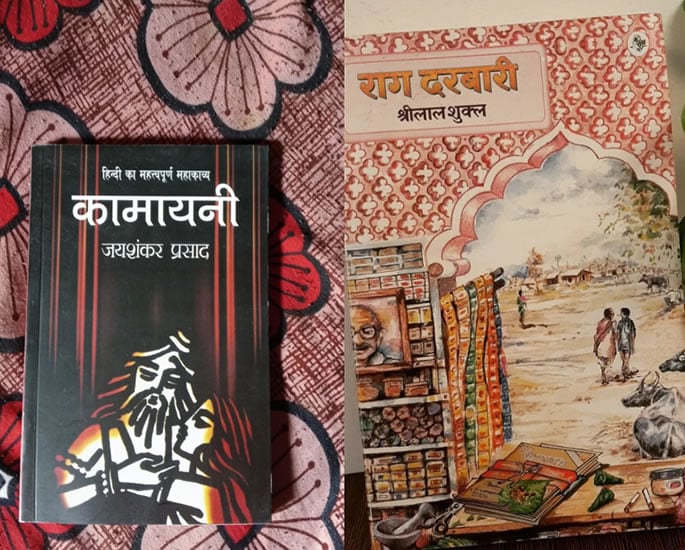
One of the most significant oversights in Western critiques of Indian literacy is the preoccupation with English-language publishing.
India’s reading culture is a multilingual tapestry that cannot be measured by English sales alone.
Hindi publishing remains a powerhouse, accounting for roughly 25% to 30% of the total industry.
In states like Kerala and West Bengal, the “reading for pleasure” tradition is deeply institutionalised through local libraries and a robust culture of political and philosophical debate.
Malayalam literature enjoys strong support in Kerala, while Bengali publishing maintains a robust presence in East India.
Tamil, Marathi, Telugu, and Gujarati literatures each possess fiercely loyal readerships and independent distribution networks that rarely register in global English-language media reports.
When The Guardian questions India’s “tradition” of reading, it overlooks centuries of written scholarship and the contemporary regional language renaissance.
The oral tradition, often cited as a counterpoint to reading, actually functions as a gateway to literacy in India; the two coexist and inform one another rather than competing for dominance.
As one commentator pointed out, “A country where books are sold on the streets, where there is a huge market of second-hand books, and much more – this kind of story just isn’t making sense.”
The vibrancy of the second-hand market in places like Delhi’s Daryaganj or Kolkata’s College Street provides a reading infrastructure that is often invisible to those looking for high-street bookshop chains as the sole metric of a healthy reading culture.
The Global Digital Shift
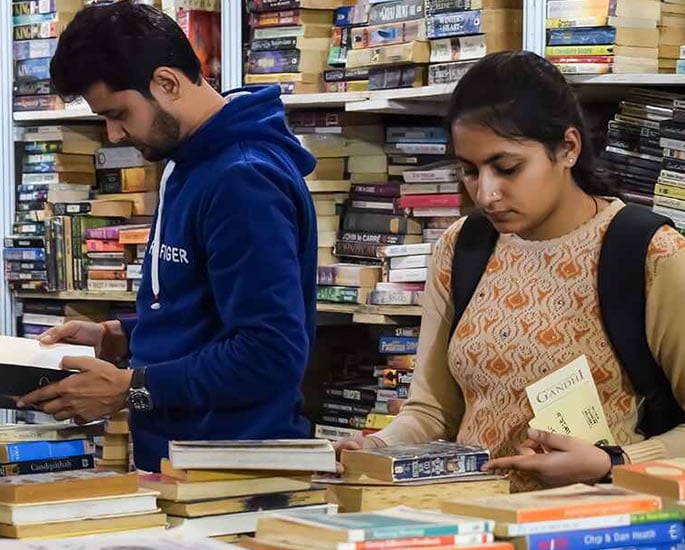
While some point to a 2024 National Literacy Trust (NLT) survey, which indicated a decline in daily reading among young people, as evidence of a fading culture, the Indian market tells a more complex story.
The NLT survey revealed that just one in three (34.6%) children aged 8 to 18 enjoyed reading in their free time in 2024, the lowest level since 2005.
This dip is largely attributed to the explosion of digital streaming and mobile devices.
However, this is a global phenomenon, not an Indian pathology.
Despite these digital headwinds, India remains among the top ten publishing hubs globally, producing approximately 90,000 titles annually.
The Indian book market is currently valued at over £6 billion, maintaining a growth trajectory that outpaces many Western counterparts.
This growth is driven not just by educational texts, but by a burgeoning interest in self-help, mythology-inspired fiction, and political biographies.
The assertion that India lacks a “reading for pleasure” culture is contradicted by the rise of home-grown literary stars who command massive followings on social media and at festivals.
Criticism of the “party vibe” at festivals also fails to acknowledge the democratisation of literature.
In a society that values community and oral discourse, the literature festival acts as a modern-day community hub where the book is the catalyst for broader societal transformation.
The assertion that India lacks a genuine reading culture is a perspective rooted in a misunderstanding of how literature functions outside the Western canon.
While the digital age poses challenges to attention spans everywhere, India’s burgeoning festival attendance and robust publishing figures suggest a culture that is evolving rather than eroding.
To dismiss the passion of millions of young readers as mere “spectacle” is to ignore the vibrant, multilingual, and economically significant reality of the Indian literary world.
If the 2026 JLF sales and the million-strong crowds in Pune are any indication, India celebrates, debates, and lives its literature in a way that few other nations can claim to match.
The conversation should not be about if India reads, but rather how the world can better learn to see the unique ways in which it does.