
















































Asda’s shelf prices are available to everyone.
Tesco has edged past Asda to claim the “cheapest big shop” crown, after fresh Which? data revealed a narrow win driven by loyalty pricing and an intensifying supermarket price war.
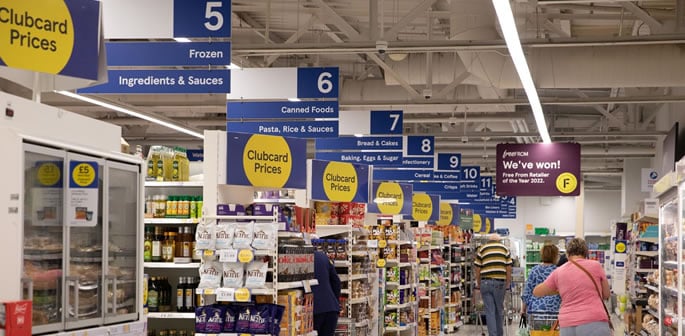
Consumer group Which? found that in January, Tesco became the UK’s cheapest supermarket for a large trolley of groceries when Clubcard discounts were applied.
The finding pushes Asda into second place, marking the first time in over a year that Tesco has topped Which?’s big-shop rankings.
For a 228-item basket designed to reflect a typical family shop, Tesco with Clubcard came in at £588.96.
Asda followed closely at £590.41, leaving a difference of just £1.45 between the two retail giants.
It is the first time since December 2024 that Tesco has beaten Asda on this specific Which? metric, after months of Asda dominance.
However, Tesco’s win comes with a major caveat that highlights how deeply loyalty schemes now shape household spending.
Without Clubcard, Tesco’s same 228-item shop would cost £641.09, which is £52.13 more than the Clubcard price and far higher than Asda’s open-to-all £590.41.
Which? tracks prices across major traditional supermarkets using two baskets: a smaller mixed shop of around 80 to 90 items, and a large trolley exceeding 150 items.
The big-shop comparison focuses on a 228-item basket including branded and own-label products, spanning fresh food, cupboard staples, cleaning products and toiletries.
Discount chains Aldi and Lidl are excluded from the large trolley rankings because their ranges are more limited and they do not always stock identical branded lines.
They still dominate the smaller basket, where Aldi was cheapest at £164.74, followed by Lidl at £166.33 with loyalty discounts applied.
Tesco with Clubcard cost £182.92 for the 89-item basket, while Asda came in at £183.04, placing both well behind the discounters.
Crucially, Tesco’s cheapest-supermarket status only applies to shoppers who can sign up for and actively use Clubcard.
Which? points out that Asda’s shelf prices are available to everyone, while Tesco’s headline savings depend on loyalty participation.
The consumer group also highlights that some shoppers, including under-18s, are not eligible for Clubcard and therefore cannot access the lower prices, driving Tesco’s ranking.
That £52.13 gap between Tesco’s Clubcard and non-Clubcard totals underlines how two-tier pricing is now embedded in the weekly shop.
It also raises wider questions about transparency, accessibility and whether loyalty-led savings truly serve all communities equally.
The result lands amid a fierce price battle, with Asda aggressively cutting prices since early 2025.
The supermarket has slashed prices on nearly a third of its range and pushed a “rollback” strategy aimed at undercutting rivals by five to ten per cent.
Analysts warned that Asda’s £3.8 billion debt burden limited how far it could sustain deep promotions, despite bold claims of being Britain’s cheapest.
Trade publications tracking the Grocer 33 basket showed Tesco and Sainsbury’s undercutting Asda on several occasions, suggesting Asda’s price push was inconsistent.
Market share figures tell a similar story, with Tesco growing to around 28.3 per cent in 2025 while Asda slipped to about 11.8 per cent.
That shift reflects stronger sales momentum at Tesco, even as Asda leaned heavily into price-led messaging.
For Asda, the symbolic loss stings, given its long history of branding itself as Britain’s lowest-priced supermarket.
The rivalry stretches back decades, including a 2005 Advertising Standards Authority ruling that forced Asda to drop adverts claiming it was “officially” the cheapest.
More recently, Asda often topped earlier Which? and Grocer price indices for large shops, making this latest result particularly significant.
For British South Asian families balancing rising living costs with big weekly shops, the message is clear.
Tesco may currently hold the crown, but only if you carry a Clubcard.