

















































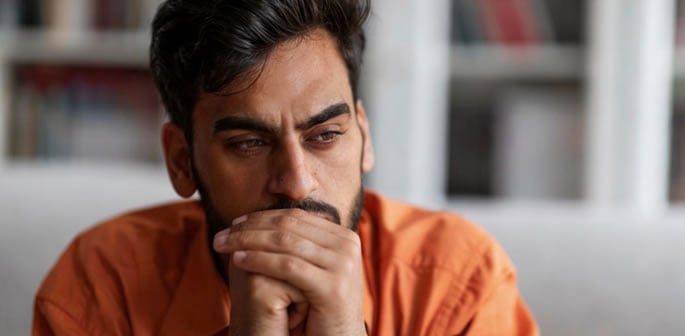
“Whenever I cried, someone would say I was acting like a girl."
Emotional silence shapes the lives of many British Asian men.
From a young age, boys are encouraged to be steady and self-controlled, but rarely shown how to express fear, sadness, or uncertainty in healthy ways.
This pattern is rooted in patriarchal ideas of masculinity, where composure is valued above vulnerability. Migration pressures add another layer. Many first-generation parents prioritised survival and stability over emotional conversation, often out of necessity rather than choice.
Across the UK, young men describe finding it difficult to speak openly at home or with friends.
Their emotional habits are shaped by expectations passed down over generations, expectations they often absorb long before they understand them.
For many, this silence becomes a defining part of adulthood. It influences relationships, mental well-being, and how masculinity is understood and performed in everyday life.
Cultural Roots

Emotional restraint often begins at home. Many British Asian boys grow up watching fathers and uncles who rarely speak about feelings. Silence becomes familiar, not because emotion is absent, but because it was never modelled.
For many first-generation fathers, this behaviour was shaped long before parenthood.
Large numbers of South Asian migrants arrived in the UK from the 1950s onwards, often entering low-paid, insecure work while facing open racism in housing, education, and employment. Survival demanded endurance, not emotional reflection.
Long hours, financial strain, and social exclusion left little space for vulnerability.
Emotional needs were quietly set aside in favour of keeping families afloat. Stability took priority, while emotional expression was postponed, sometimes indefinitely.
Children raised in these households absorbed the idea that feelings should be contained to keep the family functioning.
According to a 2024 study, over 60% of South Asian men avoided professional mental health support, often associating help-seeking with weakness rather than self-care. Participants described emotions as something to be “managed” rather than shared.
Language inside the home reinforced this outlook. Phrases such as “man up” or “don’t cry like a girl” framed emotion as feminine and therefore undesirable.
These comments were rarely intended to harm, but they reflected patriarchal values where masculinity is defined by emotional control and distance from femininity.
Nineteen-year-old Rahim, of Birmingham, described how this shaped him growing up:
“Whenever I cried, someone would say I was acting like a girl. After a while, you stop showing anything. You learn it’s embarrassing to feel.”
Over time, these messages restrict emotional vocabulary. Many boys reach adulthood unable to name stress, sadness, or fear, not because they lack emotion, but because they were taught to avoid it.
By adulthood, silence feels natural, a habit inherited rather than consciously chosen.
Family Dynamics and the ‘Good Son’
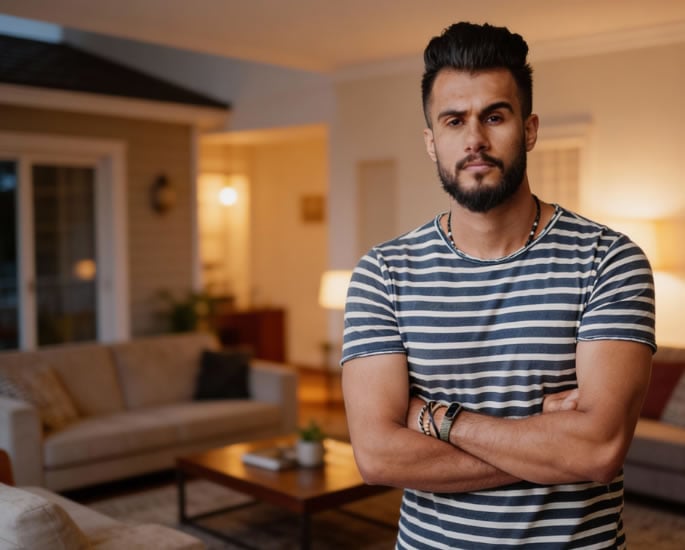
Family expectations often deepen emotional silence.
In many British Asian households, sons are valued for being dependable and composed, particularly during difficult moments. A “good son” is someone who copes quietly, supports the family, and avoids becoming an emotional burden.
These expectations are closely tied to how many parents learned to survive. For first-generation families, emotional restraint was often practical rather than ideological.
Migration to the UK frequently involved insecure employment, limited community support, and repeated exposure to discrimination.
In this context, endurance was prioritised over emotional expression.
A 2023 psychiatric review on South Asian men’s mental health found that many fathers who migrated to the UK developed habits of emotional suppression as coping mechanisms, which were later passed on through behaviour rather than direct instruction.
The review notes that children often interpret this silence as the correct way to handle stress, even when parents never explicitly discourage emotional openness.
Haroon described how this played out at home: “My parents never talked about stress, even when money was tight.
“They just got on with it. I felt like if I complained or showed anxiety, I’d be failing them somehow.”
Emotional silence is rarely imposed through explicit instruction. Instead, it is reinforced through everyday signals that shape behaviour over time.
Boys observe which responses are rewarded and which are subtly discouraged: calmness is praised, while emotional discomfort is redirected or quietly overlooked.
Gradually, this teaches sons that personal struggles should be contained and managed privately, rather than shared.
For eldest sons, this pressure is often heightened. In many South Asian families, first-born children are expected to absorb tension during periods of stress or conflict, taking on a stabilising role within the household.
Over time, this can limit their perceived freedom to express vulnerability, as emotional restraint becomes tied to duty.
Imran explained: “Being the oldest, I always felt like I had to keep things together. Even when I was overwhelmed, I didn’t feel like I was allowed to show it.”
Rather than rejecting emotion outright, these family dynamics quietly deprioritise it. Sons learn to be reliable and resilient, but often without the language or confidence to express their own needs.
Masculinity and the Identity Gap

In many British Asian homes, boys learn masculinity through correction rather than guidance.
Instead of being taught how to handle emotions in healthy ways, they are often taught what to avoid. The most common message is simple: don’t be like a girl.
This matters because it reflects a wider sexist idea that femininity is lesser. When sensitivity, fear, or tenderness are mocked as “girly”, boys learn that emotional expression is shameful.
This is not only about controlling boys but it also reinforces prejudice against girls by treating “female” as an insult.
Research on masculinity norms describes an “anti-femininity mandate”, where being seen as masculine is tied to avoiding anything coded as feminine.
This can lead to “gender policing” in everyday settings, with boys learning to perform toughness and emotional distance in front of peers and family adults to avoid ridicule or shame.
Over time, many boys internalise the belief that emotions must be hidden in order to appear “respectable”.
Respectability is often tied to emotional control, family reputation, and the ability to endure pressure without complaint.
While feelings such as sadness, anxiety, or loneliness persist, expressing them can feel risky, inviting judgment or misunderstanding. Silence becomes a way to protect both the self and the family image.
Shafiq* described growing up with this pressure:
“No one taught me what a man should be. I was only taught what not to be. Don’t be soft, don’t cry, don’t act like a girl.”
This conditioning carries clear consequences for adult relationships.
When vulnerability feels risky, friendships often remain limited to shared activities or humour, offering companionship without emotional depth.
Intimate conversations are avoided, not through lack of care, but through uncertainty about how openness will be received.
In romantic relationships, the effects are often more visible.
Emotional withdrawal can be misread as indifference or lack of investment, even when it stems from stress, shame, or an inability to articulate feelings. Partners may experience distance where none is intended, as unspoken pressure replaces communication.
These patterns also shape how men relate to women more broadly.
When boys grow up hearing that “acting like a girl” is something to be mocked or avoided, femininity becomes associated with weakness or excess emotion.
This framing does not disappear with age. It can surface later as defensiveness, discomfort, or disengagement when women express emotions openly.
Such dynamics reveal how sexist messaging damages everyone involved.
Women are reduced to a negative reference point, while men are left without the emotional vocabulary needed for connection.
What emerges is not strength, but a form of masculinity built around avoidance – one that limits understanding, intimacy, and mutual care.
The Mental Health Impact
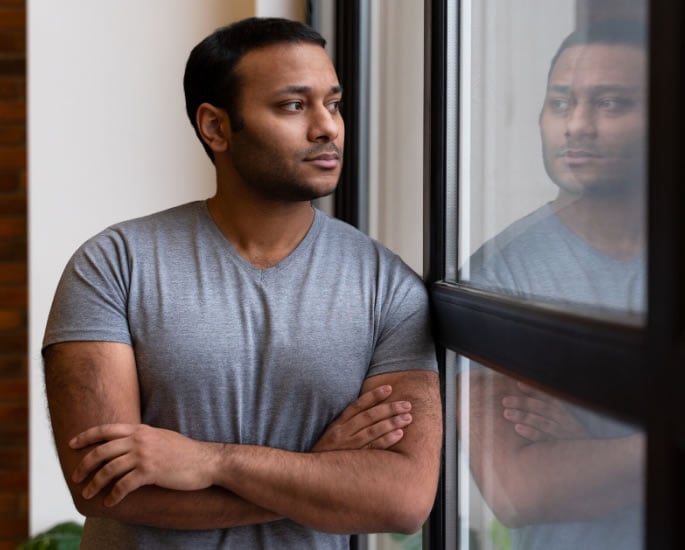
Emotional silence has clear mental-health consequences.
Ethnic minority people in the UK
People from ethnic minority groups in the UK, including South Asians, are more likely to have untreated or undiagnosed mental health problems and less likely to access professional support, even when need is comparable to the general population.
This pattern reflects differences in help-seeking behaviours linked to cultural expectations, stigma, and barriers to care.
Many British South Asian men internalise stigma around emotional struggle, often framing distress in non-clinical terms and choosing to manage it privately rather than seek support.
This pattern is linked to cultural expectations around masculinity, family responsibility, and emotional endurance that can discourage help-seeking among this group.
When emotional conversations are rare at home, many men struggle to name what they feel. Anxiety becomes tiredness, panic is reduced to stress, and sadness is dismissed as a bad week.
Without clear language, distress remains blurred and easy to overlook.
Aaliyan, a sixth-form student from Birmingham, described this confusion:
“When teachers asked what was wrong, I just said I was tired. I didn’t know how to explain what was actually happening in my head.”
Mental health stigma often persists across generations.
Older relatives may frame emotional difficulty as something to pray through, tolerate, or keep private responses shaped by their own experiences of hardship and endurance.
While often well-intentioned, this can discourage younger men from opening up.
This silence does not remain contained. It often spills into relationships.
When men withdraw emotionally, romantic partners may interpret it as distance, disinterest, or lack of care.
Priya* explained how this played out in her relationship:
“When my partner shut down, I thought he didn’t care anymore.”
“It took a long time to realise he wasn’t being cold – he just didn’t know how to talk about stress or anxiety.”
Without supportive outlets, such as friends, family conversations, counselling, or culturally aware mental-health services, pressure builds quietly.
Over time, emotional suppression becomes routine rather than deliberate. What follows is not resilience, but unresolved distress that remains unspoken until it surfaces in other ways.
What Needs to Change

Change is emerging gradually across British Asian communities, driven by families, educational spaces, and grassroots organisations rather than top-down reform.
Within households, some parents are reflecting on the emotional restraint they experienced themselves. Instead of expecting sons to remain composed, they are creating small but meaningful opportunities for conversation.
These shifts are often subtle – asking how a day felt rather than how it went – but they signal a clear break from silence.
Payal* explained: “I never saw my husband talk about feelings.
“I don’t want my son to grow up thinking silence is strength. We check in properly now, even if it’s just for a few minutes.”
Educational institutions and mental health services are also recognising that one-size-fits-all approaches often fail diverse communities.
Culturally sensitive support that acknowledges background, values, and language can reduce barriers to care and improve engagement, particularly among South Asian users who may otherwise feel misunderstood or reluctant to seek help.
Reviews of service use show that culturally responsive approaches, including linguistic awareness and trust-building around cultural expectations, are essential to improving access.
Student-led initiatives at institutions such as the University of Birmingham and SOAS have introduced peer-support groups and mental-health workshops that openly address stigma, identity, and emotional expression within South Asian communities.
Outside formal education, community-led organisations are filling critical gaps.
Groups such as Taraki, focused on British Pakistani mental health, and BESEAN, which supports British East and Southeast Asian wellbeing, offer culturally grounded resources centred on lived experience.
Faith and cultural institutions are increasingly involved.
In some mosques and gurdwaras, mental-health awareness sessions now run alongside regular community programming.
These sessions often feature counsellors, psychologists, or trained community leaders discussing stress, anxiety, and emotional well-being in accessible language.
Rather than framing mental health as personal failure, conversations focus on balance, responsibility, and collective care, concepts already familiar within faith-based spaces.
For many men, these settings feel safer than clinical environments. Hearing trusted figures acknowledge emotional struggle challenges the idea that silence is a moral or religious duty.
Together, these developments point to a broader shift.
As more spaces make room for honest conversation, British Asian men are finding ways to articulate experiences that were previously kept unspoken.
Emotional silence among British Asian men did not emerge by chance.
It was shaped by migration, family responsibility, and narrow definitions of masculinity that rewarded endurance over expression. Over time, silence became normalised, passed down, and rarely questioned.
That inheritance is now being quietly challenged. Across homes, classrooms, and community spaces, new conversations are forming about emotional well-being and what strength can look like.
Change is not dramatic, but it is deliberate, visible in everyday acts of openness once considered out of reach.
What is emerging is not a rejection of culture, but a reworking of it.
British Asian men are finding language for experiences long kept unspoken, showing that emotional openness and tradition do not have to exist in opposition.