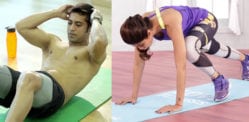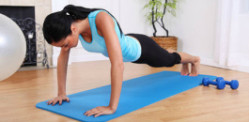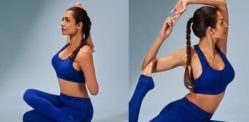













































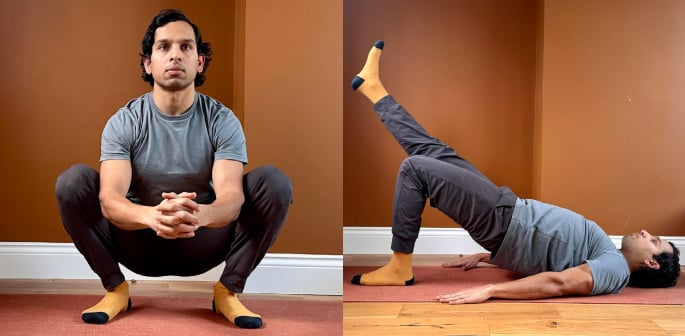
"Working out and moving well aren’t the same thing."
People can be strong but still feel miserable getting through the day.
No matter how much weight people lift in the gym, poor mobility can become the Achilles heel of their well-being.
So many experienced gym-goers spend too little time on mobility, often skipping the warm-up and stretching phases altogether.
A trade-off that does more harm than good.
A lack of mobility not only reduces the options of activities and sports that people can participate in, but also puts them at risk of injury during physical activity.
In a way, this leads to a vicious cycle of inactivity feeding worsening mobility.
“Spend most of your day sitting and the body quickly learns it no longer needs certain movements,” says Roger Frampton, a movement and mobility expert based in London.
“If a joint doesn’t move through the shapes it’s capable of, the body quietly reduces access to them.
Over time, those movements become harder to use or uncomfortable to return to.”
People who need to work on their mobility the most are those who work desk jobs involving prolonged sitting, on top of physical and mental stress.
Based on their share of the general population, South Asians, predominantly Indians, represent the largest ethnic group working in the UK’s tech, banking and finance sectors.
With increasing awareness, more and more working people are taking up regular exercise. But simply being more active in the gym might not be enough.
People must include plenty of flexibility (static) and mobility (dynamic) exercises to complement resistance training.
“Working out and moving well aren’t the same thing,” says Roger.
“Most workouts chase outcomes like strength, fitness, or weight loss. Movement is simpler. It’s your ability to move well through your joints in daily life,” he adds.
The good news is that just 10–15 minutes of mobility sessions on alternate days can undo the damage of prolonged sitting, including stiff joints and muscles, and poor posture.
So here is a list of exercises, and some accompanying tips for progression, curated to promote mobility in every inch of the body.
These exercises can be done either alongside the main workout session or as an independent session of their own.
Before getting to the exercises, remember a golden rule: just as you think you have reached the end range in a mobility exercise, push to achieve that extra inch or centimetre.
This is what drives progress.
Cat Camel
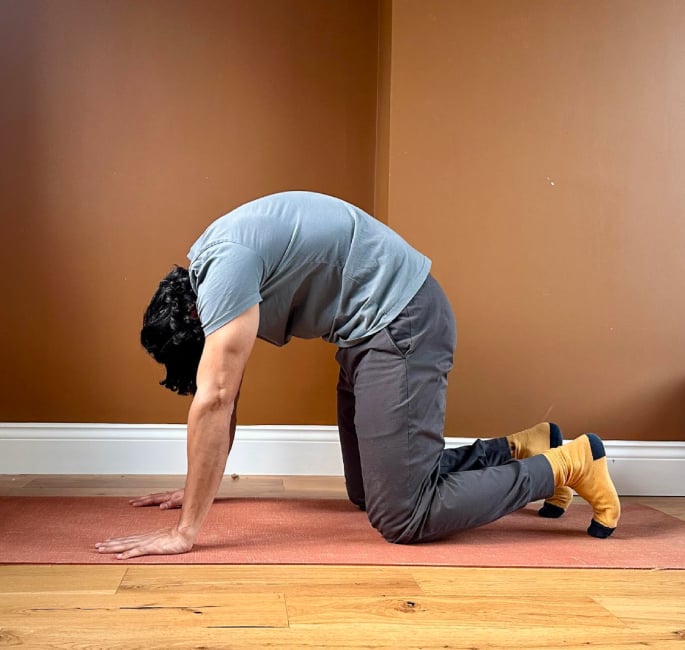 A simple and common exercise that’s so effective in mobilising the spine. Therefore, it’s a perfect exercise to start any workout session.
Position your hands beneath your shoulders and your knees below your hips.
Keep your knees at shoulder-width distance to allow freedom of movement in your hips.
Start by slowly rounding your upper back towards the ceiling. At the same time, curl your tailbone (round the lower back) and your neck.
Just when you think you have reached the end range, exhale fully to achieve extra range.
Now do the reverse. As you inhale, bend your spine in the opposite direction by pushing your abdomen towards the floor.
At the same time, lift your neck and tilt your pelvis forward (flatten the lower back).
Progression tip: Once you develop better motor control in this exercise, mobilise your joints in a waveform.
So while doing the first step of rounding, for example, begin the movement from the hip end and, like a wave, let that movement travel through each subsequent vertebra to finally reach the neck.
Squat Hold
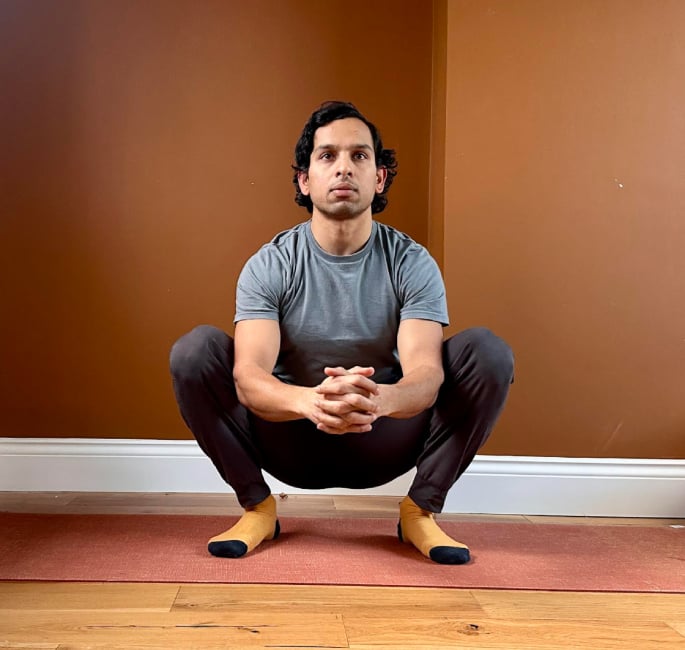 When people perform a squat under a heavy load, they can’t achieve a full range at the bottom because it’s risky.
But once the weight is eliminated, it’s an opportunity to work on limitations in your knees, ankles, hips and spine.
Holding a squat, rather than doing reps, can teach you a lot about your body, as it gives plenty of time to sense what is going on in each joint. And it’s also excellent for hip mobility.
Stand in an upright position, feet in a squat stance (toes turned slightly outwards). Then sit down into a squat.
Don’t stop mid-range. Get into a full and deep squat, and hold that position for as long as you comfortably can.
Feel free to make suitable adjustments in your ankles, foot stance and spine to extend your time in this position.
Get up or sit back carefully when you can’t hold on any longer. Do 2–3 sets to achieve maximum benefit.
Progression tip: As your joints get used to this position, try this while holding a 2 kg dumbbell in your hand using a goblet hold.
The extra weight will press the joints in your lower body further down to expand your range of motion.
Forward Lunge
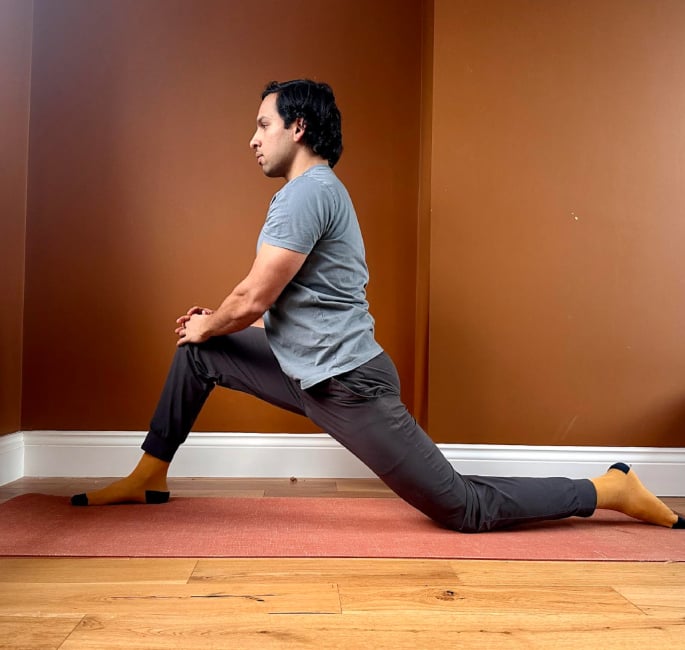 A good strength exercise when done in repetitions, but holding a lunge can also be an excellent mobility exercise, working on each side of the leg individually.
It’s an effective exercise to fix a forward-tilted pelvis resulting from a deskbound lifestyle.
If you find yourself wobbling, grip the back of a chair or any other fixed object near you to stabilise.
Position yourself into an extended lunge position, so you feel the stretch in the thigh region of your rear leg.
Rest your non-working knee on a well-cushioned surface. You can double-fold your mat to achieve that.
Hold for a minute before switching to the other side.
Progression tip: While holding this position, drive your hip forward in pulses to intensify the stretch, and eventually push forward into your comfortable range.
Lateral Lunge
 A lunge performed in a different plane. The lateral lunge, or side lunge, works on the lateral and inner side of the muscles and joints of your lower body.
Start in a wide stance, about four times wider than your squat stance.
Begin to shift your weight to the right leg, and prepare to sit down into a squat on that side.
To do this, drive your hip back and raise the right heel, all while keeping the left leg straight.
For stability, place both hands on the ground in front of you. Hold for as long as you can before switching to the other side.
Progression tip: As you build better mobility in your hips, spine and ankles, try this lateral lunge position without raising the heel of your working leg.
Supine Glute Bridge
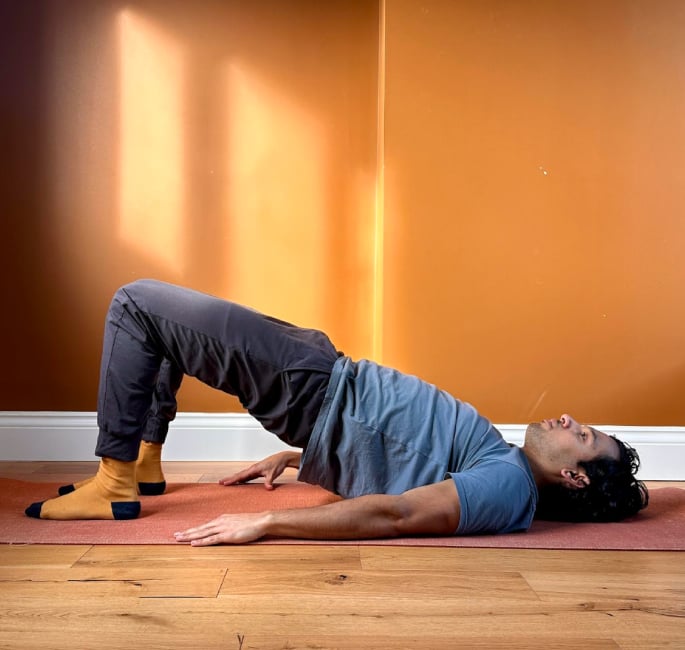 The glute bridge is great for isolating and mobilising muscles in your hips, i.e. the glutes, as well as your hamstrings.
A key thing to remember while doing this is to squeeze your glutes as you lift your hips.
Lie on your back and rest your arms at the side of your body.
Bend your knees and keep your feet in contact with the ground.
Driving with your heels, lift your hips to the point where your lower back is flattened but not overly extended.
Hold for a moment while still gently squeezing your glutes, then lower your hips to the ground. Repeat for 10 repetitions.
Supine Single-leg Glute Bridge
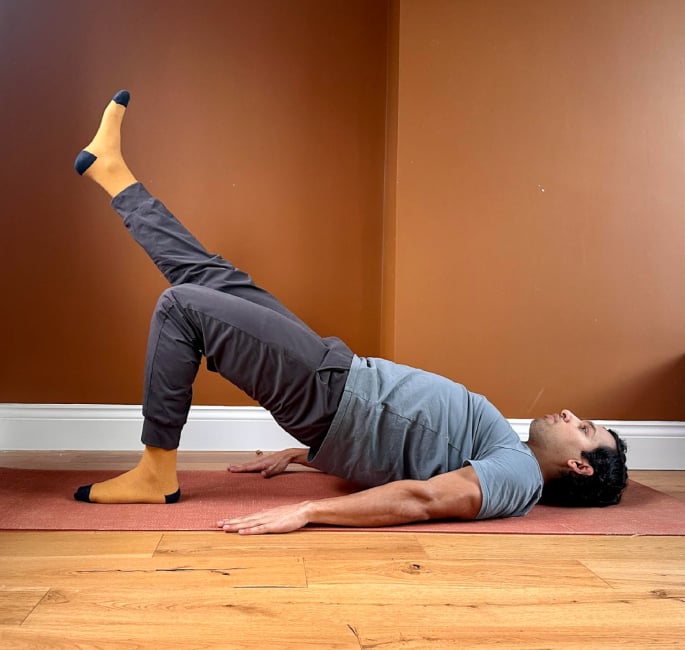 This exercise is a progression of the above exercise and is more effective in isolating and activating hidden muscles which may not activate in the two-leg version.
Repeat the first two steps of the previous exercise.
Before you start lifting the hips, lift your non-working leg from the ground and keep it suspended in the air.
Driving with the single heel of the grounded foot, lift your hips.
Lower the hips while maintaining the suspended leg in the air. Repeat for 10 repetitions before switching sides.
Seated Torso Twist
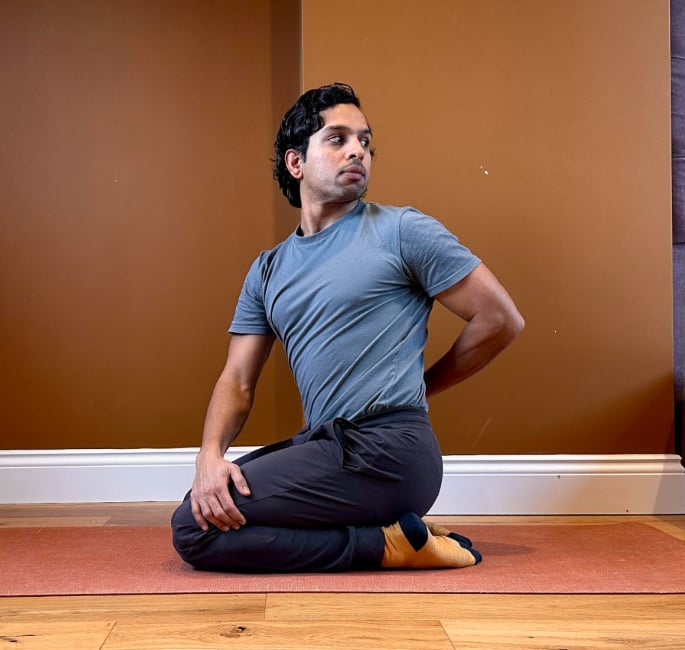 This exercise introduces transverse movement that doesn’t happen in any of the above exercises.
So this helps you build rotational mobility in your torso and core muscles.
Start by sitting on the heels of your folded legs, as in a prayer position.
To twist on the right side, use your left hand to press against the outer right thigh.
Fold your right arm behind your back.
Elongate your spine, then twist rightwards, trying to look directly behind yourself. Hold for one minute before twisting in the opposite direction.
Camel Pose
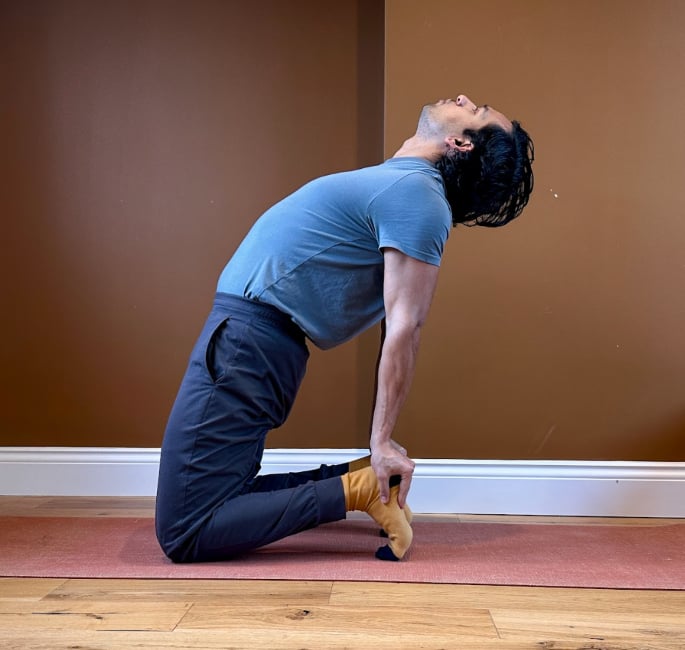 This stretch is good as it achieves the opposite of the hunched position, making it a great antidote to the harms of prolonged sitting.
The camel pose requires you to extend your chest by curling backwards. It mobilises your chest, shoulders and core.
Start in a kneeling position with knees, shins and toes in contact with the ground. Keep your toes in a relaxed position (pointed back).
One by one, place your hands on the heels behind you.
Once both hands are on your heels, try to achieve more extension in your chest by opening it outwards.
Tip: This stretch can be simplified by resting your hips on your heels, then placing your hands on the ground rather than on the heels.
Cobra
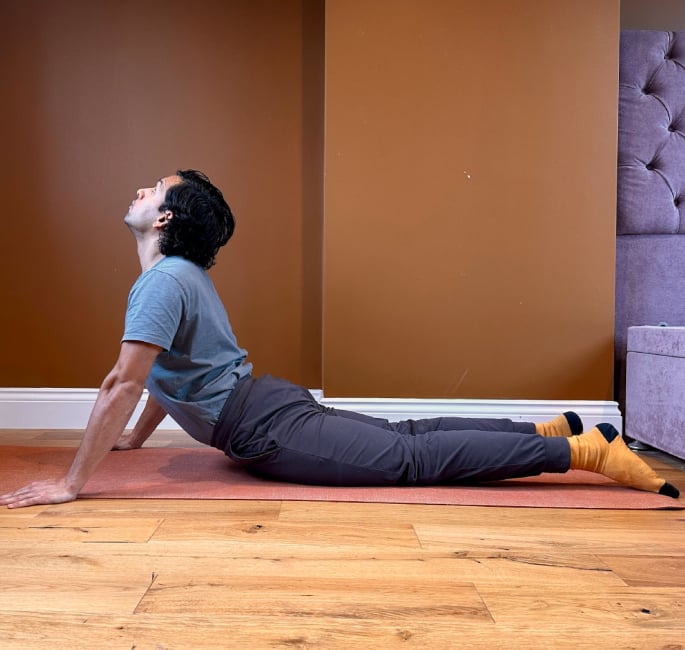 Lie down in a prone position (stomach down), with the toes of your feet pointed back.
Place your hands on the sides of your chest.
Press down to lift your chest and abdomen while keeping your hips pressed into the ground.
Lift until your elbows are fully extended.
Hold for 10 seconds, then lower down into the starting position. Perform five repetitions.
Tip: If you notice that your shoulders are crunched forward at the top, relax them and roll them back.
Wide-Legged Child’s Pose
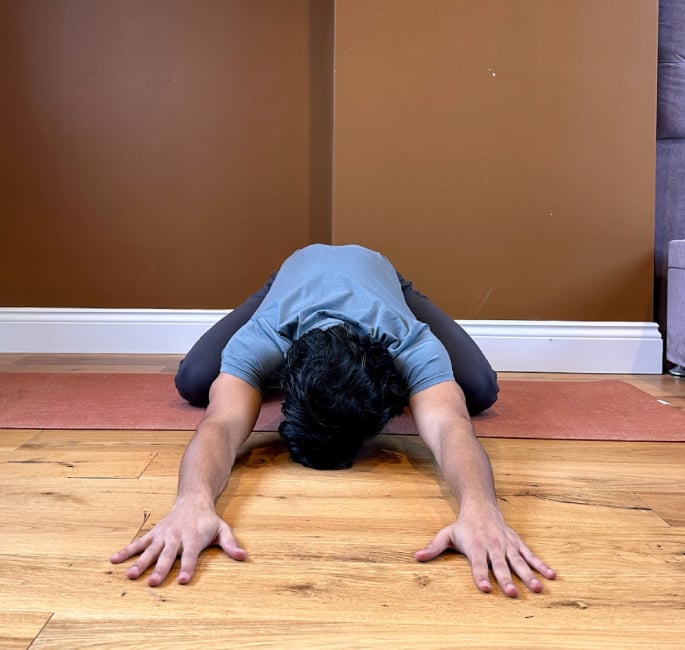 This is a relaxing pose. But at the same time, it stretches your glutes and inner thighs, which also become stiff due to prolonged sitting.
It also decompresses your spine.
Start in a kneeling position, toes relaxed behind your body.
Now widen your knees by moving them apart to about 25°. Sink your body into the ground in front of you.
Place your forehead on the ground, with your hands extended on the ground in front. Hold for two minutes or more, as you like.
Finally, people should always think of flexibility in combination with mobility.
In other words, not only static holds but also active movements that take your joints through their full range of motion and across all planes.
As well as improving the stretchiness of your body, this form of exercise also promotes its gymnastic capability.
Moreover, the huge bonus for desk workers comes in the form of improved posture, healthy joints, and freedom from aches and pains.
“Meaningful results come from a simple practice you actually come back to,” says Roger.
“Not intense. Not complicated. Just consistent. When joints revisit positions they’ve stopped using, posture often improves on its own.”