
















































"I think that's when I went off and chose to pursue the career."
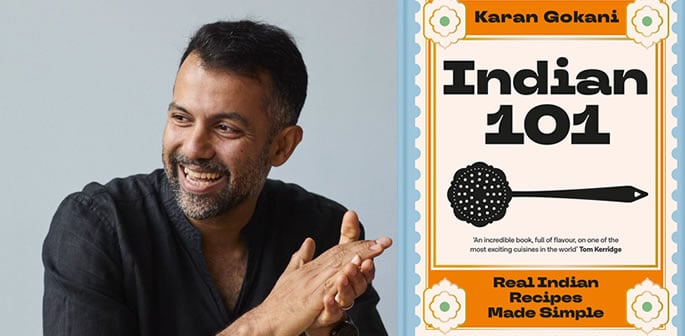
Chef Karan Gokani, founder of the London-based Hoppers restaurant chain, has released his second cookbook Indian 101.
His first book, Hoppers, published in 2022, was named one of the top three Food and Drink books of the year by The Financial Times.
While Hoppers focused on recreating the restaurant’s signature dishes, Gokani says Indian 101 is “more me as opposed to me as a founder of Hoppers”.
Gokani highlights that authentic Indian food can be simple, approachable, and fun for home cooks.
DESIblitz spoke with the chef about his journey, the inspiration behind his book and why it is a must-try for anyone craving real Indian flavours.
A Passion for Indian Food
Karan Gokani’s love of food began early, as he recalls:
“I think for me, food was always something I was extremely passionate about from the age of five years old.”
After moving to London in 2005 to study law, he worked at a law firm but felt unfulfilled:
“I reached a point in my career where I saw the next milestone was ‘partner’ or whatever it is, and I couldn’t handle that. I was like, ‘No, this is the point where I’m still relatively young, I have no responsibilities in life, no wife, no kids’.
“It’s going to be difficult; there will be a financial impact, but I want to do it. And I think that’s when I went off and chose to pursue the career.”
He emphasises that his career shift was gradual and intentional:
“I don’t think there was a single turning point. It was a very gradual, calculated, slow move.”
“I think I always knew I’ll be in food one day; I believe in manifestation and I think it was one of those manifested events in my life.”
In 2015, he opened his first restaurant, introducing Londoners to dosas and hoppers, South Indian rice-based crepes that became the restaurant’s signature dishes.
The Inspiration behind Indian 101
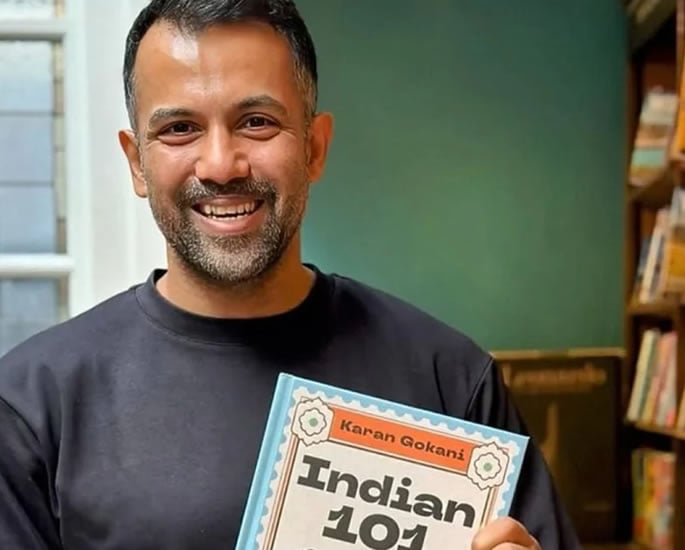
Karan Gokani’s first book, Hoppers, focused on restaurant recipes and the Sri Lankan flavours that made the chain a cult favourite.
For Indian 101, he wanted something personal: “I wanted this to be more personal. I wanted it to be something that is more me, as opposed to me as a founder of Hoppers.
“So that was Indian. It was the kind of food I cook every day.
“This book has nothing to do with Hoppers. Hoppers was the restaurant’s food.
“When you’re cooking restaurant food [versus] home food, the biggest difference is the scale of production, access to certain ingredients, time, and expertise.
“For the Hoppers book… it was reverse engineering almost all of those dishes for a home kitchen. Whereas this is actually home food, I’m giving you simple dishes.
“If you want the tandoori flavour, there’s a salmon tikka recipe you can make in your oven, or chicken tikkas you can make on the barbecue.
“But at the same time, I’m not teaching you how to make naans in a tandoor. It’s giving you a snapshot of regional Indian food, choosing recipes that we as Indians cook in our home kitchens.”
Breaking Misconceptions about Indian Food
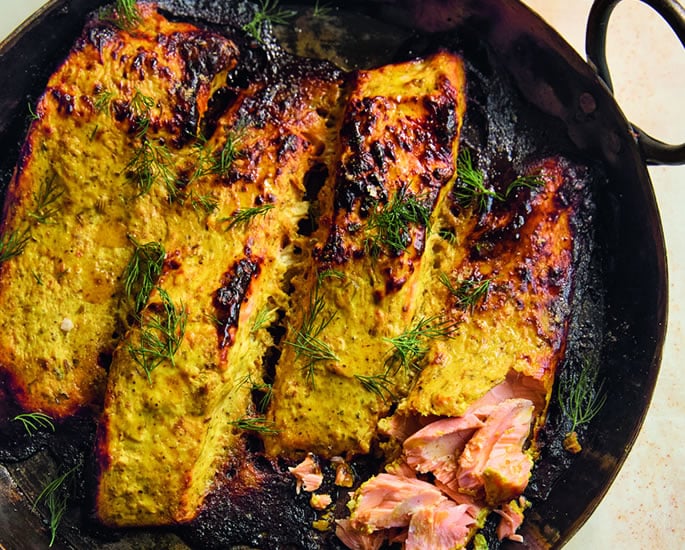
Karan Gokani says Indian 101 challenges four common myths:
“The first [misconception] is that Indian food is only North Indian, heavy food, unhealthy, rich, and associated with curry houses.
“I wanted to say that Indian food is very varied. You don’t only have to make naan at home; you can make a Koki. You can make a stuffed roti.
“Secondly, that food takes hours to make. There is a misconception that Indian food is five dishes at least but sometimes a chicken curry is enough.
“Third, ‘I need loads of ingredients’. You don’t. A lot of dishes can be cooked simply.”
“To make a simple yellow dal, all you need is a little bit of turmeric and a little bit of cumin and the rest you have from any shop.
“And fourth… it’ll cost you less than one curry in a takeaway order on Deliveroo to get all the ingredients and spices you need for an entire year of Indian cooking.”
The book is designed for cooks at any level.
Gokani explains: “The whole point of 101 was it’s not a beginner course and it’s not a masterclass. It sits in the middle.
“If you’re a beginner, you will have enough in there to get conversant with a subject.
“But I genuinely believe even if you are a seasoned Indian cook, you will find new inspiration here. Even in India, the Gujarati community doesn’t know anything about the Bengali community.
“My dream is to make Indian food exciting, cool, fun, and accessible again for everyone.”
Spices, Regional Flavours, and Real Indian Food
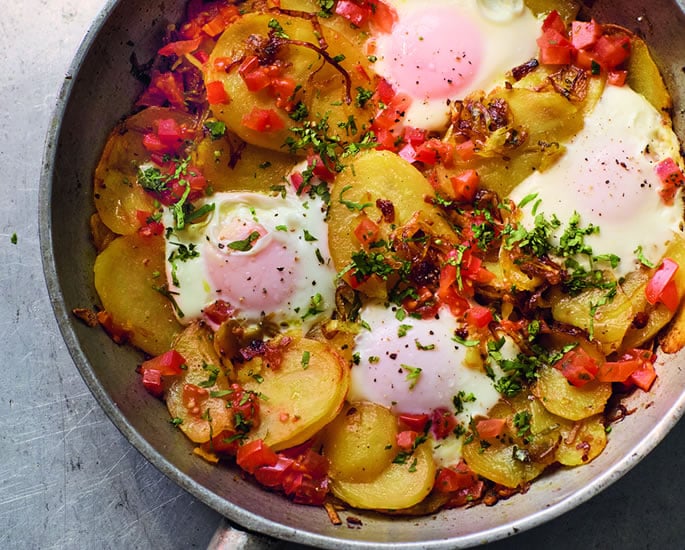
For Karan Gokani, spices are the heart of Indian cooking. He recalls the early days in the UK:
“Back in the day, when I moved here 20 years ago, I used to carry all my spices with me [from India].
“Today we have such good spices across the restaurants and I carry some spices back with me.”
Indian 101 reflects this accessibility, prioritising simplicity without compromising flavour. Recipes like ‘Simple Yellow Dal’ require minimal effort but deliver maximum taste.
The book’s regional focus draws on Gokani’s love of travel and food research:
“I grew up in Bombay, so Bombay will always have the closest connection I ever have. It’s a melting pot of cultures. I love the street food of Bombay; I love the vibe.
“That said, I think kebabs in Delhi on the streets are unparalleled… and I love Kerala, absolutely love Kerala. It’s a very hard map.
“I’m dying to find more and more excuses to travel across the length and breadth of the country and rediscover it.”
Some recipes posed unique challenges for home kitchens.
Champaran Meat, or Ahuna Mutton from Bihar, was particularly complex, as Gokani says:
“It’s one of the only dishes I’ve seen where you actually pour all the ingredients into one handi, cover it, seal it, and cook it. It’s not done in a layered fashion like we usually build a curry. I kind of had to reverse engineer it to an extent to make it cookable.
“We had to tweak the recipe, check the timings. Obviously, meat is very different, they use a very exotic goat over there; you have to use lamb.
“That was an interesting process, but I think we’ve managed to nail it.”
Gokani prefers the term “real” over authenticity:
“I purposely used the word real. Because what you cook in your house might be different from the way I cook Indian food in my house.
“And that doesn’t make one more authentic than the other. It’s food that you will find in homes.”
Indian 101 celebrates everyday dishes such as Sindhi Koki, Bitter Gourd Fry, and Alur Dom.
Its opening chapter, ‘Flavour Hacks’, equips readers with practical tips to recreate Indian flavours consistently for weekday meals.
Indian 101 is designed for those living away from home but the book also appeals to experienced cooks too.
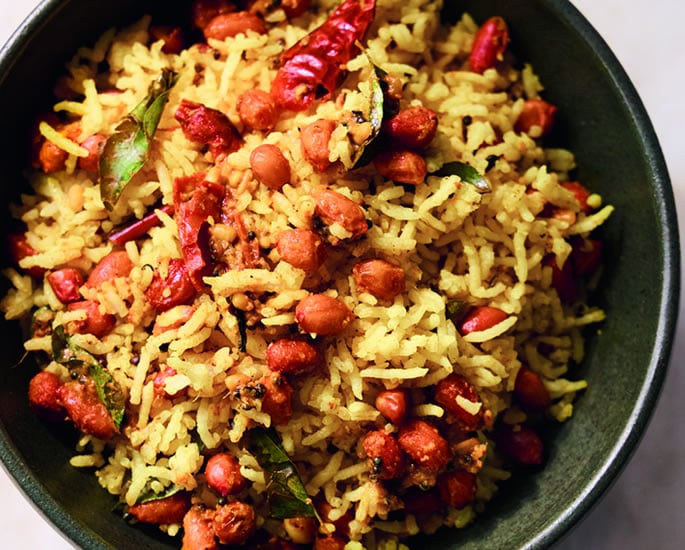
Recipes such as Potato Chaat, Vada Pav, Lemon Rice, and Easy Chicken Biryani are fun, simple, and social, inspiring cooks to invite loved ones over.
Karan Gokani sees food as a way to create change beyond the plate:
“For me, food is a language. I think at my restaurants, it’s a language to give people an experience… to connect them to either their past or future.
“In terms of charity, I’ve never looked at it as charity.
“I want to do something that’s far more meaningful, something that is tangible, just like our restaurants where you look at metrics.
“We’re able to actually look at all the metrics [for the children] – I can see height, I can see weight, I can see the difference we’re making.
“I think that just encourages us so much more to do more, to build bigger, and to support more.”
Indian 101 proves that real Indian cooking can be approachable, fun, and deeply rewarding, inviting home cooks to bring the vibrant flavours of India into their kitchens without fear or fuss.