

















































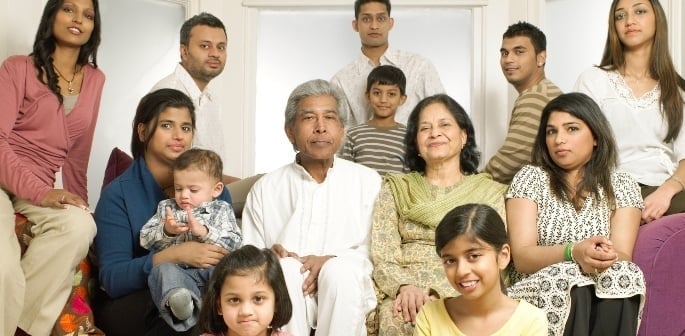
"it can't be forgotten we are more than parents and grandparents"
In Desi families in Asia and the diaspora, grandparents play a vital role and hold a revered status.
Elders are seen as the backbone of the family, and with that comes pressure and expectations.
Grandparents play a critical role in maintaining family traditions and culture and providing emotional support.
Moreover, longer lifespans also mean “an enlarged timespan of overlap of grandparents’ lives with those of their grandchildren“.
For British Asian grandparents from Pakistani, Indian and Bengali backgrounds, their role gives them symbolic prestige, yet they also encounter evolving responsibilities and challenges due to their position.
Their roles can be challenging, from caregiving duties to navigating relationships with adult children.
DESIblitz investigates the pressures and expectations Brit-Asian grandparents can face.
The Socio-Cultural Value Placed on Elders

Historically, grandparents were the family’s wise elders, guiding younger generations through experience and knowledge.
The value and reverence placed on elders such as grandparents remain entrenched in Desi culture today.
Mohammed, a 30-year-old British Pakistani, said:
“One good thing about Asian families is that we have this tight support from grandparents, parents, uncles and aunties and the rest.
“And we get to learn from them. Yeah, if it gets lecturing, it’s not good, but outside that, we get to know stuff and history that would otherwise be lost.”
Mohammed went on to say:
“Some can be bad with their parents and grandparents, not value them.”
“Some take advantage but don’t listen to them. Doing all that goes against our cultural, religious and moral values.”
The socio-cultural and ideological value placed on grandparents does not always manifest in how they are treated.
Today, the role of grandparents has evolved due to economic shifts, changing social structures, and longer life expectancies.
Childcare costs, the rise of dual-income families and women’s increased employment all matter.
These factors often mean grandparents are key players in childcare and family support.
Grandparents have always played a key role within Desi families. Modern socio-economic pressures and realities make the role of grandparents even more crucial for Brit-Asians.
Caregiving Responsibilities
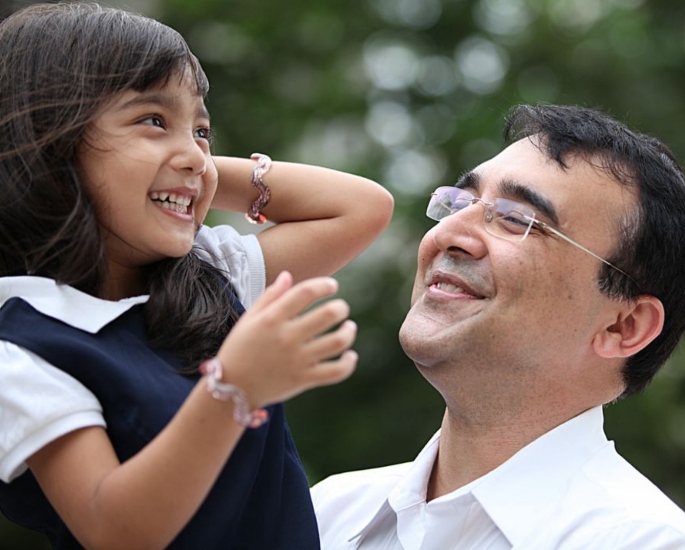
One of the most significant pressures British Asian grandparents face is providing caregiving for their grandchildren.
With both parents often working, grandparents are frequently called upon to fill the childcare gap.
According to Age UK, 40% of grandparents in the UK provide some form of childcare, with South Asian families relying even more on this support due to cultural norms.
Aliyah, a British Pakistani, told DESIblitz:
“Without my mum taking care of my kids while I’m at work I couldn’t work.
“Childcare is too expensive, and I know my mum will look after the kids how I would; I can trust her.”
Aliyah’s mother, 59-year-old Taybah, stated:
“It’s always been this way. My mum helped take care of my children. I do it for my daughter, and she will do it with her grandchildren.”
For Taybah, there is great pride in carrying on the tradition of childcare within the home and family across generations.
However, the expectation of such support can put pressure on relationships.
Fifty-three-year-old British Bengali Nazia* stated:
“I love my children and grandchildren, and happy to help when I can. But I also have my own life and, finally, a chance to do things I couldn’t when my children were young.
“Asian families are wonderful because of the generational ties and support. But it can’t be forgotten we are more than parents and grandparents.
“My daughter lives in Wales. She once got very upset that I couldn’t come down to help look after my sick grandson straightaway.
“She had her husband and my 15-year-old granddaughter. I was coming, just not as soon as she liked. I had to remind her I had other responsibilities.
“She wasn’t happy with me for a while, but they forget we cannot always drop things. If it had been an emergency, that would have been different.”
In turn, studies show that grandparents in caregiving roles are more likely to experience stress and anxiety than those who are not involved in daily childcare.
The Issue of Financial Support

Financial pressures, mainly when supporting adult children and grandchildren, can be an expectation and pressure.
Grandparents often contribute to household expenses, wedding costs, or educational fees.
Moreover, parents and grandparents can be expected to bail out those from the younger generations when they get into trouble.
Forty-eight-year-old Zeeshan*, a British Kashmiri, reflected on the tensions and expectations that can manifest:
“When my son and grandson got in trouble, they thought because I had money, all was good. I’d just give it to them.
“No, I didn’t just give and move on. It came with rules and expectations they would pay back because they had done wrong.
“It caused arguments, and some of the family said I should just give it, but that way they learn nothing.”
In turn, Nazia maintained: “Money can be a big issue. When my son lived with us with his children and wife, we covered everything.
“It was fine, but when my husband lost his job, and it was just me earning for a year, that couldn’t go on. I had to have a word with my son and daughter-in-law.
“They just didn’t think.
“It’s expected for parents and grandparents to help the young lot. But sometimes, if you don’t have health issues and are working, the younger lot can forget that we still need help, too.”
Role in Multigenerational Homes

Multigenerational households are a hallmark of Desi family life and are highly idealised.
It is common for grandparents to live with their adult children and grandchildren in multigenerational homes. This living arrangement provides numerous benefits, such as emotional closeness, financial savings, and built-in childcare support.
However, it also presents significant challenges, particularly for grandparents, who must navigate their role within the family. They are often caught between generations with differing values, expectations, and lifestyles.
Grandparents can be expected to mediate conflicts between parents and children or between different family members.
This can place them in difficult positions where they must balance fairness with loyalty to their children, often creating tension.
The emotional burden of acting as mediators in family disputes can lead to stress as they try to maintain peace while preserving relationships across generations.
Razia, a 50-year-old British Kashmiri, revealed:
“When my son and grandson would fight, my husband and me were forced to step in and try and calm things. My daughter-in-law had given up as they lashed out at her.
“It was a very stressful year and impacted our health.”
“The house was very tense, and we did, at times, upset my son and grandson because we told them when they were in the wrong.
“Despite the stress, it is our responsibility, but it is not always an easy responsibility.
“We had to put rules in place to make sure lasting damage to relationships was not done. If they could not speak without shouting, they were to leave, go to bedrooms until they could.”
Multigenerational households can thrive by fostering open communication and establishing boundaries, allowing grandparents to play a meaningful role without overwhelming pressure.
Expectations to Live with the Whole Family

In Desi households, including in Britain, it is common for more than one generation to live together. This is often necessary given the cost of living and high rental prices.
However, this can create pressure for those who want their own space and do not wish to live in a multigenerational household.
British Indian Neema*, a grandmother of five, stated:
“My husband and I want to be able to enjoy the quiet, sit reading when we like, no mess that comes with young children.
“We do not have much money or space in our house.
“We have had friends and family try and push us to move in with one of the children and their family, especially when I got sick.
“But our home is our home; it is where we want to stay and die. I’m better now, and we love having the family over and staying over. But we are happy living as we are.
“We also need our own space, and none of us can afford a mansion. I do not want to be going into my bedroom when I need quiet like some of my friends do.
“For some friends, that’s the only room they have to escape to.”
South Asian grandparents face a wide range of pressures and expectations.
Due to the collectivist nature of Desi cultures, the emphasis is often on focusing on the needs of the family rather than one’s own.
Responsibilities can include providing vital childcare, caregiving and financial support.
While deeply rooted in family values, these responsibilities can be detrimental to physical, emotional, and mental well-being.
Balancing these expectations with their own health and happiness is essential for their long-term well-being.
Families must work together to acknowledge the challenges grandparents face and offer them the support, appreciation, and space they need to enjoy their later years without undue burden.