


















































"I didn’t know where to go from here.”
In India, divorce can be granted in minutes but the effect it can have on women can last weeks, even months.
There is no clean transition out of divorce in India.
Once the legal process is over, the real disruption begins. Identity shifts, finances tighten, and everyday life is quietly renegotiated in homes, workplaces, and family circles that do not always know how to respond.
For divorced Indian women, the change is rarely contained within the relationship itself. It spills into housing, employment, friendships, and even how they are spoken about in their absence.
Some experience it immediately. Others feel it gradually, in the thinning of social ties and the subtle reclassification that follows.
What begins in court is only the formal part. The rest unfolds outside it.
When the Ending becomes the Beginning of Loss

For Gargi Kalra, the moment the divorce was granted did not feel like closure.
She said: “The entire future I had in mind was gone with that echo in the court.
“Blankness took over. I felt frozen, like I was out of a well, but now I didn’t know where to go from here.”
In the months that followed, depression made work difficult while savings were spent relocating and starting over in a new city.
The structure of everyday life had to be rebuilt from scratch because there was no alternative.
This sense of dislocation is common in the aftermath of divorce, where legal finality collides with social continuity. Roles that take years to build are removed instantly in law, but linger socially in expectation.
Terveen Gill describes it as a form of grief that extends beyond the relationship itself:
“I had spent years shaping this new identity, so the initial impact of ending it was like loss and grief. It touched every aspect of my being.”
But the emotional weight is quickly layered with interpretation.
Terveen added: “Divorce is somewhat equated to failure. Society categorises you as a misfit. You’re still a piece of the picture, but don’t completely fit.
“It’s a blend of judgment, sympathy, ignorance, and indifference.”
That interpretation often begins before divorce itself.
Counselling psychologist Srishti Mishra, founder of Unfiltered Within, explained:
“Societal stigma often influences women long before the divorce itself.
“Many women are encouraged to prioritise family reputation, social expectations, and what people will think, even when they are struggling emotionally.”
Reclassifying Everyday Life
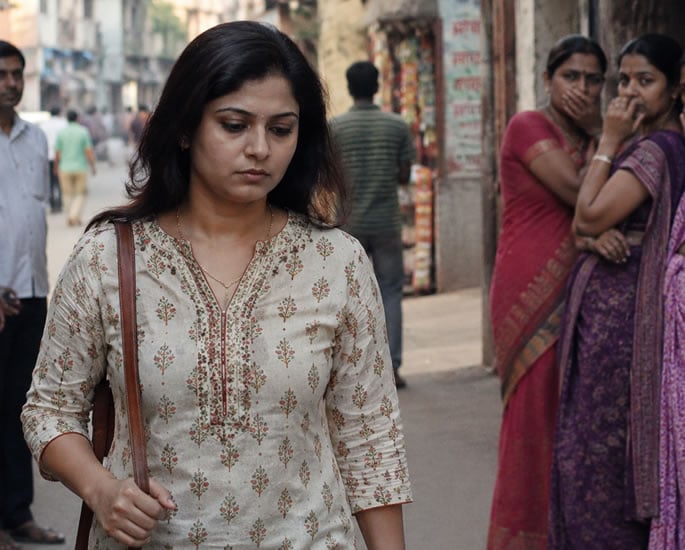
For some Indian women, life after divorce has an effect socially.
Neerja revealed a change in how people engaged with her:
“Some people became very interested in the details, the why, the how, the what, despite not being present during the difficult phases of the marriage itself.
“That can feel isolating in different ways.”
At the same time, silence becomes its own response.
In workplaces, the effect can be even more direct.
Anuradha recalled being advised not to disclose her separation, only for the information to be shared without her consent.
“After that, I decided my status was nobody’s business.”
Harshika, a psychologist in Bengaluru who also went through separation, described how quickly stability can unravel when multiple systems shift at once. Marriage relocation, financial investment, then separation – each layer requiring restart.
She said: “Rebuilding sounds empowering when people say it casually.
“But in reality, it is exhausting and daunting. Life does not pause for heartbreak.”
The Reality of Starting Again
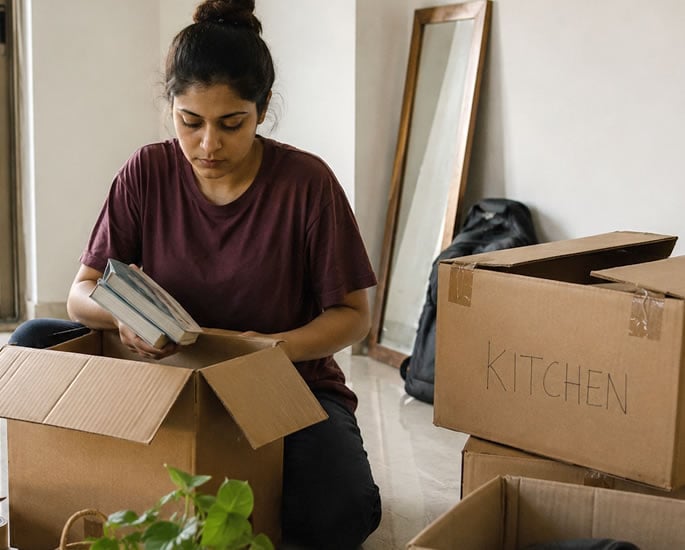
Financial stability often determines how divorce is experienced far more than the legal outcome itself.
Clinical psychologist Dr Komal Manshani said emotional recovery cannot be separated from material security. Without financial grounding, recovery becomes prolonged and unstable.
According to Harshika: “Financial independence isn’t just a number in a bank account; it is the foundational cornerstone of a woman’s agency and safety in India.”
Anuradha described how marriage itself alters social perception:
“Marriage gets women an elevated status in society. People speak to you more respectfully. You get taken seriously.”
When that status shifts, the change is reflected in access, assumption, and the ease with which women are believed or accommodated.
For many, rebuilding involves managing employment, housing, and emotional recovery simultaneously, a combination that leaves little room for pause or reflection.
Where Recovery Happens

While external life reorganises, much of the aftermath unfolds internally.
Soumyashree Mishra was 26 when she left a marriage marked by emotional abuse. The external separation did not immediately resolve the internal one.
She recalled: “The pain was beyond what words could express. I felt isolated even when surrounded by people who loved me.
“People saw me functioning, but they did not see the emotional breakdowns happening every day.”
This disconnect often extends into self-perception. Even in safety, many women carry an internal narrative shaped by blame and repetition.
Harshika described it as persistent self-interrogation:
“The smallest everyday mistake or slip-up would trigger an internal monologue: maybe this is why I was left. You deserve nothing.”
Counselling psychologist Shweta Manghnani, founder of Sukhbyshm, said:
“Women carry responsibility for things that were never entirely theirs to hold.”
Srishti Mishra revealed: “Chronic self-blame is one of the most common patterns I observe.
“Many women spend years wondering whether they could have adjusted more, sacrificed more, or done something differently to save the marriage.”
Yet for some, the narrative eventually shifts.
Bindu Cherungath, who initiated her divorce, spent years questioning how her professional voice would be received afterwards.
“I often wondered how people would trust my views when my own marriage had not worked out.”
“Today, I know I didn’t fail. I chose myself. And that took more courage than staying would have.”
Divorce in India is not a single moment of separation. It is a process that continues long after the court order is signed.
For many women, the hardest part is not the legal end of a marriage, but what follows it – rebuilding financial stability, adjusting to social change, and managing the emotional impact of starting again.
Some find a new sense of direction over time. Others continue to live with uncertainty as they piece life back together in different ways.
What remains constant is that the impact of divorce extends far beyond the courtroom, shaping everyday life in ways that are often unseen but deeply felt.