

















































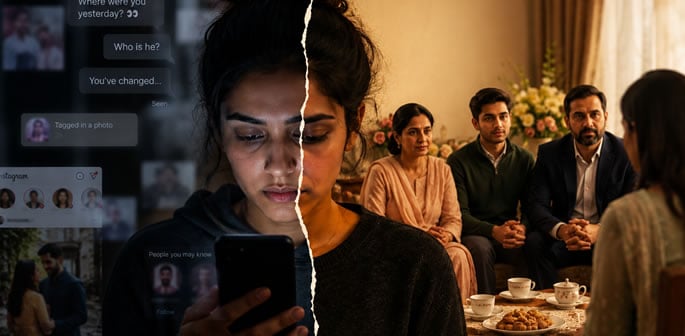
"You have to become a ghost of yourself to be acceptable"
The British Asian rishta process refers to the family-influenced system of matchmaking and marriage introductions but it is increasingly shaped by scrutiny of past romantic relationships.
What once depended largely on reputation within extended networks has evolved into a hybrid system where social media history can carry as much weight as education, career or compatibility.
This shift has created a new form of self-management among young British Asians, where the visibility of past relationships is treated as something that must be controlled, edited or removed before introductions begin.
In many cases, this takes the form of what is now commonly described as a “digital scrub”, the removal of online traces of previous relationships to align with expectations around izzat (honour) and perceived respectability.
The pressure often sits underneath conversations, unspoken but understood, shaping how people present themselves long before a formal rishta meeting takes place.
Quietly Rewriting Personal History

For some young British Asians, preparing for the rishta process begins with a retrospective audit of their own digital footprint.
Old photos, tagged posts and past interactions are reviewed with a different kind of urgency, as Sameer* recalls:
“Before my parents started looking for a match for me, I spent an entire weekend untagging myself from photos dating back to 2015.
“There was nothing scandalous, just pictures of me and my ex-girlfriend at graduation or on holidays with friends.
“But I knew that if a prospective mother-in-law saw those, I’d be labelled as ‘distracted‘. You have to become a ghost of yourself to be acceptable to the community.”
What stands out in accounts like this is the logic behind it.
The issue lies in the idea that even normal past relationships can be reframed as moral evidence.
Over time, this creates a culture of self-erasure that extends beyond individuals.
Friends become part of the process too, sometimes asked to delete old posts or avoid resurfacing memories that might later be interpreted through a different cultural lens.
When Visibility presents a Risk

The pressure to manage romantic history is not distributed evenly.
Within British Asian families, the scrutiny placed on women remains significantly more intense, particularly when it comes to previous relationships.
Men and women may share similar experiences of dating or long-term relationships, but the interpretation of those experiences often diverges sharply once the rishta process begins.
Describing this imbalance, Anisa* says: “My brother is currently being introduced to girls, and everyone knows he had a long-term girlfriend in university.
“It’s treated as a joke, like he’s finally ‘settling down’.
“But when a potential family asked about my history, my mother panicked, telling me to say that I’d rarely spoken to a boy outside of work.
“The expectation is that I should be a blank slate, while my brother is allowed to have a history.”
The same experience is reframed depending on gender, and that reframing becomes part of how suitability is assessed within marriage negotiations.
This creates a situation where honesty is not always treated as neutral. Instead, it can be perceived as strategically risky, particularly for women navigating family-led introductions.
Circulation of Fragmented Truth

“Log kya kahenge” (what will people say) has long shaped decision-making in South Asian communities, but in the digital age, it operates with new speed and reach.
It functions as a system of informal surveillance, where fragments of information can circulate widely and re-enter personal lives at unexpected moments.
What makes this environment distinctive is not only gossip, but the permanence of digital traces.
A single image, removed from context, can resurface years later in a completely different setting.
Raj* revealed how this ended a prospective marriage:
“Everything was going perfectly. Our families had met, and we were discussing dates.
“Then, a distant aunt of the girl’s family sent her mum a photo of me at a cinema with an ex-girlfriend from three years ago.
“It was just a grainy photo someone had taken of us in the background of their own selfie. That was it.
“But the wedding was called off and I was treated like I had committed a crime.”
The meaning of an image is no longer anchored in its original context but in how it might be perceived within a future family structure.
In that sense, reputation becomes something externally assembled rather than personally defined.
The Cost of Managing Reputation

As the rishta process becomes more entangled with digital history, many individuals find themselves negotiating a difficult choice between transparency and protection of family honour.
Disclosing past relationships is seen as something that could destabilise introductions, even when those relationships are long over.
This leads to a pattern where silence is not necessarily deception in intent, but a form of risk management shaped by cultural expectation.
Hina* says: “I wanted to be honest with my fiancé. Before him, I had one serious relationship that lasted four years.
“But my father warned me that if I told him, his family would find out, and it would ruin our reputation. So, I stayed silent.”
“Now we’re married, and every time someone mentions my university days, I freeze.
“I love my husband, but there’s a part of my life I’ve had to bury to keep the peace.”
Parts of personal history become emotionally separated from present relationships, not because they are shameful, but because they are considered socially sensitive.
Being Open

Despite these pressures, there is a growing shift among some British Asian couples towards openness from the outset.
Rather than managing or editing past relationships, they are choosing to address them directly as part of building trust.
This approach often exists in tension with more traditional expectations.
However, it reflects a broader change in how younger generations are negotiating identity within marriage frameworks that were not designed for digitally visible lives.
Zain* describes how this worked in practice: “When we first met, we made a pact. We told each other everything.
“Not because we had to, but because we wanted to start without any ghosts.
“When my mum heard a rumour about my wife’s ex, I was able to shut it down immediately because I already knew the truth.
“There was some pushback from older relatives but it was worth it for the peace of mind we have now.”
Honour, in this context, is no longer defined solely by absence of history, but by how openly that history is acknowledged within a relationship.
The British Asian rishta process continues to evolve under the influence of digital life, where past relationships are no longer fully contained within memory but exist as searchable, shareable traces.
In this environment, the “ghost of the ex” becomes less about the past itself and more about how that past can be interpreted, circulated and judged.
Yet alongside this, there is a gradual shift in how younger generations are approaching marriage.
While reputation and family approval remain central, there is increasing resistance to the idea that personal history must be erased in order to be accepted.
The tension at the heart of the modern rishta process is therefore not simply between tradition and modernity, but between visibility and control.
As more individuals choose transparency over concealment, the idea of the “digital scrub” begins to lose its inevitability.
What replaces it is still unfolding, but it points towards a version of the rishta process where the past is acknowledged rather than edited, and where honesty becomes part of what builds credibility rather than undermining it.