
















































His work laid the foundations for a growing Sikh community
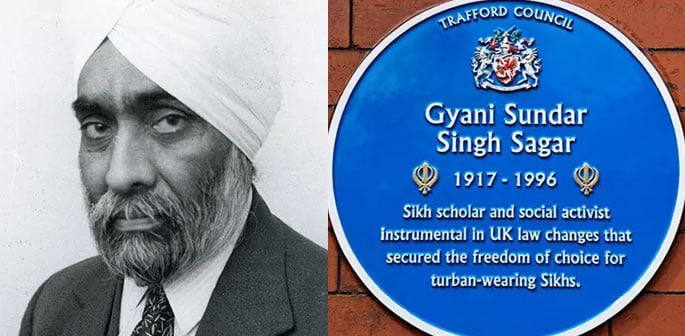
A blue plaque has been unveiled at the former Manchester home of Gyani Sundar Singh Sagar, whose campaigns helped secure landmark religious rights for Britain’s Sikh community.
Known as Gyani Ji, he played a pivotal role in advancing Sikh religious rights in the UK.
More than a century after his birth, Trafford Council unveiled the plaque at his former home, with members of his family attending the ceremony in recognition of his lasting contribution.
Born in Ghalotian Kalan, Punjab, now in Pakistan, Gyani Ji graduated with an honours degree in Punjabi language and literature before accompanying his father to England.
He made Manchester his home in 1948 and, after initially working as a freelance salesman, quickly became an influential figure within Greater Manchester’s Sikh community.
Using his education and diplomatic skills, he supported fellow immigrants and helped establish one of Europe’s earliest Sikh temples (gurdwaras) on Monton Street in Moss Side in 1953.
His work laid the foundations for a growing Sikh community while strengthening access to places of worship for future generations.
Gyani Ji is best known for his groundbreaking campaign to defend the right of Sikh men to wear turbans in the workplace.
In 1959, he was denied a job as a bus conductor because uniform regulations did not allow him to wear a turban.
Rather than accept the decision, he launched a determined seven-year campaign against Manchester City Corporation and trade unions.
Through petitions, advocacy and correspondence with public figures, he challenged misconceptions about Sikh identity and highlighted the longstanding tradition of turban-wearing in public service.
His campaign ended in a landmark victory in October 1966 when Manchester’s Transport Committee voted to allow turbans as part of the official uniform.
Gyani Ji continued campaigning for Sikh religious freedoms throughout the following decade.
As general secretary of the national turban action committee, he played a leading role in securing the Motor-Cycle Crash Helmet (Religious Exemption) Act 1976.
His acts of protest, including riding a moped without a crash helmet in defiance of the law, attracted national attention.
Despite being arrested and imprisoned, Trafford Council said his persistence ultimately led to lasting legal reform that benefited generations of Sikh motorcyclists.
Gyani Ji died in 1996 at the age of 79, but his contribution to religious equality continues to be recognised.
The unveiling of the blue plaque at his former home celebrates both his legacy in Greater Manchester and his wider impact on Sikh rights across the UK.
Councillor Eve Parker, Trafford Council’s executive member for leisure, arts, culture and heritage, said:
“It is a great honour to join the community in celebrating the life and legacy of Gyani Sundar Singh Sagar.”
“His courage, determination and unwavering commitment to equality not only transformed the lives of Sikh people in Trafford and Greater Manchester, but also helped shape a fairer and more inclusive society for all.
“This blue plaque serves as a lasting reminder of his remarkable contributions and the enduring impact of standing up for what is right.”