








































"this project records terraces as a safe space"
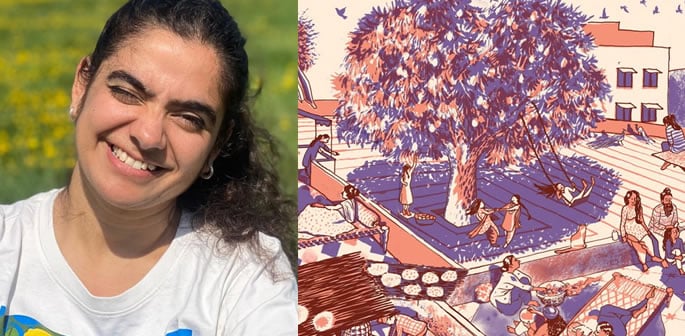
Anantjeet Kaur is an illustrator and designer from India whose work sits at the intersection of memory, culture and tactile image-making.
Trained in graphic design, she moved away from digital methods during her MA at Cambridge School of Art, developing a practice rooted in printmaking and hands-on processes.
Her work consistently explores themes of human connection, childhood curiosity and cultural identity, drawing on her Indian, Sikh and Punjabi heritage.
This focus culminated in Terrace Tales, a wordless screen-printed concertina book that captures the rhythms of life on Indian rooftop terraces and reflects a deeper search for belonging after moving to the UK.
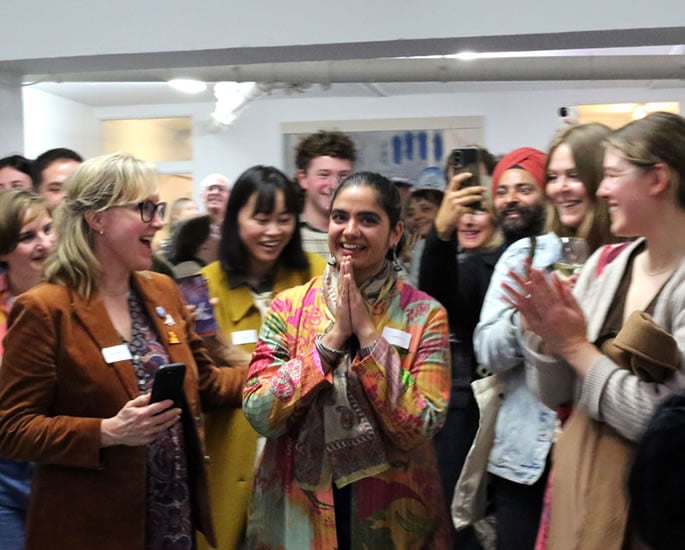
Recognised in the Book Illustration category of the 2026 Batsford Prize, the work positions her as an emerging voice in contemporary illustration.
In an interview with DESIblitz, Anantjeet Kaur reflects on the ideas, processes and personal histories that shaped the project.
Reclaiming a Disappearing Landscape
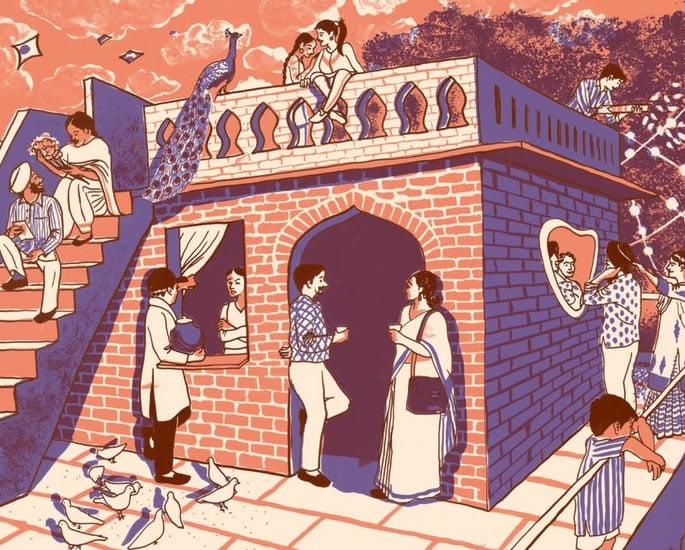
For Anantjeet Kaur, Terrace Tales began with a feeling of absence.
After moving to the UK, memories of the rooftop terraces that shaped her childhood in India became increasingly vivid. Those spaces, once woven into everyday life, became the foundation for a project that would later earn recognition at the Batsford Prize.
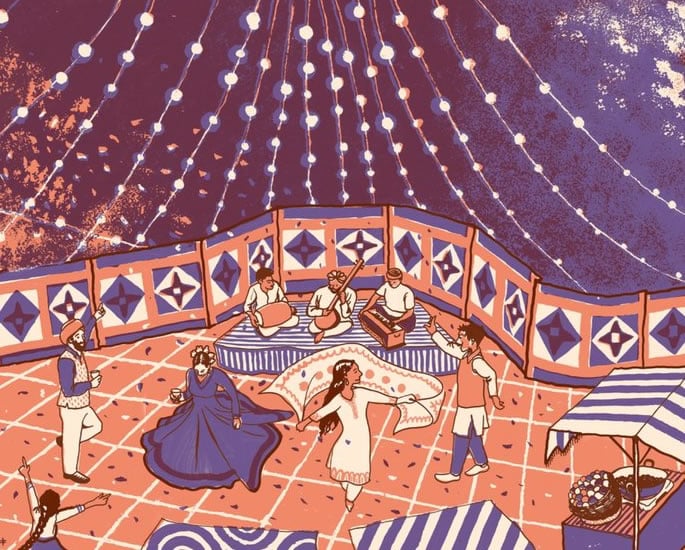
The wordless concertina book explores the social and cultural life of Indian rooftops through a continuous visual narrative.
Rather than relying on text, Kaur wanted the images to carry the story on their own:
“In the words of Mireille Fauchon and Rachel Gannon, ‘if you can show, don’t tell’.
“My idea of depicting the vibrant life on Indian rooftops did not need words to express.
“The visuals, as well as the absence of words, invite viewers of all ages and cultures to wander, revisit scenes and enter the rhythm of rooftop life at their own pace, in their own way, as an open and shared space for all kinds of interpretation.”
The decision reflects a wider tradition within visual storytelling, where meaning emerges through observation rather than explanation.
By removing language altogether, Kaur created a work that can be understood across cultures and generations, while encouraging viewers to build their own connections with the scenes.
The project itself emerged during a return trip to India, as she explains:
“I created Terrace Tales from a personal longing for the rooftop terraces of my childhood after moving to the UK.”
“Whilst on a trip to India, I began sketching these spaces to capture their overlooked nuances and the sense of freedom they offer.
“My initial ideas for the format explored many kinds of paper-folding, each intended to open out into a single image, but compositionally none of them felt right for what I was trying to communicate and given the time I had, the concertina format was the clearest solution.”
That search for the right format became central to the project. The structure needed to reflect both the physical continuity of rooftops and the interconnected experiences taking place across them.
Memory, Community and the Rooftop Terrace
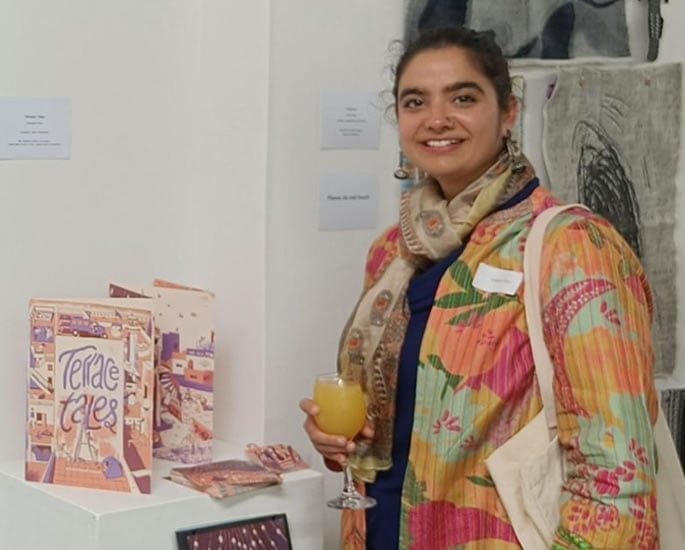
The scenes in Terrace Tales draw heavily from Anantjeet Kaur’s own experiences growing up in India.
She says: “I have surprisingly clear memories of sleeping at night on our own house terrace or at my grandparents’ house, especially on hot summer nights during power cuts.
“We would drop water balloons at unsuspecting passers-by during the Holi festival, watch neighbourhood kids fly kites or even play cricket across adjoining terraces, and participate in bonfires or family celebrations on the same rooftops.”
These memories capture how terraces functioned as extensions of the home. They were places for recreation, celebration, rest and social interaction. In densely populated cities, they offered rare pockets of openness while also strengthening community ties.
Yet Kaur has watched those spaces change dramatically over time.
“A few years later, the rooftops are silent, or have gone up several floors to accommodate the flat housing system. Nobody to enjoy them as communal spaces anymore.
“Shaped by observation, memory and imagination, this project records terraces as a safe space where play, community and solitude can coexist for people of all ages, celebrating a disappearing urban feature and my own longing for it.”
The project therefore operates on several levels. It documents an architectural feature, preserves personal memory and highlights broader shifts in urban living.
Migration also intensified Kaur’s relationship with these memories, as she says:
“Moving abroad suddenly changed my perspective on things back home, and made me appreciate all that we took for granted – the sun, the weather, the rain (or the blessed absence of it most of the year), the community, food, family, and spaces where we could come together or take a breather in. Creating something to celebrate all of it felt cathartic in a way.”
While Terrace Tales reflects a specific experience, it also speaks to a wider reality shared by many people living between cultures.
Visualising Connection through Form
The Batsford Prize theme was “Connections”, a concept that aligned naturally with Kaur’s interests as an artist.
She says: “Terrace Tales grew from the personal disconnect I felt after moving to a new country, and a desire to reconnect with something I felt slipping away.
“In a crowded culture like India’s, these spaces hold vital connections across age, time, and daily rhythms, and I wanted the work to honour that.”
The rooftop terrace becomes a visual metaphor for connection itself and Kaur extended that idea through the book’s physical design:
“The concertina format was therefore a deliberate choice to embody the theme materially.
“The illustrations open out into a continuous, wordless sequence – a flowing landscape of interconnected rooftops.
“The wordless format itself becomes a quiet connection: between scenes, readers and cultures.”
“Terrace Tales celebrates the connections these spaces make possible – across generations, across cultures, and between a disappearing urban feature and the communities it still shelters.”
The format was inspired by an earlier encounter with an artist’s book that challenged conventional approaches to narrative.
“Inspired by another book I came across in Korea, ‘Run!’ by Kawon, I wanted to create a book which was different from the usual.
“After a lot of exploration of different paper-folded formats, I settled on the concertina for the clarity and simplicity it offered to me compositionally as an artist, and practically to the viewer who could see the individual images in panels, open out to see the entire image, and exhibit it as an art object in their home.”
That flexibility allows the work to function simultaneously as a book, a sequence of illustrations and a standalone artwork.
“Readers can engage with individual moments or step back and experience the complete visual landscape.
Building a World through Printmaking
From the outset, Anantjeet Kaur wanted the visual experience of Terrace Tales to reflect the sensory intensity she associates with India.
She explains: “Right from the beginning, I wanted the drawing to involve tiny details and patterns and be visually intense, as India is in my mind.
“It also involved a fair bit of architectural drawing and perspective.”
Capturing the complexity of rooftop life required balancing visual density with clarity.
“But I was itching to make an entire project through printmaking, which forces one to use limited colours.
“My initial greyscale colour experiments in tetrapack drypoint were great, but the drawing was too ordered, and the textures too gritty for my taste. They needed rich colour.
“Plus using limited colour made the complexity readable without reducing detail. So I experimented with complementary colours till I was happy with the current scheme – reminiscent of many red sandstone buildings in Delhi.”
The final colour palette evokes both place and atmosphere. Rather than aiming for literal realism, it creates a visual identity rooted in memory and emotion.
Screen printing became the ideal medium for bringing those ideas together:
“What draws me most to screen printing is the combination of control and repeatability. The marks are predictable in a way other techniques are not.
“It means I can focus entirely on the drawing and colour decisions rather than fighting the process.”
“It also handles complexity without much effort – once the drawing is divided into different colour separations (called ‘positives’), intricate detail survives the process reliably, print after print.”
Yet Kaur is equally interested in the imperfections that emerge through the process, such as “slight registration shifts” and ink being “printed differently in each reproduction”.
That relationship between medium, structure and subject matter was ultimately recognised by the Batsford Prize judges.
Kaur says: “The competition theme was Connections, which was right up my alley. Both my masters stage projects at Cambridge School of Art express human connection, culture and community.
“I believe in this project the judges liked the connected nature of the format where the folded pages make sense on their own, but also open out into larger single images, how the colour layers are inextricably linked, bringing depth when they interact with each other and more importantly, that the scenes paint a euphoric world of people existing in harmony – by themselves and in company.”
The observation highlights the strength of Terrace Tales.
Every element, from the folding structure to the colour layers and rooftop imagery, works towards the same idea: exploring how people, places and memories remain connected, even across distance and change.
Terrace Tales stands as a carefully constructed exploration of memory, place and connection, translated through printmaking and an unconventional book format.
It brings together personal experience and technical precision to document a way of life shaped by shared spaces and shifting urban environments.
The project also reflects a broader artistic journey, where material process and cultural identity are closely intertwined.
Through this work, Anantjeet Kaur reinforces a practice rooted in observation and lived experience, while pointing towards a continued engagement with stories that bridge heritage and contemporary life.