








































"I’ve done the work to understand what actually happened to me."
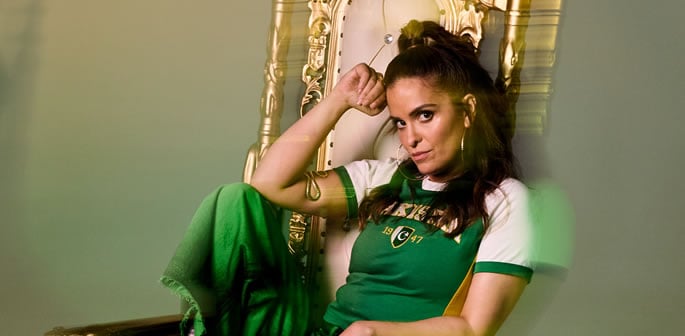
Nadia P Manzoor brings her deeply personal solo play Jerk Off! to audiences with a powerful exploration of abuse, grief, identity and the complicated ways relationships shape us.
The darkly funny production follows a British-Pakistani woman who enters the underground world of hip-hop in Boston after her mother’s death, where a relationship with a dancer transforms her understanding of love, power and survival.
Blending storytelling, comedy, movement and ritual, Jerk Off! examines how personal experiences, cultural expectations and unresolved grief can influence the choices people make.
Rather than presenting a simple story of harm and victimhood, the play explores the complexity of agency, vulnerability and the patterns that can keep people trapped.
Written and performed by the creator of Burq Off! and Shugs & Fats, the production draws on Nadia’s own journey of reflection and healing.
In an interview with DESIblitz, Nadia P. Manzoor discussed why she needed time to tell this story, how she transformed painful experiences into performance and the conversations she hopes Jerk Off! will create.
Understanding the Story before Telling

Nadia Manzoor has spent years carrying the story behind Jerk Off! before feeling ready to bring it to audiences.
The solo play explores abuse, family dysfunction, grief and identity, but for Nadia, telling it required more than revisiting painful memories.
On what made her ready to tell this story now, she says:
“Time. Distance. Maturity. Reflection. Motherhood.”
This was required to understand the experiences to shape the story, as she continues:
“I stopped breastfeeding my second baby after three intense and beautiful years of having literal life drawn out of my body, and for the first time, I had the energy to return to the stage.
“But beyond that, a story that is a personal one about abuse and family dysfunction requires a certain level of bravery and self-conviction.
“You have to be able to hold it with honesty and integrity. I can finally say I’ve arrived at that place.
“I’ve done the work to understand what actually happened to me.
“That took years and years of healing, of processing, of sitting with this story until I could find the deeper truth underneath it. Not just what happened, but why it happened: what in me, what in my life, created the conditions for it.
“When you’ve been abused, your gaze is naturally fixed on the other person. You’re trying to understand them, make sense of their behaviour, survive it. And it can take a long time to turn that gaze inward.
“But that’s where the real understanding is. That’s where the power is.
“I wasn’t ready to tell this story until I could see it clearly, until I could hold both the harm that was done to me and the deeper truth of my own experience with honesty.
“That clarity only comes with time.”
That process of understanding also changed how Nadia viewed the relationships at the heart of the play.
She explains: “For a long time, I understood it in a surface way: my mum died, I was young, I didn’t know how to grieve, and I ended up in this relationship.
“But sitting with the work over years, something much deeper revealed itself.
“I was carrying a huge amount of guilt after my mother died.
“And I think, on some level, I punished myself for that, by staying in a relationship that wasn’t good for me, by treating myself in ways that reflected how I felt inside.
“The relationship wasn’t random. It was an escape from grief, but it was also a kind of self-abandonment and punishment.”
Finding the Right Language to Tell the Story
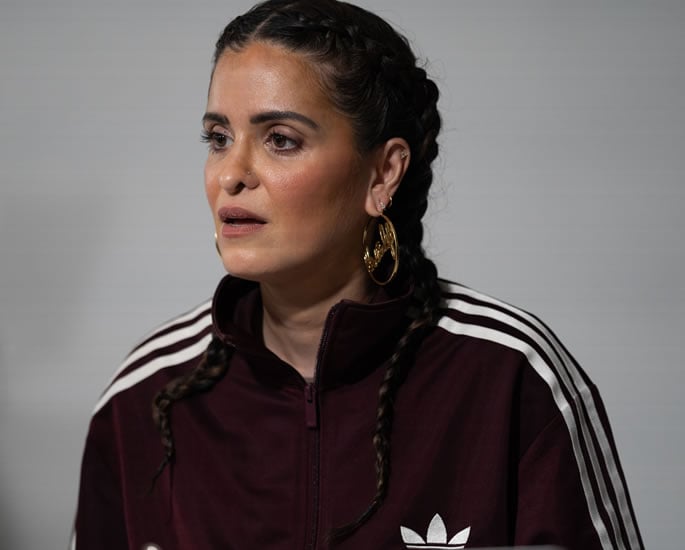
After understanding the story she wanted to tell, Nadia Manzoor also had to find the right form to express it.
Jerk Off! combines comedy, movement and ritual, allowing her to explore difficult experiences through the performance style that feels most natural to her.
This approach developed through her first solo play, Burq Off!, as she says:
“At this point, it feels like my natural language as a performer.
“With Burq Off!, my first solo play, I didn’t consciously think of what I was doing as ritual, but audiences kept describing it as an exorcism, as something spiritually cleansing. That stayed with me.
“Comedy, ritual, movement are how I live; they’re not separate from me. They’re how I process the world.
“So the form wasn’t a decision as much as a recognition. The way the show moves is very much how I move as a person and storyteller.”
That personal connection shaped the role hip-hop plays in the story.
According to Nadia, the culture represented a world that initially felt distant from her own identity, but eventually became a place where she felt accepted:
“It felt like entering another country, one that was everything I wasn’t. I felt awkward, out of place, like a loser. And that world was the opposite: confident, expressive, magnetic.
“The music, the style, the energy, it was intoxicating. I was completely pulled in.”
“But it wasn’t just aesthetic. Miguel, my dance teacher and boyfriend in the story, understood hip-hop and the dance community as a family where loyalty was everything.
“And there was something deeply comforting about that. I was able to belong.”
The play’s ability to move between humour and painful experiences is also central to Nadia’s storytelling.
When creating the play, one of the more challenging aspects was allowing serious moments to exist without immediately turning to comedy:
“My tendency with earlier drafts of the play was to lean into more humour.
“Actually letting the more serious themes sit and be experienced was harder for me… maybe because I’ve always used humour to avoid sitting with my own feelings!
“But I wanted to lean into the discomfort more, and not always offer humour as an escape.
“I think the humour in the pieces is more from the absurdity of the truth.
“But the duality of pain and pleasure in our lived experiences is very natural. Grief and humour sit side by side.”
Exploring Abuse beyond Simple Narratives
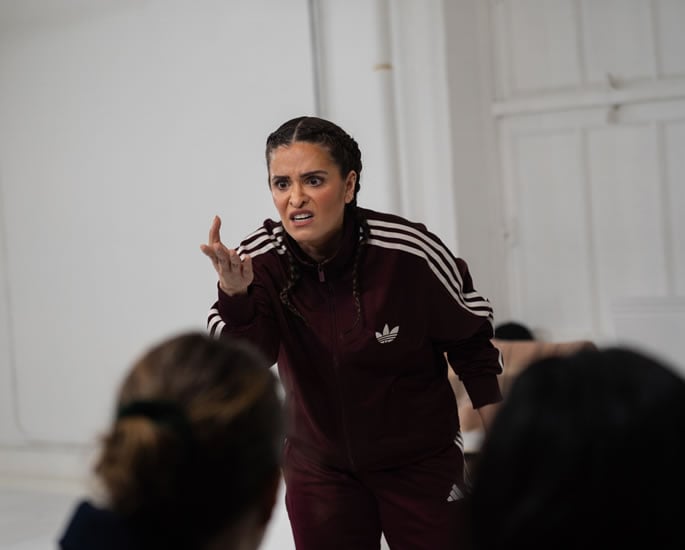
One of the most challenging aspects of Jerk Off! is the way it examines abuse without reducing the people involved to simple categories.
Nadia explains that she wanted to move away from narratives that present one person as entirely harmful and the other as entirely passive.
“Relationships are rarely clean, and I think we’ve become stuck in oversimplified narratives about abuse. They don’t move us forward; they keep us fixed in place.
“The idea that there’s a villain and an innocent person, good and bad, might feel satisfying, but it creates distance. It separates us. It reduces the so-called villain to something inhuman, and it reduces the victim to something passive. And I don’t think either of those things is true.
“We’re not passive in our own stories. And the people who hurt us are not one-dimensional.
“That binary way of thinking is actually dangerous because it stops us from really understanding what’s happening underneath these dynamics. It keeps everything external.
“I’m not interested in that. I’m interested in what’s alive in me. I’m interested in where those patterns exist in me, where the capacity for harm, control, or self-abandonment lives in my own body and choices.
“Because that’s where change actually becomes possible.”
This meant confronting uncomfortable parts of herself, as she admits it was initially difficult.
Nadia elaborates: “Because confronting the violence within yourself is painful.
“But I’ve done a lot of work to get to a place where I can acknowledge my own capacity for harm. I can be difficult, reactive, and cruel.
“If I only focus on the other person’s behaviour, I lose the opportunity to understand myself.
“And that’s not something I’m willing to do. I’m interested in truth, not self-protection.”
Conversations for Audiences

While Jerk Off! comes from Nadia’s own experiences, the themes explored in the play extend into wider discussions about family, culture and power.
She hopes audiences reflect on the ways certain behaviours and beliefs can become normalised over generations.
“There’s a deep conditioning, especially in South Asian communities, to not speak critically about where we come from. But without reflection, there’s no understanding.
“And without understanding, there’s no change.
“Many of us were raised in environments where love and harm coexisted. Being hit, being shamed was normalised. That doesn’t negate the love, but it doesn’t erase the harm either.
“I want this work to open up a deeper, more honest conversation about how power operates, and what it costs us when we refuse to examine it.”
Those conversations around power and identity are also central to what Nadia hopes audiences, particularly British South Asian women, take from the production.
She adds: “That many of the beliefs we’ve inherited about ourselves were designed to limit our power. And that’s not just for British South Asian women. The diminishment of women is structural and systemic.
“Growing up with conflicting ideas where protection and harm come from the same place can create deep confusion about love. It shapes how we see men, but also how we see ourselves.
“I want this show to be part of that larger conversation we’re all beginning to have.”
“The next part of the trilogy is Fuq Off!, and that’s about rejecting all the external voices that have told us how to live. It’s about unlearning, and stepping into our own authority.”
Through Jerk Off!, Nadia Manzoor examines the difficult intersections between love, loss, culture and power while using humour and performance to explore experiences that are often left unspoken.
The play’s honest approach challenges audiences to look beyond simple narratives and consider the wider influences that shape relationships and identity.
Jerk Off! will be performed from August 5-30, 2026, at Underbelly (Dairy Room) in Edinburgh as part of the Edinburgh Fringe.