




















































Employers who knowingly use illegal workers face prosecution
Immigration officers visited Raj of India in Stamford, Lincolnshire, in June 2026. Four people were arrested on suspicion of illegal working and the business was served with a civil penalty referral notice.
The owner could face a fine of up to £240,000, because penalties can reach £60,000 per worker. The visit was one of 282 in the East Midlands this year, which have produced 151 arrests.
The British curry house has long depended on a close-knit workforce.
Most “Indian” restaurants are widely reported to be run by British Bangladeshi families, and the Bangladesh Caterers’ Association has put the trade at around 12,000 restaurants.
That network has always relied on recruiting chefs and waiting staff from within the community and from Bangladesh itself. Owners say immigration rules have made that harder, while the Home Office says some businesses have turned to workers who cannot legally be employed.
Even with the intense scrutiny to prevent employing illegal workers, some UK Indian restaurants are still doing it. We delve into why this is happening.
The Many Raids

Officials visited The Silk Route, at West Strand Park in Preston, in June 2025 and found three people working illegally. A £90,000 fine was issued, later cut to £40,000, and it is still being challenged.
The restaurant says it was never notified of the original fine and so could not appeal in time. The Home Office is now asking Preston City Council to revoke its licence, saying management is not upholding its duty to prevent crime.
One worker told officers he had just started and was on annual leave from his Health and Care Work sponsor. He later admitted he had worked full-time at the restaurant for a year, Blog Preston reported.
The Blue Elephant in Ketley, Telford, has been raided twice. Each visit, in 2020 and 2025, led to the arrest of two illegal workers from Bangladesh.
The second raid brought a £40,000 fine, now under appeal. In April 2026, the Home Office told councillors the licence holder would have known his responsibilities and asked for the premises licence to be revoked.
Badsha Indian Cuisine in Tenterden, Kent, has been visited four times between 2015 and 2025, according to a Home Office report. Officers say they found illegal workers each time, and fines total £120,000.
During one visit, officials say a suspected illegal worker left through a window using a ladder. The owners dispute parts of the Home Office account.
In south-east London, officers found two men with no right to work at iNaga in February 2023. Director Mohammed Miah was later banned from acting as a company director for six years.
A restaurant still trades from the same address under a different company name, according to the government announcement.
A Humberside restaurant visit in early 2025 led to seven arrests and four detentions, the Home Office said. In King’s Lynn, Spice Inn lost its licence in October 2023 after a raid, and workers there were reported to be paid well below the minimum wage.
The Scale of Arrests

Between January and June 2026, Immigration Enforcement made 7,270 illegal working visits and 4,756 arrests. The Home Office called it the strongest start to a year on record.
Restaurants, takeaways and cafes were the most visited category, with 2,195 visits and 1,589 arrests. Both figures rose 31% in the same period in 2025.
Since July 2024, arrests on illegal working visits have passed 17,000, a 122% rise on the previous two years. Penalties worth more than £74 million were issued to over 1,200 businesses in the first half of 2026, according to Home Office data reported by IBTimes.
Fines for a first breach rose from £15,000 to £45,000 per worker in February 2024, and repeat breaches now carry £60,000. The government has also put £5 million into Operation Sterling, which targets takeaways, delivery riders and similar businesses.
The Home Office records visits by sector, not by cuisine. Indian restaurants feature in headlines because they are numerous, not because the figures single them out.
Then Why are the Owners Still Doing it?
Cheaper labour
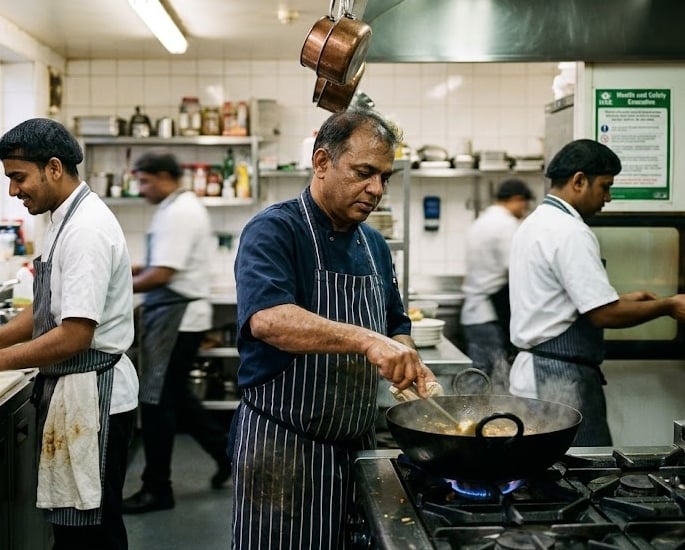
The main reason cited by officials is cost. A worker with no legal status has little bargaining power and may accept pay below the minimum wage.
In the Tenterden case, officials said two workers reported being unpaid, one receiving only food and travel costs.
In 2009, a curry house supplier said he could provide Bangladeshi staff for a fee, and nearly a third of 44 Bangladeshis found on one coach were suspected illegal immigrants.
Some were reportedly working 12-hour days for about £1.60 an hour in cash.
Cash payments and tax
Illegal working and cash-in-hand pay often go together. Wages paid off the books carry no PAYE or National Insurance, and leave no payslips for inspectors to check.
In the Preston case, the Home Office says one worker had been employed full-time for a year.
The Home Office describes illegal working as a way of undercutting honest businesses.
Staff shortages
Owners say the trade has struggled to recruit chefs legally. In 2008, as reported by NBC, the Bangladesh Caterers’ Association, which represents around 12,000 restaurants, once reported 27,500 vacancies against a workforce of about 90,000.
It blamed immigration rules introduced in 2005 that made it hard to bring unskilled workers from outside the EU. Owners also say Bangladesh has few catering schools that produce the skilled chefs the visa system requires.
Many in the industry backed Brexit expecting easier visas for South Asian cooks, Bloomberg reported at the time. They said that did not happen, and closures followed.
Visa conditions and weak checks
Not everyone found working illegally is an overstayer. Some hold visas that do not allow the work they are doing, or limit their hours.
The Silk Route case involved a worker linked to a care sponsor. The Ipswich fine followed a worker breaching conditions. The employer is legally responsible for checking documents properly.
Community ties
One explanation heard within the community is loyalty. A man with no papers turns up looking for work, and an owner from the same part of Bangladesh finds it hard to say no.
There is no published case showing an owner was found to have acted this way. The cases that do exist point to something looser.
At Jilabi, the licence holder said the men were on a trial shift and that he had left the document checks to someone else. That is informal hiring, not charity, and the law treats it the same way.
An employer who does not carry out right-to-work checks is liable whatever the relationship with the worker. Helping a countryman is not a defence.
What Owners Risk

A civil penalty can reach £45,000 per worker, or £60,000 for repeat breaches. That is enough to close a small restaurant.
Directors can be disqualified, as in the iNaga case. Employers who knowingly use illegal workers face prosecution and up to five years in prison.
Councils can also review or revoke alcohol licences, as in Telford, Preston and Birmingham. The Home Office publishes the names of penalised businesses in a public register.
Industry figures argue that enforcement can be heavy-handed.
They point to Preston, where the restaurant says it never received the first fine, and to Middlesbrough, where a penalty was overturned.
They also say a visa system that made hiring skilled chefs close to impossible helped create the problem. The Home Office says the law applies to everyone and that checking right-to-work documents is the employer’s job.
Several of the cases are still before the Home Office, councils or tribunals, so outcomes may change.
Ultimately, raids alone are unlikely to solve the problem of illegal working in Indian restaurants.
While enforcement operations can expose offenders and hold businesses accountable, they do little to address the wider conditions that allow exploitation and illegal employment to persist.
As long as demand for cheap labour, vulnerable workers and unscrupulous employers remain part of the equation, the cycle is likely to continue.
Tackling the issue requires more than surprise inspections and arrests; it demands sustained enforcement, stronger accountability and action against the networks that profit from illegal working.