




















































"Privacy is a choice; shame is the feeling that there's something wrong with you."
Most of us have a few parts of our lives we don’t discuss with our families. Plenty of Desi women would put their sex lives firmly in that category, and there is nothing wrong with that.
The harder question is understanding the cultural stigma beneath that silence: Is it a choice, or is it fear?
Lucy Beresford, a psychotherapist and broadcaster who spent years hosting the Sex & Relationships show on LBC, draws the line clearly.
In an exclusive interview with DESIblitz, she says:
“You have every right to keep your sex life private.
“But privacy is a choice; shame is the feeling that there’s something wrong with you for having these feelings in the first place.”
It is a short distinction, but it changes how we look at silence in South Asian communities.
A woman who chooses not to discuss her relationship over Sunday lunch is exercising discretion.
A woman who won’t book a GP appointment about painful sex, because she can’t bear the thought of saying the words out loud, is not exactly the same thing.
How Shame is Built in Desi Homes
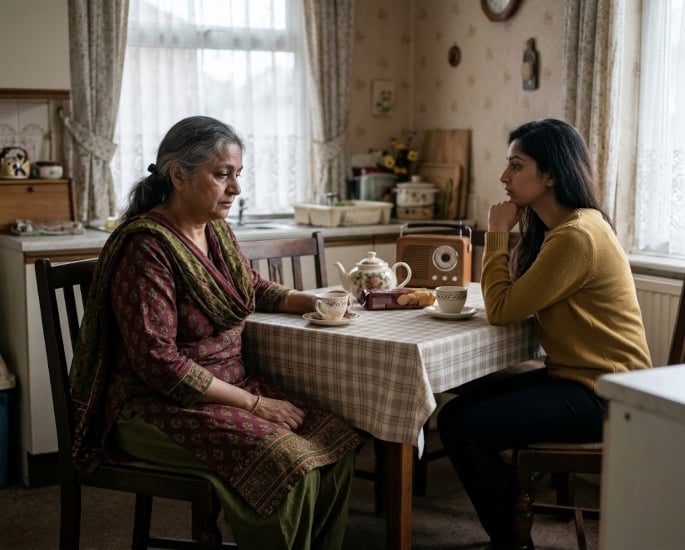
Shame rarely arrives all at once. Beresford says it tends to be taught gradually from a young age:
“A girl might grow up learning to protect her reputation, avoid being seen as forward and put other people’s needs first.
“She may then become a wife and mother without ever having a comfortable vocabulary for discussing what she likes, what she doesn’t like, or what she needs.”
The result is a woman who may be perfectly capable of speaking about sex but has never been given the words or the permission.
Beresford adds: “And if she has never seen women around her speaking openly about sexual pleasure, she may assume that her own questions are unusual or inappropriate.”
For many Desi women, the audience for that judgement goes well beyond a partner.
“The fear isn’t always simply, ‘What will my partner think?’ It can be, ‘What would my mother think? What would my community think? What would happen if someone knew I love sex?’”
What the Research Says

That fear has been studied.
A 2025 paper in Health Care for Women International, by Sabina Gerrard and Gill Thomson, explored how British-born South Asian women aged 18 to 25 in North-West England understood and experienced sexual health, and whether religion and socio-cultural factors influenced them.
The researchers used constructivist grounded theory, which builds conclusions from what participants say rather than testing a ready-made idea.
It is a small, qualitative study, so it describes experiences in depth and does not give percentages for a whole community. Its central idea is that women navigated shame in order to negotiate sexual agency.
Gerrard’s earlier doctoral research found that women place themselves on a continuum where shame and sexual agency are concerned. That matters because the women were not sorted into the ashamed and the unashamed.
Different women, and the same woman at different times, sat at different points on that spectrum.
This is exactly why it would be wrong to assume that a private woman is a secretly ashamed one.
The study also describes how women coped. They showed different levels of agency by finding ways to keep relationships secret and by working out how to reach healthcare services.
Three broad themes emerged: the influence of religion, culture and the community; maintaining a secret relationship alongside acculturation; and accessing sexual health services, advice and awareness.
Together they show women making careful, practical decisions rather than simply obeying or rebelling.
Gerrard’s work also explains why British-born women can feel pulled in two directions.
She notes that many South Asian religions stress that sex before marriage is forbidden and may limit information about positive sexual health, while British culture generally holds more permissive standards.
For a young woman raised in both, that can be a difficult balancing act. It is not a niche issue either, as South Asians are the largest ethnic minority group in the UK.
The Silence is Evidenced in Clinics

The consequences of the shame, stigma and silence show up in clinics.
A separate UK study interviewed South Asian women aged 18 and over about sexual health services, and found that limited knowledge of local services, stigma and shame, and worries about confidentiality were important barriers.
Participants found it hard to talk about their sexual health with anyone, and were often met with judgement and a lack of partnership from clinicians.
The authors concluded that South Asian women are uncomfortable accessing sexual health services and discussing their concerns with health professionals.
Worry about confidentiality is reasonable in communities where everyone seems to know someone who knows your mother. Some caution is not shame at all, but is a sensible response to the risk of being talked about.
The problem comes when that worry keeps a woman from treatment for pain, an infection or menopausal symptoms. At that point, privacy has stopped protecting her and started costing her her own health.
This research focuses on younger women, while Beresford’s interview is about women over 40. The two groups are not the same, and one cannot be used to predict the other.
Still, the patterns overlap in many ways. If a woman learns at 19 that sex is not to be discussed, there is no obvious reason that lesson would switch itself off at 45.
Why Midlife Makes It Matter More

Midlife is often when women most need to talk. Beresford says perimenopause and the menopause can bring vaginal dryness, discomfort or pain during sex, changes in libido, disrupted sleep and shifts in mood.
These are recognised parts of the transition, she says, “and help is available”. She is careful not to overstate it, adding that “menopause is not a switch that turns off a woman’s sexuality.”
Some women notice a drop in desire, some notice little change, and some feel more liberated.
In her view, what shifts is often willingness rather than wanting: “sometimes, what changes after 40 isn’t the desire itself. It’s a woman’s willingness to give that desire a voice.”
New research from Ashley Madison and YouGov suggests many women are ready to put their needs first.
Its Sexual Prime report found that 45% of female Ashley Madison member respondents said they reached their sexual prime at 40 or older, although members of a dating platform are not a representative sample of all women.
Separate YouGov polling of 2,182 UK adults found that 36% of women aged 45 to 54 said their pleasure had been prioritised throughout their relationship. The figure for women aged 25 to 34 was 42%.
Set beside the shame research, an important and relevant picture emerges. Many women in their forties and fifties have questions about desire and comfort, but may have spent decades without anywhere safe to ask them.
Telling Privacy and Shame Apart

Nobody can diagnose this from the outside, but a few questions based on Beresford’s distinction may help. Am I choosing not to share this, or do I feel I’m not allowed to?
Would I raise it with a doctor if I knew it would stay confidential? Do I feel something is wrong with me for wanting what I want?
If the honest answer is “I’m choosing”, that is privacy, and it needs no fixing. If the answers lean the other way, it may be shame, and it is worth testing gently.
Beresford suggests starting small:
“If you’ve spent years not talking about sex, you don’t need to go from silence to a major relationship summit overnight!”
She recommends getting comfortable with your own experience first, then perhaps sharing an article with a partner as a way in. From there you can build up to saying: “I’d love us to talk about the things you like and I’d love to tell you about my preferences too.”
With a doctor, she advises being specific:
“I’m going through changes in my sexual desire and/or comfort, and I’d like to understand whether perimenopause could be contributing and what my options are.”
You can mention dryness, pain, or changes in libido, sleep or mood, and ask whether a referral to a menopause specialist would help. Beresford’s point is that nobody should feel they have to endure discomfort in silence.
None of this means Desi women should talk about sex more publicly.
Beresford is explicit: “We don’t have to make everyone discuss sex publicly. Not everyone had to phone into my radio show!”
The aim is to make it possible for women to discuss concerns “safely with their partners, friends and healthcare professionals”.
A woman can keep her private life entirely private and still ask her GP a direct question.
She can also honour her family’s values without carrying every silence she was handed.
As Beresford puts it: “You can respect your family’s values without having to inherit every silence.”
Privacy is yours to keep. Shame is something that was handed to you, and you are allowed to put it down.