


















































“What inspired me was the lack of representation."
For years, Tanisha Zaman questioned whether spaces like beauty pageants had a place for someone like her.
As a British Bangladeshi Muslim woman, she grew up rarely seeing women who shared her identity represented in mainstream beauty spaces, shaping her determination to challenge the standards that made so many young women feel excluded.
Now a Miss Great Britain London 2026 finalist, youth activist, researcher and public speaker, Tanisha is using her platform to confront colourism, celebrate diversity and redefine what representation looks like.
Beyond pageantry, her work supporting working-class and South Asian young women has seen her advocate for confidence, leadership and inclusion.
In recognition of her community impact, she was awarded the SHE Award – Community Champion 2026, highlighting her commitment to creating meaningful change.
In an interview with DESIblitz, Tanisha Zaman reflects on her pageantry journey, why representation matters and how she hopes to inspire a new generation of young women.
Challenging the Lack of Representation in Pageantry
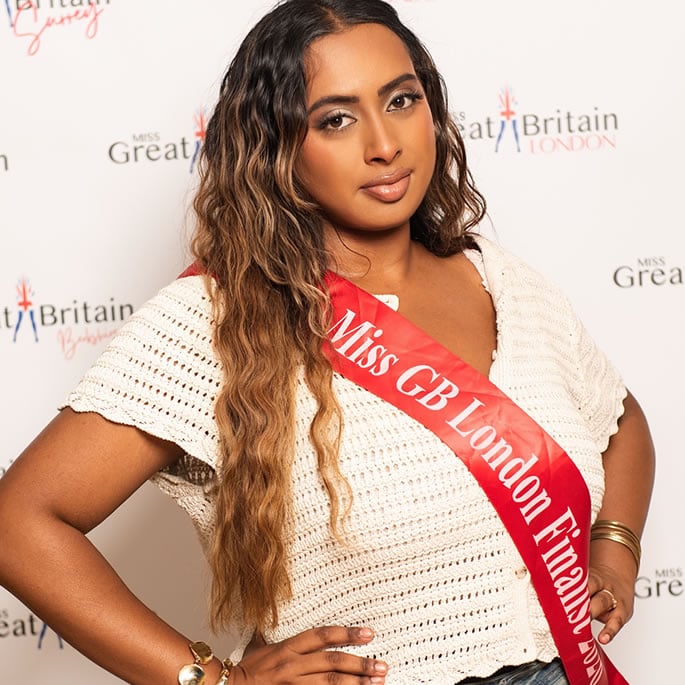
For many young women, seeing someone with a similar background represented in spaces they aspire to enter can influence whether they believe they belong there.
For Tanisha, the absence of British Bangladeshi and openly Muslim women in pageantry shaped her early perceptions of competitions like Miss Great Britain.
She says: “What inspired me was the lack of representation.
“Even when I looked at South Asian representation in pageantry, I didn’t see any British Bangladeshi women, nor did I see openly Muslim women.
“I never looked at a pageant stage and thought, ‘Someone like me belongs there’.
“Growing up, I genuinely didn’t think pageantry was for girls like me.”
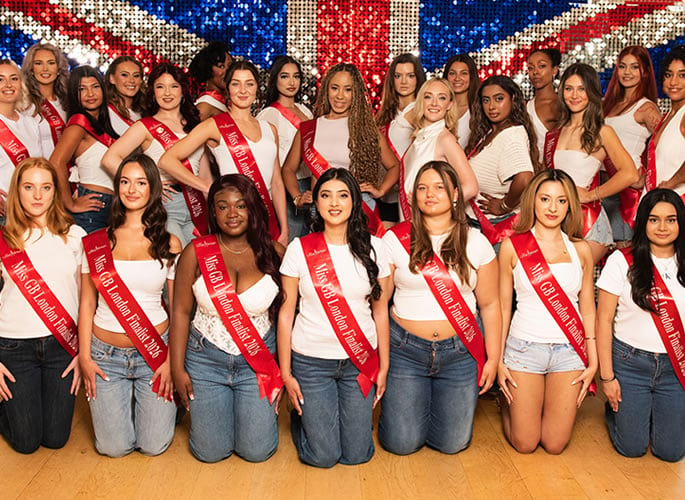
“Reaching the final means so much more than a title. To the best of my knowledge, I’m the only British Bangladeshi and openly Muslim finalist this year, and that’s something I’m incredibly proud of.
“If one young Bangladeshi or Muslim girl sees me and thinks, ‘Maybe I can do that too’, then this journey has already been worth it.”
For Tanisha, the competition provided an opportunity to open conversations about identity and belonging:
“For me, Miss Great Britain has never just been about a crown.
“It’s another platform to have conversations that matter, challenge stereotypes and show young women that they don’t have to change who they are to belong.”
While beauty pageants have historically faced criticism over limited representation, Tanisha believes competitions are beginning to reflect a wider range of experiences.
She states: “I definitely think Miss Great Britain is becoming more representative, and I want to acknowledge that.
“Last year’s Miss Great Britain London, Chanel, represented diversity in so many ways, and it’s encouraging to see competitions moving in the right direction.”
However, Tanisha believes representation must continue expanding to reflect the reality of diverse communities, as she admits:
“That being said, I don’t think we’re there yet. London is one of the most diverse cities in the world, yet that isn’t always fully reflected on stage.
“I’d love to see even more diversity in ethnicity, faith, body types and life experiences because that’s what London actually looks like.”
Colourism and Beauty Standards

Tanisha Zaman’s advocacy around representation is closely connected to her own experiences with colourism.
Growing up as a darker-skinned Bengali girl, she often felt excluded from both British and South Asian ideas of beauty.
She says: “Being a darker-skinned Bengali girl, I never really felt like I fitted either beauty standard.
“I didn’t fit the stereotypical British beauty standard with my black wavy hair, big brown eyes and South Asian features, but I also didn’t feel beautiful within South Asian beauty standards because of my skin tone.”
According to Tanisha, these experiences began from a young age.
She recalls: “I was one of the darkest people in my family growing up.
“At school I was called ‘khala’ by my peers, and even within my own family I’d hear comments telling me not to stay in the sun because I’d get darker or that lighter skin was prettier.
“People often brush those comments off as jokes or think they’re harmless, but they’re not when you’re a young girl trying to figure out who you are.”
These experiences affected how she viewed herself and her place within the community:
“Those comments have shaped me for life. They made me question my appearance, my confidence and whether I was ever enough.
“I don’t think people realise the long-term impact colourism has on a young girl’s identity.”
“What might seem like a passing comment can stay with someone well into adulthood.”
Highlighting how colourism can create feelings of exclusion, Tanisha continues:
“I was even questioned on whether I was really Bengali because of my skin tone, which made me feel out of place within my own community.
“The reality is that Bengalis are an incredibly diverse ethnicity.
“We come in every shade, and I think that’s something we should celebrate more kindly instead of making people feel like they don’t belong because of the colour of their skin.”
On evolving beauty standards, she says: “Beauty standards are constantly changing, especially with social media and now AI, but no girl should ever be made to feel less beautiful because of the skin she’s in.
“That’s exactly why I’m speaking about it today.”
Creating Conversations around Confidence, Faith and Ambition
Tanisha Zaman believes tackling colourism requires more honest conversations, particularly within communities where comments about skin tone can become normalised.
She details: “I think we need to start having much more honest conversations about it.
“Colourism is still normalised in so many families that people don’t even realise they’re doing it.
“Comments about staying out of the sun or someone getting ‘too dark’ are often said so casually, but they can have a lifelong impact.”
For Tanisha, addressing these issues starts with changing how young people are spoken to about their appearance:
“The biggest conversation we need to have is around kindness. We need to stop commenting on children’s skin tone altogether.
“Instead, we should be celebrating every shade and teaching young people that beauty isn’t determined by how light or dark they are.”
Her commitment to challenging assumptions also extends to how Muslim women are represented in traditionally viewed spaces.
During Miss Great Britain London 2026, Tanisha chose to wear a burkini instead of a bikini, a decision she says reflected her personal values:
“To me, being beautiful shouldn’t mean having to compromise my faith or my values.
“Choosing to wear a burkini was never about making a statement against anyone else – it was about showing that Muslim women belong in every space, including pageantry.
“I also wanted to challenge assumptions from both sides.
“Sometimes pageantry is seen as something Muslim women can’t be part of, while within some Muslim spaces people assume pageants and modesty can’t exist together.
“I wanted to show that both of those assumptions can be challenged.”
For Tanisha, empowerment comes from having the freedom to make personal choices without feeling pressured to fit expectations:
“Real empowerment is about choice.
“My choice was to compete while staying true to my faith, and I hope that encourages other young Muslim women to know they never have to choose between their identity and their ambitions.”
Beyond pageantry, Tanisha’s work with young women through mentoring has shown her how confidence can be affected by social pressures.
She believes social media has intensified comparisons around appearance, success and lifestyle.
“I think social media has completely changed the way young women see themselves.
“They’re constantly comparing their faces, bodies and lives to people online, many of whom are using filters, editing or cosmetic procedures.
“Filler and surgery have become so normalised that many girls feel they have to look a certain way before they even feel confident.”
Highlighting the wider pressures young people face, she says:
“At the same time, the world has become incredibly competitive.
“Whether it’s getting into university, finding a job or building a career, there’s constant pressure to be the best. When you combine that with unrealistic beauty standards, it’s no surprise that confidence suffers.
“Through my mentoring, I always tell young women that confidence doesn’t come from looking like someone else.
“It comes from recognising your own strengths and understanding that your background, your appearance or your postcode should never determine what you believe you’re capable of.”
Inspiring Future Generations
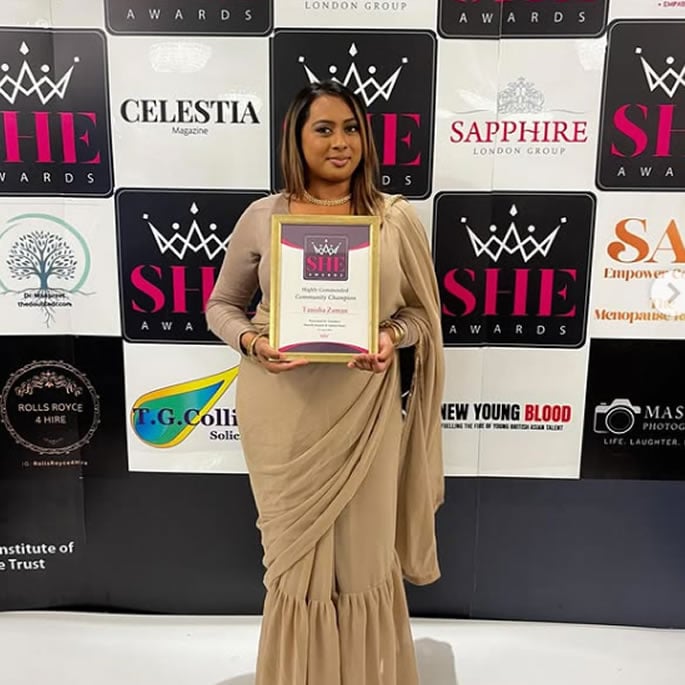
Tanisha Zaman’s advocacy has taken her to platforms including Times Radio, LBC and Parliament, experiences she says have transformed her confidence as a speaker and campaigner.
“Public speaking has completely changed my confidence.
“When I was younger, I was always opinionated, but I didn’t always have the confidence to use my voice.
“Saying yes to opportunities that scared me – whether that was speaking on Times Radio, LBC or in Parliament – has taught me that lived experience is just as powerful as statistics.”
Personal stories can help people understand the human impact behind wider social issues but leadership is not just about visibility, as Tanisha explains:
“It’s also taught me that leadership isn’t about being the loudest person in the room. It’s about making sure the people who aren’t usually heard finally have a seat at the table.
“Every opportunity I’ve had has made me even more determined to keep advocating for working-class young people and communities that are often overlooked.”
She also wants young South Asian women who face pressure between cultural expectations and personal ambitions to understand that they do not have to compromise their identity.
“If everyone agrees with everything you’re doing, you’re probably not pushing any boundaries.
“Staying inside your comfort zone might feel safe, but over time it keeps you stagnant. That stagnation can turn into regret, and eventually bitterness.”
“You don’t have to choose between your culture, your faith and your ambitions. Find your own voice, because no one else can tell your story the way you can.
“The people who matter will respect you for being authentically yourself.”
Looking ahead, Tanisha hopes her pageantry journey helps create a future where greater representation is no longer viewed as unusual.
She says: “I hope that one day a British Bangladeshi Muslim woman entering a pageant won’t even be considered news.
“I hope we reach a point where young girls aren’t told to stay out of the sun because they’ll get darker, where they don’t question whether they’re beautiful enough because of their skin tone, and where nobody feels like they don’t belong in their own community because they don’t fit one narrow idea of beauty.
“For me, this journey has never been about being the most beautiful girl in the room. Even if I’m not, I’ve never felt the need to dim my spark again.
“For so many years I questioned whether I was enough, but I’ve realised my worth isn’t defined by somebody else’s standard of beauty.”
She hopes young women from underrepresented backgrounds see identity as a strength rather than a barrier:
“More than anything, I want young women – especially those from working-class, British Bangladeshi and Muslim backgrounds – to know that their identity is never something they have to overcome. It can be their greatest strength.
“If one young girl looks at my journey and realises she doesn’t have to change who she is to chase her ambitions, then that will always mean more to me than any crown.
“My goal has never been to represent just myself – it’s been to make the path a little easier for the girls who come after me.”
Tanisha Zaman’s journey is a reminder that representation is not simply about being seen; it is about creating the belief that others can follow.
From confronting colourism to challenging assumptions around faith, beauty and ambition, she is using every platform available to make conversations that have often been overlooked impossible to ignore.
Her path to the Miss Great Britain London final reflects a wider commitment to ensuring young women do not feel pressured to change who they are in order to succeed.
Through her advocacy, mentorship and public voice, Tanisha is helping to create a future where identity is recognised as a source of strength rather than a barrier.