

















































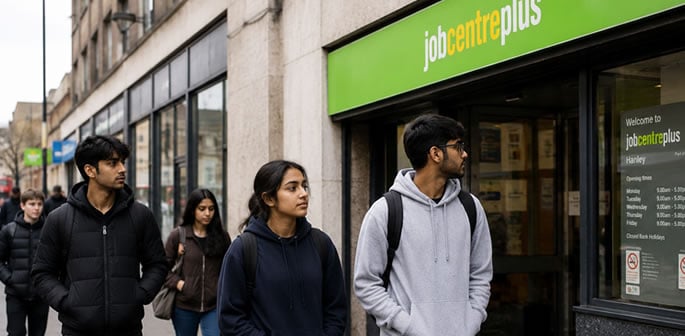
“This is not simply a crisis affecting a small minority."
Young people in England are losing confidence in their future prospects, with new research linking the trend to rising fears of long-term unemployment, inequality and worsening mental health.
The decline is most visible among 16- to 21-year-olds, who are now less likely than they were a decade ago to believe they will succeed in life.
According to the Institute for Public Policy Research (IPPR), young Brits are becoming less optimistic about their futures, with data showing a steady erosion in trust that hard work leads to security and opportunity.
The think tank argues this shift is not limited to a small group, but is happening across regions, genders and social backgrounds.
The findings come as more than 1 million 16- to 24-year-olds are now not in education, employment or training (NEET), a milestone not reached in over a decade.
Confidence in Opportunity is Falling

Belief in fairness and opportunity has weakened sharply among younger age groups.
Based on 100,000 respondents, just one in four 16- to 29-year-olds agrees that “everyone has a fair chance to go as far as their talent and hard work will take them”.
This compares with 35% of 50- to 69-year-olds and more than 40% of over-70s, highlighting a clear generational divide in outlook.
5 Facts about the Youth Unemployment Crisis
- 24% of young people believe they have a good chance of succeeding in life.
- Over 1 million 16- to 24-year-olds are now not in education, employment or training.
- Young people who fear long-term unemployment in their lifetime has more than tripled.
- A £2.5 billion youth support package is being brought forward to help almost 1 million young people.
- Youth job losses have led to a surge in anxiety and depression.
The shift is also visible in how young people assess their own futures.
In the Understanding Society survey, the share of 16- to 21-year-olds who rated their chance of future success at 20% or less rose from 2% in 2015-17 to 6% in 2023-25.
At the same time, the proportion who believe they face an 80% or higher chance of long-term unemployment more than tripled to 7% over the same period.
IPPR argues this is not a marginal trend.
Ellie Harris, IPPR’s head of children and young people, said:
“This is not simply a crisis affecting a small minority. Confidence is falling across England, across social groups, and across genders.
“Young people are telling us clearly that the deal no longer adds up. For too many, the promise that hard work will lead to security and opportunity no longer feels credible.”
Factors reshaping Outlooks

The report links declining confidence to a combination of long-term economic and social pressures.
It points to the mid-2010s as a turning point, when austerity began to take effect more visibly, online environments became increasingly shaped by algorithms, and youth mental health began to deteriorate.
It also suggests that young people may be responding rationally to their environment, rather than becoming more pessimistic without cause.
Rising housing costs, unstable work and higher youth unemployment are all identified as factors shaping expectations about adulthood.
Mental health plays a central role in the findings.
The IPPR estimates that as many as four in 10 women and three in 10 men aged 16 to 24 experience poor mental health.
Among those affected, only 24% believe they have a good chance of succeeding in life, compared with 48% of those without mental health challenges.
The report warns this matters beyond individual wellbeing.
It argues that lower confidence in future opportunity can reduce participation in education and work, while also weakening long-term economic productivity by discouraging saving, training and career progression.
Policy concern has grown alongside these trends.
The number of 16- to 24-year-olds classified as NEETs has now passed 1 million, prompting warnings about long-term exclusion from the labour market.
Former Labour minister Alan Milburn is currently leading a government review into the issue.
In an interim report, he warned Britain risks a “lost generation” and could see NEETs rise by 25% to 1.25 million by 2030 without intervention, signalling that welfare reforms may be part of any solution.
What is the Government’s Response?

The government has set out plans aimed at addressing youth unemployment and opportunity gaps.
A spokesperson said:
“We recognise too many young people have been locked out of opportunity.”
“That’s why we are bringing forward a £2.5 billion youth employment support package to help almost 1 million young people either earn or learn.
“We are also expanding youth hubs to every corner of Great Britain to provide crucial skills, job and housing support for the future generation.”
The IPPR’s research forms part of its wider “State of a Generation” project, supported by the Youth Futures Foundation, Big Change and McDonald’s.
The data points to a consistent decline in confidence among young people in England, driven by economic pressure, mental health challenges and weakening belief in social mobility.
While government intervention is increasing, the findings suggest the underlying trust in opportunity has already been significantly eroded.
The central question now is whether policy responses can rebuild the expectation that effort leads to meaningful progress in modern Britain.