



































"I watched the women in my family cook every day"
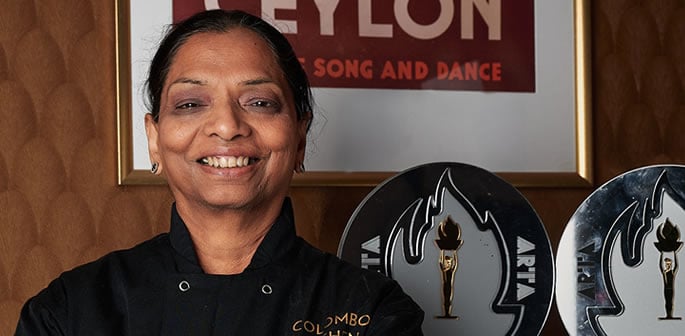
Sylvia Perera has emerged as one of the most influential voices in bringing authentic Sri Lankan cuisine into London’s mainstream dining landscape.
As founder and Executive Chef of Colombo Kitchen, she has built a reputation rooted in heritage cooking, disciplined technique and an unwavering commitment to tradition.
Her journey spans decades, beginning in Kurana, near Negombo, where family kitchens and generational knowledge first shaped her understanding of food.
After moving to the UK in 1984, she navigated a culinary landscape where Sri Lankan food had little visibility, gradually introducing it through catering, street food and, later, structured restaurant spaces.
Today, her work is recognised at the highest levels of British Asian enterprise, with major industry accolades highlighting both her influence and cultural impact.
In an interview with DESIblitz, she reflects on the experiences, decisions and philosophy that have defined her path from home cook to award-winning chef.
From Kurana Kitchens to Colombo Kitchen’s Foundations
Sylvia Perera’s approach to cooking begins far from London’s restaurant scene, rooted instead in the domestic kitchens of Kurana, Sri Lanka.
Long before she built a culinary identity in the UK, she absorbed cooking as something lived.
The chef explains: “Everything I do in the kitchen really goes back to growing up in Kurana. I watched the women in my family cook every day, and they never followed recipe books.
“It was all memory, instinct, and this kind of inherited skill you pick up just by being there.”
That environment defined her understanding of food as a relational act, tied closely to care and responsibility within the family unit.
Her aunt played a central role in that development through participation and example.
“My aunt Nanda was the biggest influence. She spent hours cooking for all six of us kids, and when I was old enough, she let me join in.
“She showed me that cooking isn’t just about food. It’s love, it’s care, it’s looking after the people around you.”
“That belief is the heart of what I do at Colombo Kitchen.
“Every time I cook, I still feel like that kid in Kurana, just hoping I’m doing justice to what Nanda showed me.”
Entering the UK Food Scene
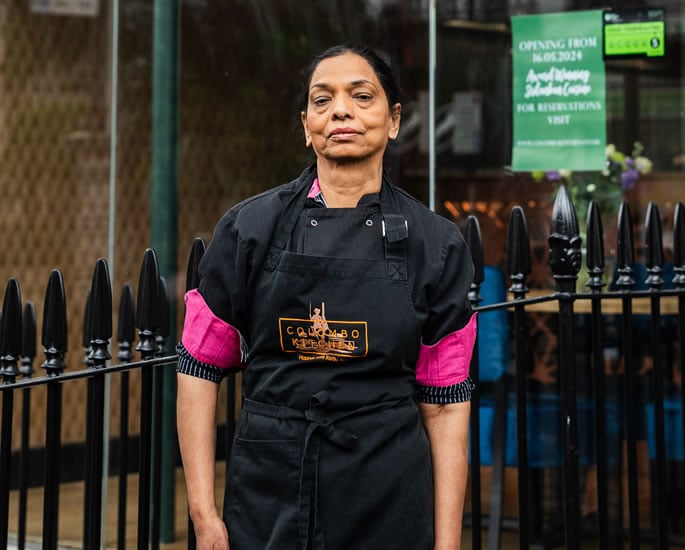
When Perera arrived in the UK in 1984, Sri Lankan cuisine had little to no visibility in the mainstream dining scene.
The dominance of Indian and Chinese restaurants meant that most diners had no reference point for her food, often placing it into broad or inaccurate categories.
She recalls: “When I moved to the UK in 1984, nobody really knew anything about Sri Lankan food. You saw Indian and Chinese restaurants everywhere, but Sri Lankan food? It just wasn’t on people’s radar.”
Her early years in Britain were focused on family life while cooking remained largely in private spaces. Yet even in informal settings, her food consistently generated curiosity and strong reactions from those unfamiliar with it.
Perera says: “For a while, I wasn’t cooking for a living. I was raising four children and settling into life here.
“But whenever I cooked for friends or family, their reaction was always the same: they’d never tried anything like it.”
A recurring challenge was the tendency to collapse Sri Lankan cuisine into neighbouring South Asian food cultures, rather than recognising its distinct identity.
“People would ask if it was just another version of Indian cuisine. I’d always say no, it’s unique, its own thing.”
Over time, exposure and repetition shifted perceptions.
Once diners engaged with the food directly, assumptions tended to dissolve, replaced by repeat interest and word-of-mouth momentum.
That laid the groundwork for later commercial ventures, but also reinforced the importance of visibility and clarity in presenting Sri Lankan cuisine on its own terms.
The Kottu Kart Breakthrough
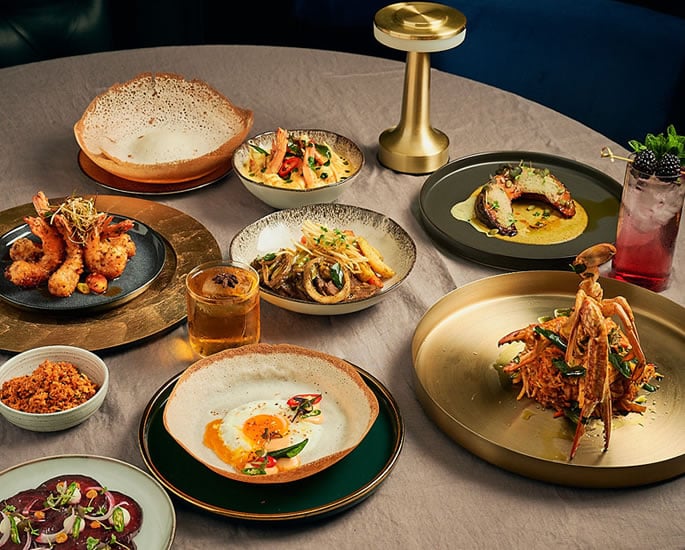
Sylvia Perera’s culinary development was shaped by two parallel tracks: informal family learning and formal professional training in Australia, with the latter providing structure and technical grounding to what had previously been instinct-led practice.
She explains: “Training in Australia gave me the technical backbone I needed.
“Before that, I was just doing what I’d learned by watching my family; it was all instinct. Studying formally let me understand the science behind what I already did and gave me the confidence to lead a team in a professional kitchen.
“But I never wanted technique to erase authenticity. Both have to work hand in hand, and I think that balance is what makes Colombo Kitchen stand out.”
That balance became increasingly important as she moved into public-facing food ventures, particularly the Kottu Kart stalls in Central London.
Positioned in areas like Piccadilly and Canary Wharf, they served as a direct testing ground for British diners’ response to Sri Lankan street food.
Perera continues: “The Kottu Kart stalls in Piccadilly and Canary Wharf were game-changers for me.
“I needed honest feedback from real customers, not just people who love you and would never criticise your food.
“The response blew me away. The queues were always long; people brought their friends back week after week.”
“Turns out, British customers are much more adventurous than people think. They’re curious, and when the food’s authentic and tastes good, they’re all in.”
Spice levels, often presumed to be a barrier for British audiences, became another point of learning.
Perera says: “Folks would finish a spicy kottu and come right back for more chillies, more heat.
“It taught me there’s a real appetite for bold flavours – you just have to give people a chance.
“That proof gave me the push to take the next big step. The Piccadilly stall is still there, and it makes me proud every time I see it.”
That phase marked a shift from informal experimentation to structured ambition, laying the commercial and cultural groundwork for Colombo Kitchen.
Building Colombo Kitchen
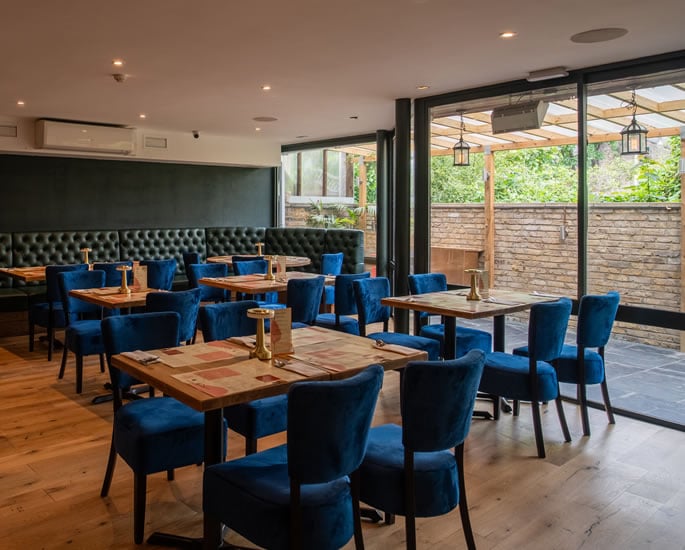
The decision to open Colombo Kitchen in Worcester Park at the age of 60 marked a turning point in Sylvia Perera’s career.
She says: “Opening Colombo Kitchen at 60 was a big leap, but I knew it was time to risk it.
“The market stalls showed me people genuinely loved my food, and I realised if I didn’t do it then, I never would.”
Her confidence was shaped by years of balancing family life, work and informal catering. That long-term resilience translated into the demands of running a restaurant, as she admits:
“Running a restaurant is tough; it’s relentless, always something going on, but hard work never scared me.
“I spent decades raising a big family and working long hours, so I knew I had the resilience. Sure, I doubted myself sometimes but you have to trust your instincts. I’m glad I did.”
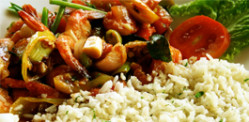
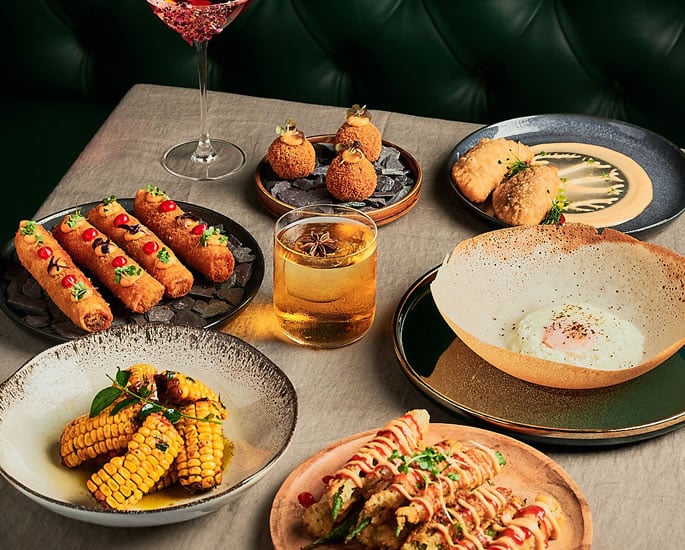
At the centre of Colombo Kitchen is a firm commitment to culinary authenticity, particularly in dishes such as hoppers, Jaffna crab curry and lamprais.
“Authenticity means everything to me. It’s the foundation of Colombo Kitchen.
“There are plenty of places in London doing fusion and modern takes, but that’s not my goal.
“I wanted to bring the true flavours of Sri Lanka to new people, and to give the Sri Lankan community a taste of home.”
That commitment extends beyond technique.
“When someone says a dish tastes exactly like what their mum made, that’s the best compliment I can get.
“Recipes like lamprais and Jaffna crab curry carry so much history; I feel a big responsibility to keep them true. Nanda’s recipes live on through my cooking, and that’s important to me.”
Her visibility was amplified by honours such as receiving the Culinary Innovator of the Year Award at the Asian Who’s Who Awards 2026, and being included in the prestigious British Asian POWER 100 annual list.
“Being named Culinary Innovator of the Year really matters; I can’t pretend otherwise.
“It still feels strange to go from a young woman in Kurana, or a mother working hard for her kids, to standing in a room getting an award like that.
“Getting onto the British Asian POWER 100 list is huge.
“I hope people see that Sri Lankan cuisine deserves a solid place in London’s food world not just as a novelty, but as a deep and rich tradition like any other.”
Across her restaurants in Worcester Park and Putney, the challenge now lies in maintaining consistency while responding to a fast-moving London dining landscape.
Perera says: “Honestly, none of this would be possible without my staff. They’re incredible people who really believe in the values and standards I set.
“They get what Colombo Kitchen stands for, and it shows in how they treat every customer. I’m proud of them, and I’m so grateful. They’re the backbone of everything.”
Customer response remains a key measure of success. For Perera, recognition from diners carries more weight than external validation, as she adds:
“We’re especially proud that customers tell us, over and over, Colombo Kitchen is the best Sri Lankan restaurant in London. I don’t say that lightly; it comes from the people we serve, and that’s what matters most.
“It tells me that sticking to our roots and aiming for a truly great experience is the right way. Authenticity never goes out of style.”
Sylvia Perera’s journey reflects a long-term commitment to preserving culinary heritage while adapting to a competitive and evolving London food scene.
From early family influences in Sri Lanka to formal training and street food experimentation in the UK, each stage has contributed to the development of Colombo Kitchen’s identity.
Her restaurants in Worcester Park and Putney now operate as established spaces for authentic Sri Lankan cooking, balancing tradition with the expectations of a diverse urban audience.
Recognition through major awards and industry listings has amplified her visibility, but the foundation of her work remains rooted in consistency, cultural integrity and community response.
As Colombo Kitchen continues to grow, her focus remains firmly on maintaining authenticity while strengthening awareness of Sri Lankan cuisine within the UK’s wider culinary landscape.