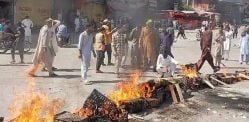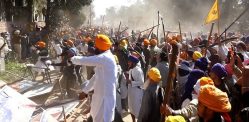

















































Protests linked to the group have resulted in significant violence
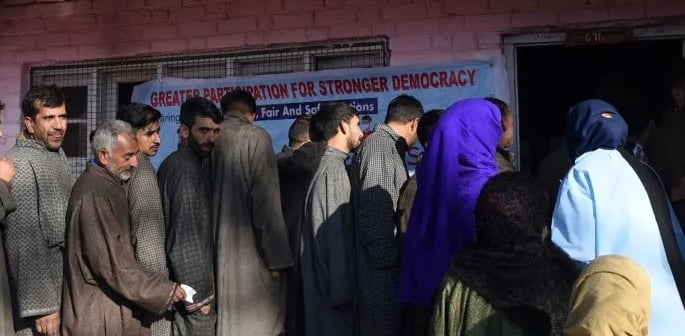
Voting has begun in the final phase of Pakistan-administered Kashmir’s Legislative Assembly elections, with only four constituencies going to the polls after unrest forced seven other contests to be postponed.
More than 460,000 registered voters are eligible to cast their ballots across over 800 polling stations in Bagh and Haveli districts.
Polling opened at 8 am local time and is scheduled to close at 5 pm.
The elections are taking place amid months of political unrest and protests across Azad Jammu and Kashmir (AJK).
The Jammu Kashmir Joint Awami Action Committee (JAAC), a local pressure group, has called for an election boycott.
The group has been campaigning against 12 legislative seats reserved for displaced Kashmiris living elsewhere in Pakistan.
The JAAC was banned by authorities in June under anti-terrorism laws.
Protests linked to the group have resulted in significant violence, with residents and rights groups reporting more than 50 deaths.
The government has not confirmed that figure, but said at least seven police and paramilitary personnel were killed.
Seven constituencies have been removed from Monday’s vote because of security concerns.
Five of those constituencies are in Poonch, while two are located in Sudhnoti district.
Officials are expected to announce new polling dates for the postponed constituencies in the coming days.
The final phase includes several high-profile political contests.
AJK Prime Minister Faisal Mumtaz Rathore, a member of the Pakistan People’s Party (PPP), is defending his seat in Haveli.
Meanwhile, Bagh is seeing a contest between two former prime ministers.
Sardar Tanveer Ilyas of the Istehkam-e-Pakistan Party is competing against Sardar Attique Ahmed Khan of the Muslim Conference.
Monday’s voting marks the conclusion of a three-phase election for the 53-member Legislative Assembly.
The first phase took place in Mirpur division on July 27.
The Pakistan Muslim League-Nawaz (PML-N), which governs Pakistan, won nine of the division’s 13 seats. The PPP secured the remaining four seats.
The second phase took place on August 2 across the Muzaffarabad division and 12 refugee constituencies across Pakistan. The PML-N won 15 seats during the second phase, while the PPP secured six.
Turnout has remained lower than previous elections.
Election authorities recorded 46 per cent turnout during the first phase and 53 per cent during the second phase.
Both figures were below the more than 60 per cent turnout recorded during the 2021 and 2016 elections.
The scaled-back final phase highlights the continuing political and security challenges facing Pakistan-administered Kashmir.
Poonch division has remained a major centre of opposition to the regional government and the electoral system.
The region has also experienced an intermittent internet shutdown lasting more than 50 days.
Authorities have additionally restricted international media access to Pakistan-administered Kashmir.
International reporters were reportedly instructed to leave the region and obtain government clearance before returning.
The restrictions have raised concerns about independent reporting during a politically sensitive election.
For voters, Monday’s poll represents the final opportunity to influence the composition of the regional Legislative Assembly.
However, the postponed constituencies mean the complete election result will not be settled until those seats are contested.
The outcome could shape the political direction of Azad Jammu and Kashmir following months of protests and growing public dissatisfaction.
The election is also being closely watched by Pakistan’s political parties, particularly the governing PML-N and opposition PPP.
As polling continues, security remains a central concern across the affected districts.
The postponed contests are expected to determine the final balance of power once voting eventually resumes.