

















































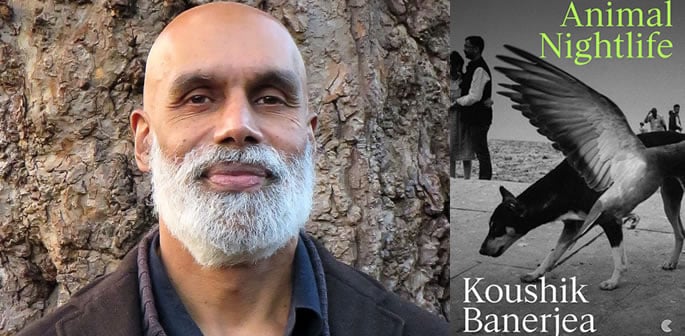
“Everybody’s looking for somewhere they can call home"
Koushik Banerjea’s Animal Nightlife is a genre-defying exploration of race, identity and belonging in a Britain shaped by migration, inequality and social division.
Released on July 9, 2026, the novel presents a “kaleidoscopic portrait” of contemporary Britain through the experiences of those who find themselves viewed as outsiders.
Following lifelong friends Vikram, Ravi and Sean, the story imagines a world where some people exist as hybrid human-animal forms while confronting questions about difference, acceptance and power.
Set against a backdrop of rising prejudice, economic uncertainty and social unrest, the book examines how communities respond when ideas of belonging become increasingly contested.
Banerjea draws on his own experiences of growing up in south London to explore the complexities of immigrant identities and the forces that shape modern Britain.
In an interview with DESIblitz, Koushik Banerjea discusses the personal experiences behind Animal Nightlife, the importance of community and why more nuanced stories about identity are needed.
Exploring Race, Identity & Belonging in Modern Britain

Koushik Banerjea’s Animal Nightlife explores what happens when questions of identity and belonging become shaped by conflict, exclusion and political division.
The novel examines how communities are defined by those in power and how ideas of who belongs can become a source of tension.
Rather than treating belonging as something straightforward, Banerjea explores the uncertainty many people experience when their identities exist across different cultures, places and histories.
Banerjea says the novel was shaped by his concerns about how ideas of belonging are used to separate people rather than bring them together:
“Everybody’s looking for somewhere they can call home, especially in an unstable, fractured world.
“We see this constantly all around us, in the claims being made, particularly by unscrupulous politicians and their backers, about who ‘really’ belongs and who doesn’t.”
He believes discussions about outsiders have become more explicit in recent years, with political debates often focusing on division rather than addressing deeper social concerns.
“In the past, they might have stopped short of actually naming who they believed were outsiders, or interlopers.”
“But more recently, and especially since the Brexit vote and the rise of Trump Stateside, no such embarrassment exists anymore.”
These tensions became central to the creation of Animal Nightlife, as Banerjea explains:
“Communities, cultures, and regions have been pitted against one another in a dismal zero-sum game which nonetheless performs the very useful function (for those in power) of diverting the masses’ anger away from oligarchs’ yachts and instead towards small boats.
“I found those manifold hypocrisies increasingly hard to ignore, and by turns they found their way into the raw material for Animal Nightlife.”
How London shaped the Characters

At the centre of Animal Nightlife are Vikram, Ravi and Sean, three friends from south London whose experiences force them to question where they fit within society.
Although the characters’ journeys are fictional, Banerjea drew on his own childhood experiences of growing up in London during a period of major social change.
He recalls: “Growing up in the 1970s and 1980s, London looked and felt like a very different city to how it is today. It was grey and much more derelict.
“Kids still played on bombsites and in abandoned buildings, and in an age which was still largely analogue, there was little CCTV and no mobile phones, so many of my recollections from that time were of roaming around, largely unmonitored, with a freedom that kids today could only dream of.”
However, that freedom existed alongside hostility towards minority communities.
Banerjea continues: “It could be very dangerous, though, especially for Asians.
“Racial attacks and murders were commonplace, and the National Front was active in our area. So you were reminded of your ‘difference’ even when all you wanted to do was blend in.”
Those experiences contributed to the sense of restlessness that runs through Vikram, Ravi and Sean’s stories.
“I remember being very young, say eight or nine years old, and kids singing ‘You’re going home in a London ambulance’ to me; and the teachers laughing.
“So yeah, you felt your difference, and it sparked a fierce longing within me to escape that bit of London, which is a little ironic, seeing as though to this day I only live in the neighbouring borough.”
For Koushik Banerjea, the important connection between himself and his characters is that they share a willingness to question the world around them.
“But the restlessness I felt, that’s there fluttering away throughout the book with Vikram, Ravi and Sean.
“The key thing is, whatever else their life journeys involve, they themselves are not static in their thinking. They have questions, even if they don’t always find the answers they’re looking for.”
Hybrid Identities to Challenge Ideas of Difference
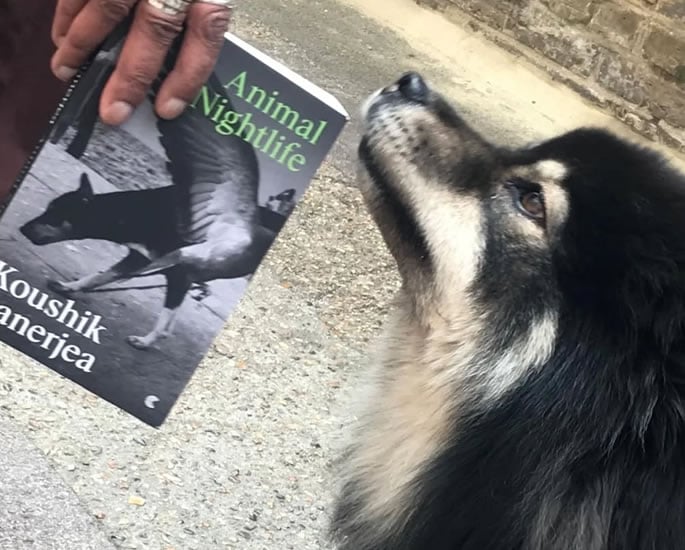
One of the most distinctive features of Animal Nightlife is its portrayal of people existing in hybrid human-animal forms known as ‘Multiples’.
Through these characters, Koushik Banerjea explores how difference is perceived and why identities that do not fit traditional categories are often misunderstood.
He says: “Wings and beaks, or elsewhere snouts and tails, or claws, signify at their most basic level some kind of difference from the ‘norm’.
“I liked the idea of playing around with ‘Multiples’, hybrid human-animal forms, since, in one way, they simply render explicit what we all already know, but mostly choose to gloss over: that the human species is merely one animal amongst many.”
This idea extends beyond human identity, with the novel also exploring humanity’s relationship with the natural world.
Banerjea argues that recognising connection and interdependence is essential when facing environmental challenges:
“We need to relearn how to better live side by side, or else the degradation of the planet will go into overdrive.”
For British South Asian communities in particular, he believes these layered identities have often been overlooked despite their contribution to British culture and creativity.
He says: “The other thing about ‘Multiples’, about those hybrid forms, is that they gave me a way to talk about how especially immigrants and their kids often speak, for instance, several languages besides English, and how the richness of that cultural exchange is too often overlooked by the establishment.
“The story finds a heroic place for ordinary ‘Multiples’, and a value in what they bring to society.
“This felt important to me at a time when so much of the public discourse is mired in damaging ‘culture wars’ and some archaic ‘singular’ desire to return Britain to a mythical golden age before Black and Brown people arrived and apparently ruined their idyll.”
Friendship, Music and Community

Although Animal Nightlife explores prejudice and division, Koushik Banerjea also focuses on the relationships and cultural connections that help people survive difficult times.
The author believes collective action has historically challenged exclusion and created support networks for those facing hardship. He points to south London’s history as an example of how communities can resist intolerance.
“Margaret Thatcher, also known as the ‘Milk Snatcher’, famously suggested there was no such thing as society, only individuals working for their own advantage. That always struck me as a dismal worldview.”
Banerjea argues that the community has played an important role in opposing extremism and supporting people from different backgrounds.
He states: “Without community, we’d never have turned the fascist tide in Lewisham, or gone on to become not just London’s but the UK’s first ‘borough of Sanctuary’ for those fleeing violence and persecution in their own countries.
“Friendship, love, music and compassion are perhaps our most valuable weapons against hatred and bigotry.”
While communities can be complicated, Koushik Banerjea believes their value lies in their ability to bring people together despite differences.
“It’s not always perfect, and there’s times it can be a right pain, but that’s just life really.
“Whereas love, and compassion, and all the joy that comes with, are the speakers turned round to face a bigger world. Full of uncertainty, sure. But hope too.
“Without that, we may as well throw in the towel now. And I’m not ready to do that.”
Challenging Stereotypes
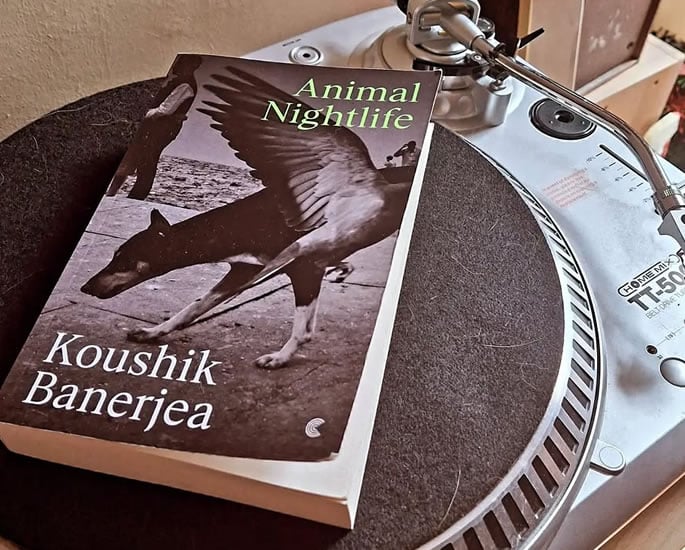
Koushik Banerjea believes British South Asian experiences are often still presented through limited frameworks, with writers and communities expected to fit simplified ideas of identity.
Through Animal Nightlife, he aims to explore the complexity of lives shaped by many different influences.
His own background reflects that mixture, as he explains:
“I’m a Bengali south Londoner who nonetheless supports West Ham.”
Banerjea’s parents experienced displacement following Partition, yet continued to maintain strong connections to culture and creativity despite difficult circumstances.
“My parents were refugees, but even when they were living ten to a room, or in my dad’s case, on the streets (back in the chaos of post-Partition Bengal), they never stopped loving Tagore, or classical painters or Baul singers.”
He says these different influences demonstrate why identity cannot be reduced to one background or experience.
Banerjea believes more stories are needed that allow British South Asian characters to exist beyond expectations and stereotypes.
“There are, of course, some brilliant exceptions – yep, I’m looking at you, Man like Mobeen, and most things involving Riz Ahmed – but that boldness is all too rare.”
Ultimately, he wants writers to have the freedom to tell stories that reflect the full complexity of people’s experiences.
He adds: “We just need more stories and to worry far less about pleasing other people.
“Luckily, that’s not something I’m particularly skilled at, so I’m just going to keep telling the tale however I want.”
Through Animal Nightlife, Koushik Banerjea presents a story about exclusion and resistance while exploring the many ways people create connections in a divided society.
The novel reflects on the experiences of communities that have often been overlooked, while challenging narrow ideas about identity and belonging.
The book combines social commentary with imaginative storytelling to examine some of the most pressing issues facing Britain today.
By placing friendship, compassion and cultural complexity at its centre, Animal Nightlife offers a distinctive perspective on what it means to find a place in an uncertain world.