













































Tesla refers to this technology as its “sucker system”.
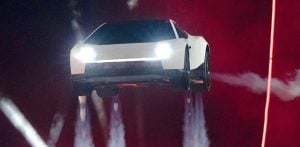
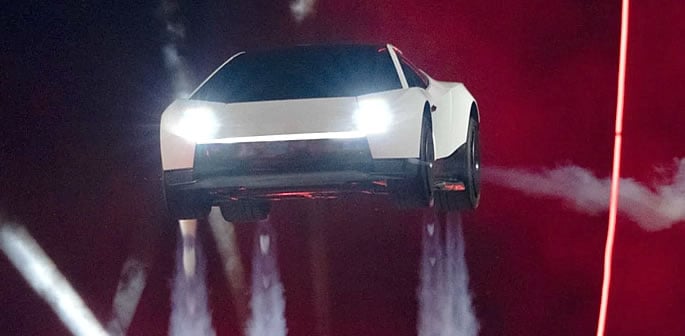
Elon Musk unveiled Tesla’s latest Roadster 2 prototype and one of the most eye-opening moments was when it appeared to fly.
The demonstration took place at SpaceX’s rocket development and testing facility in McGregor, Texas, where the billionaire showcased a series of gravity-defying stunts designed to highlight the car’s capabilities.
The prototype accelerated from 0 to 60mph in less than a second before launching over a line of Tesla vehicles.
Another stunt saw it drive up a curved ramp, travel upside down and flip back onto the ground.
Musk said the car operated remotely during the demonstration “to make sure we don’t kill anyone”, with the vehicle using a combination of powerful suction fans and compressed-gas thrusters to perform its tricks.
At the unveiling, he said: “Flying cars are real. It’s got altitude controls, thrusters and main thrusters in the rear.
“So it can basically fly like a rocket, it can do rolls, crazy gymnastics.”
But he acknowledged that the technology could face regulatory obstacles, saying, “I’m not sure it’s necessarily legal in all jurisdictions”, before describing the prototype as “not necessarily a safety optimised car but it takes the fun meter to 11”.
The Roadster 2 has been long-delayed, having first been announced in 2017.
The two-seater electric sports car is expected to be available in different versions, with the more advanced Thrust model incorporating the technology required for its rocket-assisted manoeuvres.
But how was it able to fly?
How did the Car drive Upside Down?

One of the Roadster 2’s most unusual features is its ability to generate additional grip using powerful electric fans mounted beneath the vehicle.
Tesla vehicle engineering head Lars Moravy said the system uses four 20-kilowatt fans and independently deployable skirts along the sides of the car to draw air out from underneath its chassis.
This creates a vacuum-like effect that pulls the vehicle towards the surface beneath it, increasing the force holding its tyres against the road. Tesla refers to this technology as its “sucker system”.
Ordinary sports cars rely heavily on tyre grip and aerodynamic downforce to remain stable at high speeds.
Downforce is the force generated by airflow that pushes a car towards the road, helping its tyres maintain contact with the surface. However, aerodynamic downforce becomes less effective at lower speeds because there is less airflow over the vehicle.
The Roadster 2’s suction system is designed to overcome this limitation by actively drawing air from beneath the car, rather than relying solely on its movement through the air.
This means additional grip even when the vehicle is travelling relatively slowly. According to Moravy, the system can generate more than twice the force of gravity in a corner under certain conditions, helping the car maintain traction during extreme manoeuvres.
During the Texas demonstration, this technology allowed the Roadster 2 to climb a curved ramp and remain attached to its surface while travelling upside down.
The fans provide the adhesion needed to keep the vehicle in place, while the car’s other systems help control its movement.
However, the approach is not entirely new to automotive engineering.
The McMurtry Spéirling Pure, an electric track car, also uses powerful fans to suck air from underneath its chassis and generate substantial downforce. But Tesla combines this principle with rocket-inspired technology to take the Roadster 2 beyond conventional road-car performance.
What Role does SpaceX Technology Play?
The suction system explains how the car can grip a surface, but its ability to jump, flip and control its descent relies on a separate technology developed with input from Musk’s aerospace company, SpaceX.
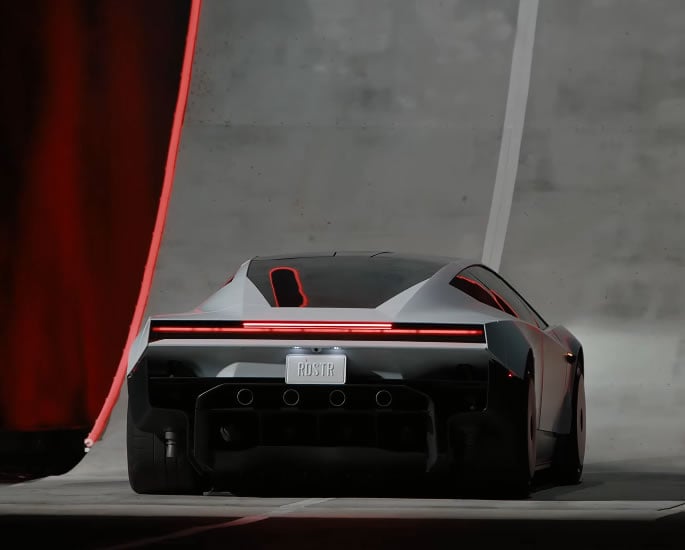
Tesla calls this the car’s “SpaceX system”. It uses cold-gas thrusters, which release pressurised nitrogen to generate thrust.
Similar systems are used on spacecraft to adjust their orientation and movement without relying on conventional engines.
The nitrogen is stored in high-pressure tanks known as composite overwrapped pressure vessels (COPVs). These reinforced vessels are designed to contain gas at extremely high pressures, allowing it to be released through thrusters when additional force is required.
The Roadster 2’s Performance version is expected to have the suction system but no thrusters.
The more advanced Thrust version adds the rocket-inspired equipment, enabling it to generate extra acceleration and perform the dramatic stunts shown during the unveiling.
According to Moravy, the rear thrusters can produce more than 80 kilonewtons of thrust in launch mode.
Combined with the car’s electric powertrain, this is intended to help the vehicle accelerate from 0 to 60mph in less than a second.
The full flight system goes further by adding six extra thrusters, including units at each corner and two at the front, providing greater control over the vehicle’s orientation, allowing it to adjust its position in the air rather than simply launching forward.
The system is designed to help the car control its rotation and cushion its descent.
When the Roadster 2 flips during the demonstration, the thrusters can adjust its orientation and produce an opposing force to slow its fall before it reaches the ground.
However, the technology does not mean the car can fly like an aeroplane. It relies on stored pressurised gas to generate short bursts of thrust, rather than wings and sustained aerodynamic lift.
Its ability to leave the ground and control its movement is therefore different from the continuous flight of a conventional aircraft.
The system also has practical limitations.
As the compressed nitrogen is released, the pressure and available thrust decline, eventually requiring the tanks to be refilled.
Moravy compared the process to releasing air from a balloon, explaining:
“When I open the end of a balloon, all the gas comes out, and at a certain point, it starts tapering off. That same thing will happen here.”
Tesla has reportedly been working to reduce the time needed to refill the tanks, but the system remains a complex addition to an electric sports car.
Despite the spectacle, important questions remain over the Roadster 2’s final specifications, safety and regulatory approval.
Tesla has previously missed its proposed production timelines, and the prototype’s performance during a controlled demonstration does not establish that the same manoeuvres could be carried out safely in everyday driving.
For now, the unveiling offers a glimpse of how Tesla is combining electric propulsion, active suction and spacecraft-inspired thrusters to create a car capable of stunts far beyond those of conventional road vehicles.
Whether the technology will make it into a commercially available model, as demonstrated, remains to be seen.