



















































"Starlink would change their lives for the better."
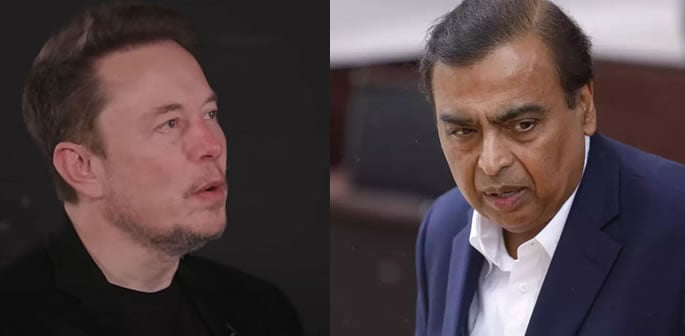
Elon Musk took a swipe at Mukesh Ambani, sarcastically calling the billionaire “Prime Minister” over the delay in launching Starlink in India.
On X, Musk wrote: “Dear Prime Minister Ambani, please accept my humble apologies for not realising that you are the real boss of India.
“Naturally, you would prefer to maintain your monopolistic exploitation of the great people of India, but would you nonetheless consider allowing Starlink to compete?”
Musk argued that Starlink could help bridge India’s digital divide by bringing internet connectivity to underserved communities:
“There are many areas of India, as there are in all countries, with no Internet access, which denies children the opportunity for education and for small businesses the opportunity to sell their goods to a global market.
“Starlink would change their lives for the better.”
He also highlighted the potential role of satellite communications during emergencies, adding:
“Starlink has proven to be essential for saving lives during natural disasters throughout the world, when all other communications systems have failed, so you would also be helping save men, women and children throughout India.”
Musk’s comments come after he previously accused “certain oligarchs” of obstructing Starlink’s entry into India, describing the situation as a “crime against the people of India”.
However, the Indian government has rejected suggestions that the regulatory process unfairly favours domestic telecommunications operators.
In a statement on October 8, the Ministry of Communications said:
“The Government has put in place a fair and non-discriminatory authorisation framework for all telecommunication services, including satellite communication services.
“Under the terms and conditions of licence, every such licensee is required to demonstrate compliance with security conditions… aimed at ensuring that services provided meet various security requirements to ensure safety of all users and their data.
“Security assessment as part of this process is currently underway in respect of all three licensees.
“As and when this process is completed for a licenced entity, it may proceed to the next step of seeking assignment of spectrum.
“At present, all three entities are at broadly the same regulatory stage. As such, the suggestion that the framework or its application is unfair or discriminatory is baseless and misconceived.”
Starlink has already secured a Global Mobile Personal Communications by Satellite (GMPCS) licence and other statutory approvals required to offer satellite communication services in India.
However, the company still needs to complete the outstanding security process before it can move towards commercial launch.
Dear Prime Minister Ambani,
Please accept my humble apologies for not realizing that you are the real boss of India.
Naturally, you would prefer to maintain your monopolistic exploitation of the great people of India, but would you nonetheless consider allowing Starlink to compete?
There are many areas of India, as there are in all countries, with no Internet access, which denies children the opportunity for education and for small businesses the opportunity to sell their goods to a global market. Starlink would change their lives for the better.
Thank you ?
— Elon Musk (@elonmusk) October 9, 2026
Other operators that have secured GMPCS licences include Eutelsat OneWeb, backed by Bharti Enterprises, and Jio Satellite Communications, a wholly owned subsidiary of Jio Platforms.
Amazon’s satellite internet venture, Amazon Leo, is also seeking entry into the market.
Bharti Airtel chairman Sunil Bharti Mittal, whose company is involved in Eutelsat OneWeb, has pushed back against Musk’s allegations, pointing out that his own venture is also waiting for the necessary approvals to begin operations in India.
Starlink received authorisation from the Indian National Space Promotion and Authorisation Centre (IN-SPACe) for its satellite constellation in July 2025, in what industry executives described as the final regulatory approval required for the company to launch its services.
The company had previously secured an operator licence from the Department of Telecommunications after first applying three years earlier.
Despite those approvals, the government has yet to give the green light for a formal launch, with security concerns understood to be a key factor.
Officials are particularly concerned about foreign satellite operators potentially bypassing Indian gateways to provide services, which could limit the government’s oversight of communications and data.
The dispute comes as Reliance Jio considers developing its own sovereign low Earth orbit satellite constellation, with a proposed network of 1,600 to 1,650 satellites reportedly carrying an estimated cost of $10 billion to $15 billion.