

















































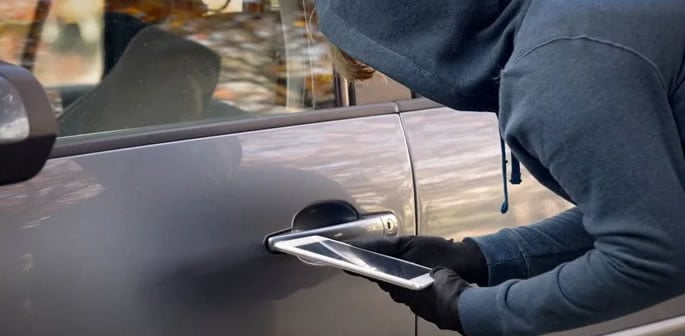
Relay attacks exploit this.
Relay attacks are one of the most common ways criminals steal keyless cars, allowing them to unlock and start a vehicle without having the actual key.
The theft can happen in under a minute, with no broken windows, forced locks or obvious signs that anything is wrong.
Criminals use electronic devices to extend the signal between a key fob inside a home and a car parked outside, effectively tricking the vehicle into thinking its key is beside it.
As keyless technology has become increasingly widespread, so too has this form of theft, with relay methods accounting for a significant proportion of vehicle thefts in the UK.
Understanding how relay attacks work, and the other techniques thieves use, can help drivers better protect their vehicles.
How does a Relay Attack Work?

Keyless entry systems are designed to make accessing a vehicle more convenient.
The car communicates with an authorised key fob when it is nearby, allowing the doors to unlock and, on compatible vehicles, the engine to start without the driver physically using the key.
Relay attacks exploit this. Usually, two criminals work together, using two electronic devices to extend the distance over which the key and vehicle can communicate.
One device is positioned near the home, where it captures the signal from the key fob. The second is placed near the vehicle and receives the relayed signal before transmitting it to the car.
The vehicle thinks the signal means its key is nearby. The doors unlock and the engine can start, allowing the thieves to make off with the car.
The theft does not require criminals to have the physical key, break a window or force the vehicle’s locks.
This makes it particularly difficult for owners to realise their vehicle is being targeted until it has already been stolen.
Why are Relay Attacks so Common?
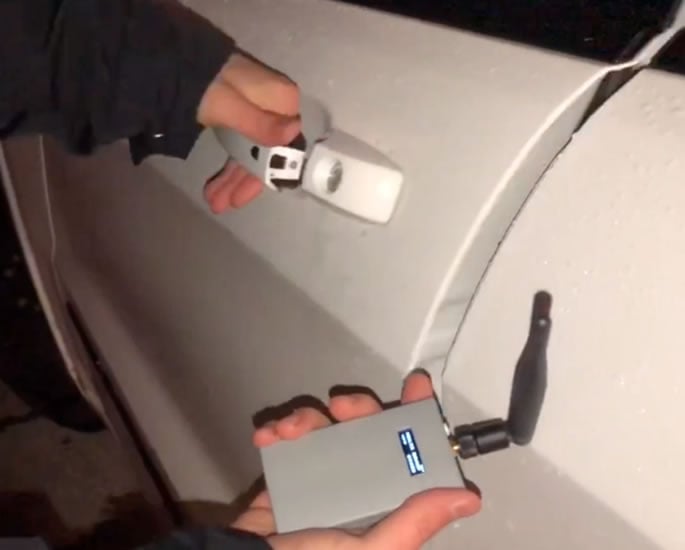
As more cars are fitted with passive entry and start technology, so have keyless thefts.
Data from the Crime Survey for England and Wales found that 58% of car thefts between March 2023 and March 2024 involved criminals manipulating keyless entry signals.
The Association of British Insurers (ABI) reported that relay methods accounted for 70% of stolen vehicles in 2024. However, figures vary between sources because different organisations use different definitions and datasets when measuring keyless and relay theft.
The proportion has also increased substantially over time.
Relay attacks accounted for around 14% of UK car thefts in 2019, highlighting how the technique has become a more significant threat as equipment has become smaller, cheaper and more accessible.
Vehicles fitted with keyless entry and start systems are the primary target.
Newer and higher-value models can be particularly attractive to organised theft groups because of their technology and potential resale or export value, although the vulnerability is not limited to luxury cars.
Faraday pouches can help protect against relay attacks because they block the radio signals emitted by a key fob.
However, they need to be used consistently and checked regularly because damaged or worn pouches may no longer provide effective protection.
What is the Headlight Method?
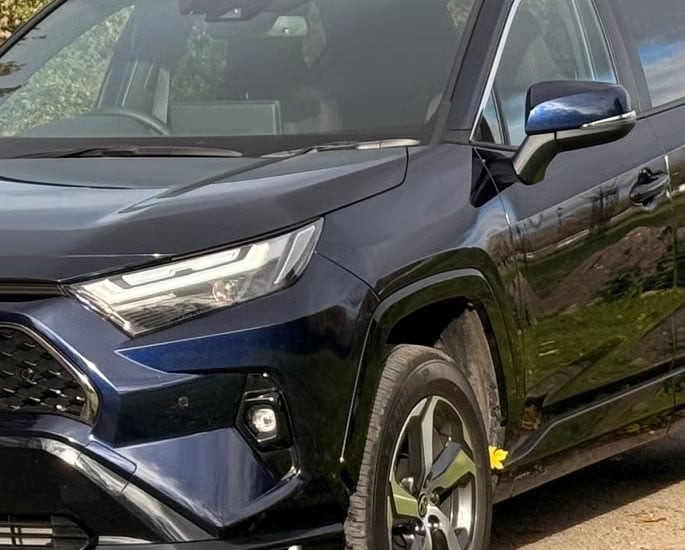
Another method thieves are using to target keyless cars is the headlight method, also known as CAN bus theft or headlight hacking.
CAN stands for Controller Area Network and it is different from a relay attack because criminals do not need to capture the key fob’s signal.
In a CAN bus attack, thieves exploit a vulnerable access point to the vehicle’s network.
In some models, this can involve accessing wiring around the headlight, while other vehicles may have different vulnerable points, including around the tail lights.
Once they have access, criminals can send false commands through the vehicle’s network.
Depending on the vehicle and vulnerability, this can allow them to interfere with the immobiliser, bypass keyless security or make the vehicle’s systems behave as though an authorised key has been used.
The technique has affected a range of Toyota and Lexus vehicles, including models such as the Lexus RX, Toyota C-HR and Toyota RAV4.
Because the attack targets the vehicle’s electronic network rather than the key fob’s radio signal, a Faraday pouch will not prevent it.
This is why drivers of vulnerable vehicles may need additional physical and electronic security measures.
How can you Keep your Car Safe?
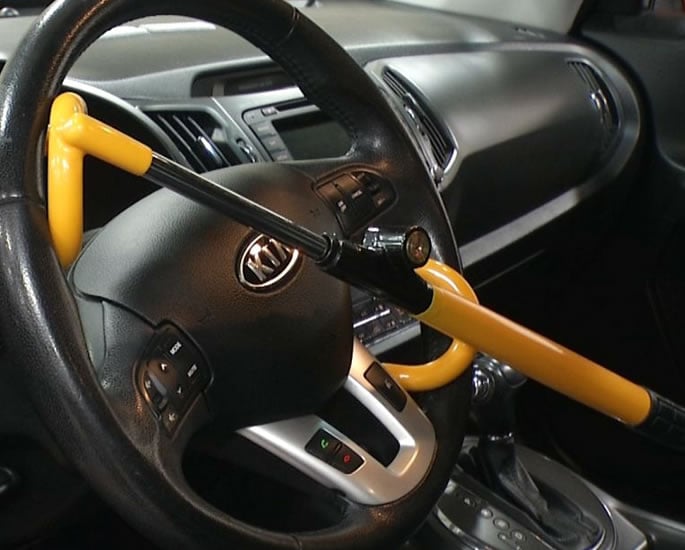
No single security measure can eliminate every form of vehicle theft, but combining several layers of protection can make a car harder to steal.
Drivers should:
- Check the vehicle is locked: Always physically check the doors before leaving the car. Thieves can sometimes exploit vehicles that have accidentally been left unlocked.
- Keep keys away from doors and windows: Store keyless fobs away from the front door and vehicle when they are at home.
- Use a Faraday pouch: Keep keyless fobs inside a good-quality signal-blocking pouch when they are not being used. Test the pouch periodically and replace it if it becomes worn or damaged.
- Disable wireless signals when possible: Some keyless fobs have a sleep or signal-off function. Check the vehicle manufacturer’s instructions to see whether yours supports this.
- Use a steering lock: A visible steering wheel lock provides an additional physical barrier and can make the vehicle more difficult to drive away.
- Consider a secondary immobiliser: An aftermarket immobiliser, such as a Ghost immobiliser, can require a PIN or other authorisation before the engine can be started.
- Activate tracking: Use a manufacturer’s tracker if the vehicle has one. A third-party tracker can provide an additional layer of protection, although thieves may also target factory-fitted tracking systems.
- Check the vehicle’s programmed keys: Ask a dealer or qualified specialist to check which keys are registered to the vehicle. Any missing or unwanted keys should be removed from the vehicle’s system.
- Park securely: Use a private garage where possible. If this is not available, choose a well-lit and open location.
- Secure the driveway: Homeowners with driveways can consider measures such as security posts or wheel clamps to make the vehicle harder to remove.
These measures address different stages of a potential theft. Signal-blocking protection can reduce the risk of a relay attack, while physical locks and additional immobilisers can provide protection if criminals find another way into the vehicle’s systems.
Relay attacks demonstrate how the convenience of keyless technology can create new opportunities for criminals, but they are only one method used to steal modern vehicles.
CAN bus attacks show that thieves can also target weaknesses within a vehicle itself rather than the key.
The most effective approach for drivers is to use several layers of security rather than relying solely on a Faraday pouch or the vehicle’s factory-installed systems.
Keeping keys secure, adding visible physical deterrents and considering additional immobilisation or tracking can make a vehicle a more difficult target.