











































“I will always carry home with me”
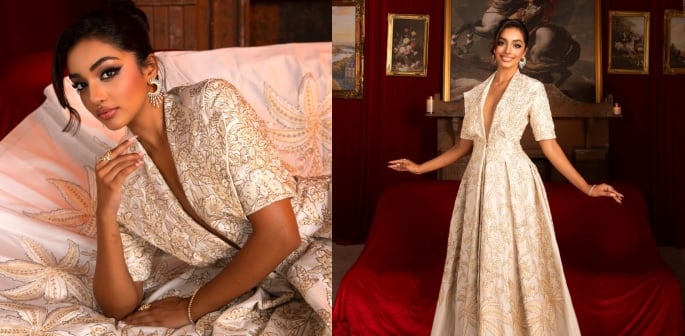
Kerala’s cream and gold have arrived at Miss Universe 2026 through Kaziah Liz Mejo’s wardrobe.
For the personal interview round in Puerto Rico, India’s representative wore a gown inspired by the kasavu saree, with accessories recalling her first headshot and her departure for the competition.
In an Instagram caption, she wrote: “I wanted my personal interview look to be more than just an outfit.”
Her explanation traced the look back to family roots, an early photograph and the women who preceded her in the competition.
The kasavu appearance followed another saree moment earlier in November.
For her departure from New Delhi, Kaziah wore a maroon saree by Samant Chauhan, combining organza, raw silk and zari work.
The interview look moved to the pale palette associated with Kerala’s kasavu sarees, translated into a gown with handwork. This was a change of colour and form within a wardrobe that had already included Indian dress.
Kaziah’s explanation makes the regional choice deliberate. At an international competition where she represents India, naming kasavu directs attention to the place and dress tradition she wanted to acknowledge.
What Makes Kasavu Recognisable?
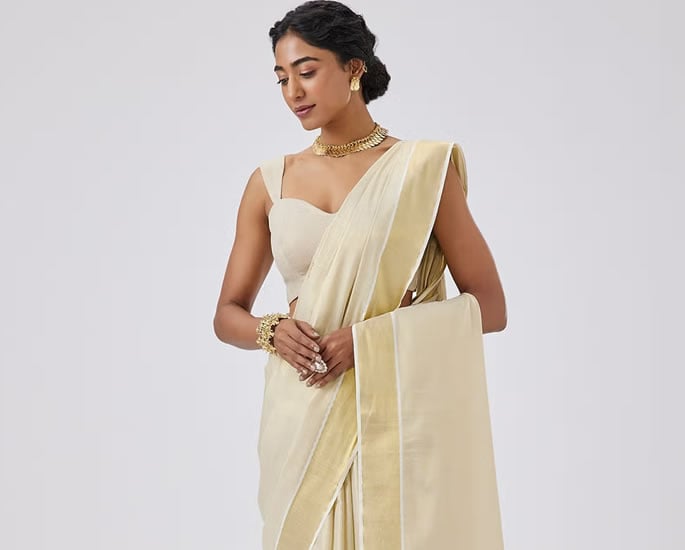
Kasavu is often used as shorthand for Kerala’s cream and gold sarees, although the word refers specifically to the golden zari border.
Kerala Tourism identifies that border as the defining element and records variations using silver, bronze and other colours.
The saree is also distinct from the set mundu, or mundum neriyathum. The former is a single continuous drape, while the latter comprises two pieces, with one worn around the lower body and the other over the blouse.
These garments are associated with occasions including Onam, Vishu and weddings.
For someone familiar with those celebrations, their colours can recall clothes worn by relatives, festival photographs and the ritual of dressing for a particular day.
That background gives a gown inspired by kasavu a reference beyond its colour scheme. The original garments remain recognisable through the association Kaziah has made, even as she chooses a different form for this appearance.
The Memories in Her Accessories
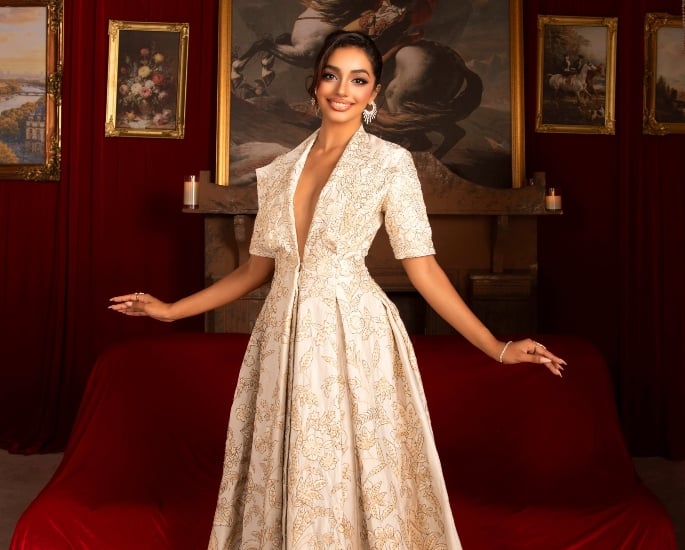
The gajra in Kaziah’s hair recalled her first official headshot. That detail connected her interview styling to an image from the beginning of her pageant journey.
Her bangle was the same one she had worn when leaving for the competition, while the earrings belonged to her predecessor. The publication reported both details from her account of the look.
Together, those choices marked different stages: an early photograph, her departure and the titleholder who came before her.
Their significance came from associations Kaziah could describe, giving familiar accessories a meaning specific to this appearance.
That is also an accessible idea for readers planning their own occasionwear. Repeating a bangle or choosing jewellery connected to another person can give a new outfit a link with something already significant.
Kerala Roots and an Upbringing Abroad
Kaziah’s connection to Kerala has a history beyond this outfit.
An August 2026 interview described the 19-year-old law student’s family roots in Mavelikkara and her schooling in Abu Dhabi.
She was crowned Miss Universe India on August 23, 2026, becoming the first contestant from Kerala to win the title.
Her upbringing gives that choice a particular resonance for a diaspora audience. Family origins, the place where someone grows up and the country they represent can each describe a different part of the same person.
The relationship with kasavu connects to Radhika Nandakumar, a Malayali living in Chester, who brought out a treasured family kasavu saree for Vishu.
For Nandakumar, the occasion was Vishu in Britain; for Kaziah, it is an interview round in Puerto Rico. Both examples show how clothes, or a reference to them, can make a connection with Kerala visible far from the state.
The two occasions also leave room for different ways of wearing a tradition. Nandakumar’s family saree and Kaziah’s gown can each hold meaning for their wearer, with the connection explained through personal experience.
The Weaving Behind the Palette
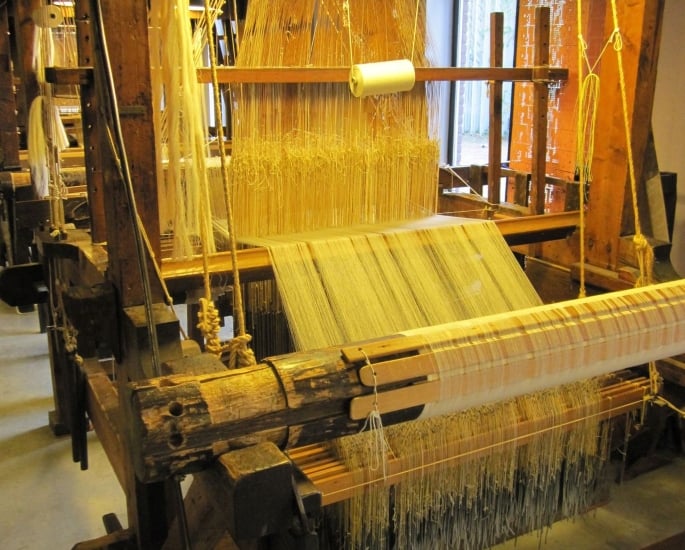
Kasavu’s identity also comes from the work of specific weaving centres. Kerala’s Directorate of Handlooms and Textiles documents distinct traditions in Balaramapuram, Kuthampully and Chendamangalam.
Balaramapuram, in Thiruvananthapuram district, is known for fine cotton textiles using undyed yarn and gold zari.
Its weaving history is associated with the former Travancore royal family, which supported the settlement of weaving families.
In Thrissur district, Kuthampully’s handwoven cotton sarees combine kasavu borders with designs produced using jacquard techniques.
Chendamangalam, in Ernakulam district, is particularly associated with set mundu and dhotis.
The directorate also identifies a distinctive detail in Chendamangalam sarees: puliyilakara, a narrow black line running beside the fabric’s edge. Such differences give each weaving centre an identity within the broader tradition.
Kerala Tourism notes that thread counts and motifs vary between weaving clusters. That variation is part of kasavu’s appeal: the shared palette leaves room for differences in texture, border and pattern.
Those distinctions help explain the textile heritage Kaziah is referencing. They describe the original kasavu garments, whose influence is being adapted in her gown.
For those drawn to the look, a useful starting point is the relationship between colour, clothing and accessories. A kasavu saree, a set mundu or a gown inspired by their palette offers a different way to approach the same reference.
With a saree, the border’s width and the blouse colour can help determine how formal the outfit feels. A matching cream blouse keeps the colours close, while a deeper shade creates a stronger contrast around the drape.
Anyone choosing a piece for its weaving heritage should also ask about its maker, fibre and loom process. Kerala Tourism notes that both handloom and powerloom kasavu products are available, so colour alone cannot establish how a garment was made.
For someone with family roots in Kerala and an upbringing abroad, the choice of kasavu gives that promise a particular meaning.