

















































"deliver reliable broadband services across the country"
Starlink is coming to India.
The satellite internet company, owned by Elon Musk, is set to enter the Indian market after securing deals with two major telecom firms.
Bharti Airtel announced that it would partner with Starlink, marking the first such agreement in India with the SpaceX-owned firm.
Airtel said it would offer Starlink equipment through its retail outlets and provide the service to businesses, schools, and health centres.
Managing director and vice-chairman Gopal Vittal said:
“Working with SpaceX to offer Starlink to Airtel customers in India is a significant milestone and further demonstrates our commitment to next-generation satellite connectivity.”
This was followed by a deal with Mukesh Ambani’s Reliance Jio.
The company plans to sell Starlink equipment in its retail and online stores and offer installation support.
In a statement, the company said: “Through this agreement, the parties will leverage Jio’s position as the world’s largest mobile operator in terms of data traffic and Starlink’s position as the world’s leading low Earth orbit satellite constellation operator to deliver reliable broadband services across the country, including the most rural and remote regions of India.”
Both deals are contingent on regulatory approval from the Indian government.
Elon Musk has long aimed to enter India’s growing internet market, but regulatory challenges, security concerns, and opposition from domestic telecom giants like Reliance Jio have delayed Starlink’s entry.
A key dispute between telecom firms revolved around spectrum allocation. While Reliance Jio pushed for an auction, the government ultimately decided to allocate the spectrum, following global norms.
In November 2024, Telecom Minister Jyotiraditya Scindia stated that Starlink had yet to comply with security norms and that a license for satellite communications services would only be issued after meeting all requirements.
How does Starlink Work?

Unlike traditional broadband services that rely on fibre optics or cell towers, Starlink provides internet through low-Earth orbit (LEO) satellites.
Ground stations send signals to Starlink satellites, which then relay the data back to users.
Starlink operates around 6,900 LEO satellites, each weighing approximately 260 kilograms.
The company provides users with a kit containing a satellite dish, a dish mount, a Wi-Fi router, a power cable, and a 75-foot cable connecting the dish to the router.
The system’s satellite dish automatically connects with the nearest Starlink satellites, ensuring uninterrupted connectivity.
Although Starlink is primarily designed for fixed locations, it can also be adapted for vehicles, boats, and aircraft. Ukraine’s military has successfully used Starlink to maintain communications during its conflict with Russia.
What are the Expected Speeds & Costs?

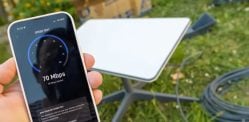
Starlink is expected to offer download speeds between 25 to 220 Mbps and upload speeds ranging from 5 to 20 Mbps, with latency between 25 and 50 milliseconds.
Pricing details for India are yet to be announced.
In the US, Starlink’s basic home plan costs $120 (approximately Rs 10,467) per month, while the roaming plan is priced at $165 (around Rs 14,393).
Business plans range from $500 (Rs 43,000) to $5,000 (Rs 436,000) per month.
While Starlink may not match the affordability and speeds of JioFiber or Airtel Xstream, its key advantage is its ability to deliver internet to remote and geographically isolated regions.
In India, where 40% of the 1.4 billion population still lacks internet access, satellite broadband could help bridge the digital divide.