





































"The Bhangra Ceilidh album can be listened to."
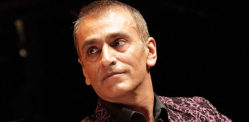
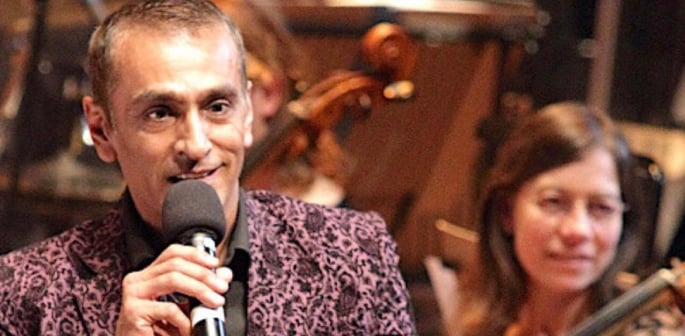
Kuljit Bhamra MBE, music composer and tabla player, is one of the most famous names in the British Asian music scene.
His main instrument is the tabla, and he is recognised as the pioneer of British Bhangra, collaborating with musicians across various genres and continents.
Bhamra and folk musician Becky Price have produced a brand-new album of Bhangra Ceilidh tunes.
In celebration of its release, the English Folk Dance & Song Society, in collaboration with Keda Records, are holding a special evening of Bhangra Ceilidh.
The genre is “an uplifting fusion of the irresistible moves of bhangra and ceilidh dancing” and the event is open to all skill levels.
Kuljit Bhamra has been involved in music his whole life.
When asked about his earliest memory of music, he said: “My parents took me to see a Hindi film movie when I was about four years old.
“It was called Madhumati. I remember being deeply affected by the music and the songs.”
In an exclusive interview with DESIblitz, Kuljit Bhamra discussed his musical inspirations and the formation of the Bhangra Ceilidh genre.
Who or what are your biggest musical influences, and how have they shaped your style?
 I have listened to many styles of music since a young age l from Jazz, rock pop, Arabic music, orchestral music and Indian folk and classical.
As a teenager, I listened intently to Michael Jackson, George Benson, Oum Kulthum and Stevie Wonder in addition to heavy doses of Punjabi and Hindi film music.
I wanted to know how it was all put together and recorded.
What initially drew you to the tabla, and what do you find most distinctive about it as an instrument?
 My mother is a well-known folk singer in the Punjabi community, and I have accompanied her on the tabla since the age of six.
Looking back on it, it was chosen out of necessity.
My mother needed a tabla to accompany her when she sang in temples and community events – and there weren’t that many players around at the time.
How did the idea for a Bhangra-Ceilidh fusion come to you, and what do you hope it brings to listeners?
During the last few years of working with English Folk Dance & Song Society, I realised how similar English folk music and Punjabi folk music are.
I knew that combining the styles and rhythms would work very well.
What emotions or experiences do you hope people connect with when they listen to your music?
Essentially, the music on the Bhangra Ceilidh album can be listened to – or danced to.
I hope that listeners find the tunes catchy and also emotionally rich.
I teamed up with well-known folk accordion player Becky Price and a team of talented young musicians from both English and Indian backgrounds.
How has your cultural background influenced your identity and voice as a musician?
 At this stage in my career (having produced and recorded so many albums) I sometimes wonder what my cultural background really is!
I was born in Kenya, have Punjabi heritage and have lived in London since the age of two!
So, I’m rather hesitant about saying precisely what cultural background I have – British Indian?
I think that this confusion is evident in my musical output. The style of my music is extremely wide-ranging, but usually recognisable by the presence of tabla and Indian percussion.
What are the key benefits of blending cultures through music, particularly with genres like Bhangra Ceilidh?
I am excited about seeing members of my community coming to an event at a venue that they’ve never been to – and enjoying themselves by hearing a new style of music that has recognisable elements but from a different culture.
Music and dance have the power to bring people from diverse cultures together and Bhangra Ceilidh has also been created to do just that!
Do you have a particular method or mindset when composing music that spans multiple genres?
 I am passionate about combining instruments that wouldn’t normally be played together.
For example, in this album, bansuri and tabla sit comfortably alongside concertina, accordion and mandolin.
Indian violin plays alongside western violin and cello, and some tunes even have Indian vocals singing in a ‘La la la’ fashion.
From your perspective, how has Western perception of Indian music changed over time?
I have noticed a change over the years.
The shroud of magic and mysticism that detrimentally cloaked Indian music in the West since the 1960s is gradually wearing thin. I love that!
What advice would you give to young musicians looking to create cross-cultural compositions?
 Young musicians can use techniques and composition styles from other cultures to create their own unique personal style of music that helps them stand out amongst other artists.
It’s a simple and effective way of allowing music to evolve and develop worldwide.
What kind of legacy do you hope to leave for future generations in the music world?
I would like to think that I have demonstrated in my own way how artists can celebrate each other’s cultures by creating new music together.
Bhangra Music is a perfect example of this – it’s a British invention!
Ceilidh- (pronounced kay-lee) is a traditional social dance event with live music.
It’s a Scottish Gaelic word that is used in England as well as Scotland.
Ceilidhs are also danced at celebrations, festivals, weddings and community events as they are very accessible to new dancers.
The Bhangra Ceilidh event will take place on Saturday November 7, 2024 at Cecil Sharpe House, 2 Regent’s Park Road, London NW1 7AY.
The nearest tube station is Camden Town.
Expert callers Lisa Heywood and Hardeep Sahota will guide you through the dances and then there will also be interval dance spots from bhangra and morris dancers to enjoy.
Melodeonist and singer Hazel Askew will lead a band of young musicians brought together from alumni of the National Folk Ensemble with specialist Indian instrumentalists.
The musicians taking part in the event are the leaders, Kuljit Bhamra, who plays the tabla, and Hazel Askew, who plays the melodeon.
Other instrumentalists include Alice Robinson, a Fiddle player; Meera Patel, who plays Indian violin; and Shenara McGuire, who plays the concertina.
They are joined by Pheobe Harty playing the Cello, Prayag Kotecha, a Bansuri player and Vishal Mahay who plays Percussion, Harmonium and Toombi.
For more information and to buy tickets, you can visit: cecilsharphouse.org