














































“That’s how my journey in Kathak truly began"
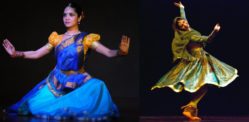
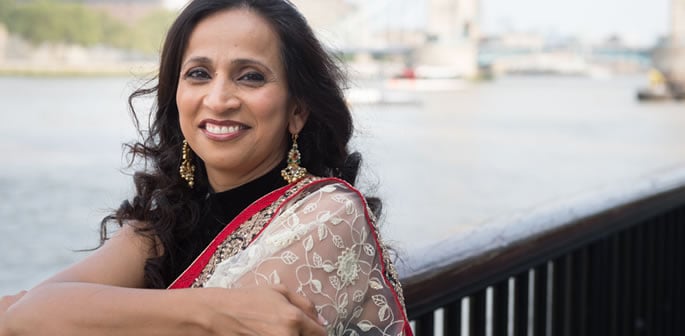
Urja Desai Thakore’s presence in the UK dance landscape is unmistakable, yet her path into Kathak began with a moment of chance that would shape everything that followed.
Today, she stands as one of the country’s most respected voices in Indian classical dance, known for her ability to weave history, precision and emotional clarity into every step.
As Artistic Director and CEO of Pagrav Dance Company, she has become a driving force for the South Asian arts community, championing the form across stages, schools and wellbeing settings.
Her work has reached cancer patients, survivors and carers, proving that dance can hold meaning far beyond performance.
Thakore’s story is one of discipline, blessing and fierce advocacy, a life shaped by Kathak and dedicated to its future.
Exclusively speaking to DESIblitz, Urja Desai Thakore reflects on her journey, her philosophy and the evolving landscape of Kathak in the UK.
A Journey Shaped by Blessings, Persistence & Kathak

Urja Desai Thakore’s relationship with dance began long before she understood its scale in her life.
She recalls feeling as though she was “always dancing”, first entering the world of Bharatanatyam at the age of four.
Her early years were marked by enthusiasm, restlessness and a spark her teachers struggled to contain, as she reveals:
“Apparently, I was very interested in dance but also extremely naughty, and I never paid enough attention in class!”
Everything changed the day her mother took her to watch Sitara Devi perform. What followed became family legend.
Thakore says: “Sitara Devi blessed me to become a great Kathak dancer.”
Her mother immediately pointed out that she was training in Bharatanatyam. Sitara Devi’s response was immediate: “No, she is going to learn Kathak.”
That blessing shifted the course of Thakore’s childhood.
Her mother sought out a Kathak teacher, eventually reaching the legendary Kumudini Lakhia.
At first, Thakore was considered too young, but Lakhia “kindly allowed me to sit in and observe the classes whenever possible”.
Her mother’s determination ensured that she attended every session until, with time and persistence, she was finally enrolled.
“That’s how my journey in Kathak truly began, through my mother’s determination, blessing, and guidance from my Kumiben.”
Training under Kumudini Lakhia later became one of the defining relationships of her life and artistic identity.
And through observation, commentary and presence, Lakhia pushed her to think beyond movement.
Thakore says: “Being around her was always deeply educational and enriching.
“She didn’t just teach me how to dance; she taught me how to see dance.”
The Power of Teaching

Urja Desai Thakore is one of the UK’s most respected Kathak practitioners, and her advocacy for the form stems from a fundamental principle: naming and presenting Kathak with clarity.
She explains: “I believe, and I want people to know, Kathak as Kathak, not simply as a category under ‘South Asian dance’.”
The only broader term she is comfortable with is Indian classical dance, because it “preserves the identity, lineage, and nuance of the form”.
Her national advocacy involves bringing Kathak into as many spaces as possible.
Thakore works across theatres, festivals, schools, universities and arts-in-health settings to build visibility where it does not naturally exist:
“I want Kathak to live not only on formal stages but also in community environments, educational contexts, and everyday spaces.”
By mentoring, performing and curating platforms, she pushes the form into wider artistic conversations.
Teaching, which she has now done for more than 20 years, remains one of her greatest motivators. The transformation she sees in her students keeps her energised.
“What motivates me to keep teaching after 20 years is the immense transformation I witness in my students, not just as dancers, but as people.”
Kathak, Thakore says, doesn’t only require discipline; it builds it.
It cultivates focus, awareness and creative resilience, qualities she watches develop year after year. These shifts remind her why she continues:
“Kathak becomes more than a dance form; it becomes a foundation they can carry into every part of their lives.”
Storytelling is another pillar of her practice. Thakore describes it as central to the art itself, anchored in the idea that “Katha Kahe so Kathak”.
Whether literal or abstract, narrative allows emotional texture to emerge.
“Storytelling is what transforms Kathak from movement into experience.”
The Reality of UK Infrastructure

Thakore’s work in wellbeing settings is rooted in the belief that dance reconnects people with themselves:
“Dance introduces us to our own existence in a very intimate way.”
Through rhythmic patterns, gentle gestures and moments of stillness, participants find grounding and release.
The aim isn’t performance but presence, an opportunity to feel lighter, clearer and more centred.
Thakore says: “The initiative creates a safe, joyful space where participants can experience upliftment, clarity, and calm.”
But supporting Indian classical dance in the UK remains challenging.
According to Urja Desai Thakore, the biggest hurdle is that “the everyday cultural reinforcement that Kathak thrives on simply doesn’t exist”.
Artists must build their own infrastructure, a task that requires time, energy and constant advocacy.
Access to space, training pathways and long-term development opportunities remains limited, affecting both emerging and established practitioners.
Funding poses another barrier. Too often, support for Kathak is tied to diversity agendas. Thakore describes it as a “tick-box exercise” that forces artists to justify their practice or reshape work to fit external expectations.
Despite these systemic gaps, the Kathak community remains committed and resilient, working to create opportunities where none exist.
Thakore’s advice to young people entering this landscape is grounded in honesty.
“Work hard. There is no shortcut in classical arts.”
She urges students to observe deeply and to embrace patience, humility and repetition. She also stresses the importance of integrity.
“Don’t feel pressured to dilute your art.”
At the same time, Thakore encourages openness to evolution, emphasising that understanding tradition is what allows artists to expand its meaning.
The Future of Kathak

Looking ahead, Urja Desai Thakore envisions a future in which Kathak stands confidently beside Western classical forms, supported by its own institutions, funding structures and training systems.
She says: “I see the future of Kathak in the UK as one where the art form stands confidently in parallel with ballet and other established Western forms – supported, valued, and visible.”
Thakore imagines a landscape rich with opportunities for dancers at every level – more stages, commissions, collaborations and national platforms where Kathak is recognised for both its classical depth and contemporary relevance.
“I imagine a landscape where Kathak is part of education, part of mainstream programming, part of the national arts conversation.”
For her, the future depends on continued community building, strong advocacy and long-term support systems.
Thakore adds: “If we continue to build community, advocate strongly, and create the right support systems, I believe Kathak in the UK can grow into a truly vibrant, robust, and flourishing ecosystem.”
Urja Desai Thakore’s journey offers a clear picture of what devotion to an art form looks like: grounded in tradition, sharpened by observation and strengthened through community.
Her insights reveal the depth of Kathak, not only as a classical practice but as a cultural force capable of healing, educating and connecting people across generations.
Through teaching, performance and advocacy, she continues to carve out space for Indian classical dance within the UK’s artistic landscape, often building structures that do not yet exist.
As she looks toward a future where Kathak stands confidently alongside major Western forms, her commitment remains unwavering.
It is this combination of vision, resilience and purpose that ensures her impact will extend far beyond her own stage – shaping dancers, communities and the very ecosystem of South Asian dance in the UK.