

















































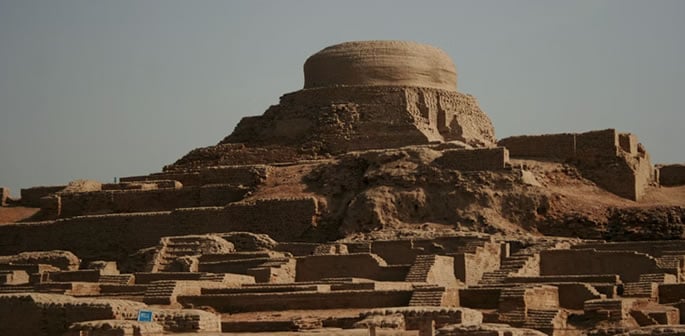
the data points to centuries of recurring droughts
The Indus Valley Civilisation, which flourished across present-day Pakistan and northwest India, is known for its advanced urban planning, gridded streets, multi-storey brick homes, and early sanitation systems that included flush toilets.
For decades, many believed its collapse came from one mysterious event.
However, a study has now challenged that assumption by presenting evidence that a series of prolonged droughts triggered its decline.
Published in Communications Earth and Environment, the study draws on paleoclimate data and computer modelling to examine climate patterns from 3000 to 1000 BCE.
The research shows that the fall of Harappa, one of the civilisation’s largest urban centres, was not due to a single catastrophe.
Instead, the data points to centuries of recurring droughts that slowly dried up rivers and soils.
As lead author Hiren Solanki of the Indian Institute of Technology at Gandhinagar explained, these prolonged dry spells likely forced Harappans to move frequently in search of viable places to live.
Co-author Balaji Rajagopalan, a hydrology researcher at the University of Colorado Boulder, said droughts were only one part of a wider challenge. He emphasised that declining food supply and a fragile governance system intensified the pressure, pushing the society towards fragmentation and dispersal.
Despite these conditions, the Indus Valley Civilisation endured for nearly two millennia.
The researchers found evidence that the Harappans adapted by changing agricultural methods, diversifying trade routes, and relocating towards more stable water sources, particularly along the Indus River and its tributaries.
This long-term resilience offers lessons in proactive planning, water management, and sustainable agriculture that remain relevant today as modern societies confront climate change.
To recreate the climate of that era, the team combined computer simulations with environmental indicators, including stalactites and stalagmites from Indian caves and lake-level records from several regions.
This allowed them to form a clearer picture of the environmental shifts that shaped the civilisation’s trajectory.
Between 3000 and 2475 BCE, monsoon activity was unusually strong due to cooler tropical Pacific conditions.
This La Niña-like pattern brought higher rainfall and supported the spread of settlements into rain-rich areas.
As the tropical Pacific warmed in the centuries that followed, rainfall decreased and temperatures rose, leading to repeated droughts.
The researchers identified four major drought events between 2425 and 1400 BCE, each lasting more than 85 years.
One of the most severe droughts peaked around 1733 BCE, lasted about 164 years, and affected almost the entire region.
Data also showed an overall temperature rise of 0.5 degrees Celsius and a 10 to 20% drop in rainfall.
These shifts had far-reaching consequences.
Co-author Vimal Mishra and his team detailed how shrinking lakes and shallow water bodies, falling river levels, and drying soils disrupted trade networks and weakened farming, particularly in communities far from reliable water.
This forced large population movements and played a clear role in the civilisation’s decline.
Geoscientist Liviu Giosan of the Woods Hole Oceanographic Institution noted that the study marks a significant development in understanding how ancient civilisations responded to hydroclimatic stress.
While earlier research relied on limited geological samples, this work integrates multiple records to show how changes in the water cycle shaped the region.
The approach could also help researchers studying other river-based ancient cultures, including those in Mesopotamia, Egypt, and China.
Giosan added that the findings reveal the unexpected ways droughts affected settlement patterns in the Indus region, offering new directions for archaeological exploration.
He also highlighted the resilience of these civilisations during long periods of climate instability, pointing to clear parallels with today’s challenges.
Rajagopalan stressed that future shifts in tropical Pacific temperatures will play a major role in determining South Asia’s rainfall patterns, raising critical questions for ongoing climate research.