


















































The film is estimated to have cost over $500,000 to make.
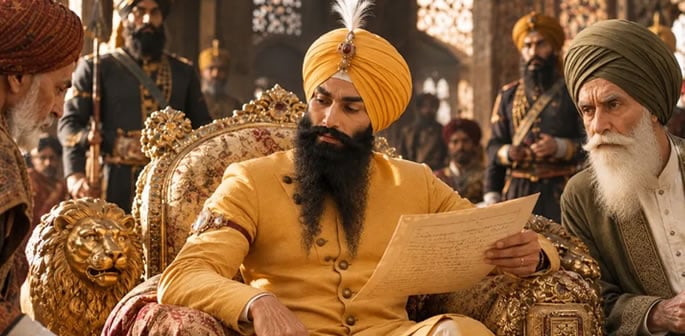
A generative AI film based on a novel about Sikh ruler Maharaja Ranjit Singh is nearing completion, with its makers hoping to release it in April 2027.
Maharaja in Denims, based on the novel by author Khushwant Singh, follows a young man who relives the lives of several figures from Sikh history, including 19th-century ruler Maharaja Ranjit Singh.
The feature-length film is being made by Intelliflicks Studios, with Ahmedabad-based Twenty-Twenty One Studios joining as co-producer.
Punjab-based filmmaker Balpreet Kaur is directing the film and retains final creative control.
The team is considering a theatrical release followed by non-theatrical distribution.
Bringing the story to the screen has proved challenging, with the filmmakers effectively rebuilding the production three times as generative AI technology developed.
The novel was originally optioned in July 2020 by producer Guneet Monga Kapoor, but that version never materialised.
Khushwant Singh, who is also CEO of Intelliflicks Studios, said the timing presented significant challenges, with the Covid pandemic delaying the recovery of cinemas and the story’s multiple historical settings making it an expensive undertaking.
The idea of using generative AI came from Gurdeep Pall, then corporate vice-president of incubations at Microsoft.
During a visit to Chandigarh in 2023, Pall questioned why the novel had not yet been adapted for the screen and suggested exploring AI filmmaking as an alternative.
Singh said: “It has unfolded exactly as predicted.”
The pair subsequently co-founded Intelliflicks in 2023 and unveiled the project with a short clip the following year.
Production initially began using Midjourney and Runway in 2024 before moving to Google Veo, with Nano Banana used to generate still images.
The team subsequently experimented with Kling AI and Seedance 2.0 before completing the film using tools available on Higgsfield.
ChatGPT and Google Imagen also helped develop the original character references, while face-swapping software, Photoshop and Adobe Firefly were used to correct inconsistencies.
Nano Banana allowed the filmmakers to create different camera angles and compositions using reference images, reducing the amount of manual correction required.
However, Singh revealed near-perfect consistency between shots only became achievable four or five months ago.
The team consequently rebuilt the film’s still images three times before settling on its final visual style.
Although newer developments allowed moving shots to be generated directly from character sheets, switching to that approach would have increased the production time and costs. Instead, the filmmakers animated the still images they had already created.
The performances also required a carefully controlled approach.
Early experiments involved real actors guiding the AI-generated performances through Runway Act-One, while a single person created most of the motion shots to ensure characters maintained consistent speech, movements and reactions throughout the film.
The short clips generated by AI also gave the editor less flexibility to shape individual scenes than conventional footage would have allowed.
Singh continued: “For example, if a lampshade is placed at a particular spot in a two-minute scene, it must remain in exactly the same position across every generated shot, irrespective of the camera angle. Even the slightest inconsistency can disrupt the cinematic experience.”
The film is estimated to have cost over $500,000 to make. This excludes marketing, which has yet to begin.
Despite the extensive use of artificial intelligence, Singh insists that the creative decisions have remained with the filmmaking team:
“Throughout this technological evolution, the creative process has remained entirely human-led.
“Screenwriting, direction, storyboarding, shot composition, performance evaluation and final creative decisions remain with our filmmaking team. AI is the technology that helps us translate that vision onto the screen.”
Set in 2008, Maharaja in Denims follows Hari Sandhu, who experiences flashbacks to three previous lives: as Maharaja Ranjit Singh, as a victim of Partition violence in 1947 and as a victim of the 1984 anti-Sikh violence.
According to Singh, the production remained closely guided by historical sources, although some creative liberties were necessary when the available AI tools struggled to reproduce period costumes accurately.
Maintaining consistency in characters’ faces and headgear was another major challenge during the early stages of production, with some of those imperfections still visible in the finished imagery.
Singh also reviewed the screenplay for historical accuracy, with input from historians, while leaving the day-to-day filmmaking decisions to Kaur.
While AI has played a central role in creating the film’s visuals, its music and audio have been produced entirely by people.
Playback singer Sukhwinder Singh recorded two versions of the title track, composed by emerging singer Hargun Kaur. The production had also considered working with Rahat Fateh Ali Khan, Wazir Patar and Daler Mehndi.
Recorded in Mumbai, the title song combines contemporary production with traditional instruments associated with 19th-century Punjab.
Internet sensation Inayat Kaur Bajaj makes her film debut, while Punjab-based artists Azaad and Gurprasad Singh composed and performed several tracks.
The film avoids drawing on styles or intellectual property belonging to individual artists or companies.
Singh also rejected concerns that AI filmmaking will eliminate opportunities for actors, animators and other film industry professionals, arguing that the industry has continually adapted to technological developments, including the introduction of visual effects.
He said: “Having made this film, we see a need for human creativity and talent, from storytelling to cinematography to music.
“Sometimes the specific roles change but human involvement will be needed to make compelling cinema with AI.”
Some technical glitches may remain but Singh compares the film’s imperfections to those found in the earliest days of cinema.
He added: “I definitely see Maharaja in Denims as an experiment, and a successful one at that, because technically, it will be the first full-length generative AI film rooted in realism, and it will be there for everyone to see.”