
















































Try each and see which one challenges you more.
Pilates isn’t just for women and this guide is here to prove it.
If you’ve dismissed Pilates as a gentle stretch class, you’re not alone. But that outdated view is stopping men from accessing one of the most effective, full-body training systems out there.
This guide will break down what Pilates really is, why it was originally created for men, and how it can build serious strength, improve flexibility, and prevent injury.
Whether you’re a gym regular, an athlete, or just looking to move better, this is your no-nonsense introduction to Pilates, what it involves, how it works, and why it belongs in your fitness routine.
Forget the stereotypes; this is a smart, practical, and sustainable way to train that delivers results.
Originally Developed for Men

Joseph Pilates, the method’s creator, was a boxer, gymnast and martial artist.
He developed “Contrology”, now known as Pilates, in the early 20th century to rehabilitate injured soldiers during World War I.
Using bed springs for resistance, he helped them recover through movement. That early innovation led to the Pilates Reformer, a machine now used in studios worldwide.
But how did this system become stereotypically known as a women’s workout?
The shift came as Pilates gained popularity with dancers, especially ballerinas, and was marketed to highlight flexibility and grace.
Over time, it became associated with a lean, feminine aesthetic.
But the method’s core principles, centring, control, breath, flow, and precision, were never gender-specific.
Today, professional male athletes ranging from footballers to rugby players rely on Pilates to stay strong, agile, and injury-free.
They’ve recognised what Joseph Pilates always knew: this is a practice built on strength, balance, and resilience.
Mat or Reformer

Pilates comes in two main forms, mat and machine, and both are serious workouts.
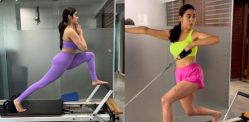
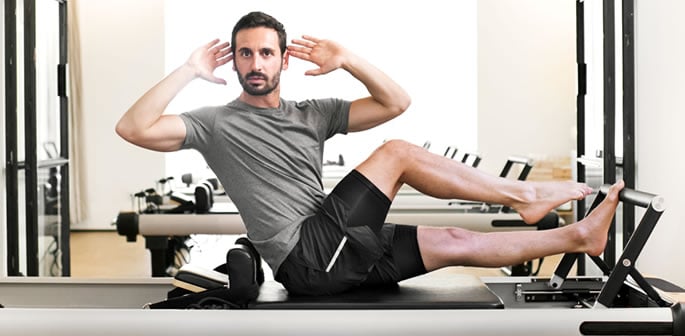
The Reformer might look intimidating with its springs, pulleys and sliding carriage, but it’s one of the most versatile pieces of fitness equipment around.
The resistance can be adjusted to support or challenge you, offering an experience that feels familiar to those used to lifting weights.
It’s ideal for building strength, improving flexibility, and correcting alignment. Plus, it’s low-impact on your joints.
Mat Pilates is just as intense. Using only your bodyweight, it demands core control, precision, and concentration.
Many men wrongly assume it’s easier, but with no machine to support you, every movement engages deep stabilising muscles.
It builds core strength from the inside out and improves coordination, posture, and mobility.
It’s also incredibly accessible. No studio? No problem. Just roll out a mat and get started.
Both formats are valuable. Try each and see which one challenges you more.
Many seasoned practitioners mix the two to enjoy the full spectrum of benefits.
The Benefits of Pilates for Men

A six-pack may be the standard image of male core strength, but real power comes from deeper muscles.
Pilates targets the entire core, including your abs, lower back, pelvic floor and deep hip stabilisers. This builds a strong, supportive base for all movement.
It protects your spine, improves breathing, and enhances balance.
Back pain is one of the most common issues men face, often due to poor posture, long hours at a desk or lifting with bad form.
Pilates strengthens the muscles that support the spine, easing existing pain and preventing future problems. It’s rehab and prehab in one.
Flexibility is another overlooked benefit.
Many male-focused workouts shorten muscles, such as weightlifting or HIIT.
Pilates does the opposite: it strengthens muscles as they lengthen, increasing flexibility and range of motion. Tight hips, hamstrings and glutes loosen up. Posture improves. You feel more mobile, less stiff, and ready for any physical challenge.
It also balances the body by correcting muscle imbalances. That makes you more resilient and less injury-prone.
Elite athletes use Pilates to prepare joints, activate underused muscles, and train for long-term performance.
The result is a more functional, agile and powerful physique.
The mental benefits of Pilates are just as powerful. Every move requires total focus, turning each session into a form of active meditation.
The emphasis on breath and control calms the mind and relieves stress. Many men report feeling more grounded and clear-headed after a session.
Over time, Pilates builds body awareness and coordination.
You’ll awaken muscles you didn’t even know existed, and your brain will learn how to move more efficiently. The challenge is real but so are the rewards.
Consistency brings transformation: reduced pain, improved posture, and a deeper sense of strength from your core outwards.
Your movements become more fluid. You stand taller. You feel more connected to your body.
Exercises to Try
Getting started with Pilates doesn’t require a high level of fitness, but it does demand concentration and a willingness to learn.
The beauty of the system is its adaptability; exercises can be modified to suit any ability level.
Here are a few foundational mat exercises to begin your journey.
The One Hundred

This is a classic Pilates warm-up that gets your blood pumping and engages your core immediately.
How to do it
- Lie on your back with your knees bent into your chest.
- Lift your head and shoulders off the mat.
- Extend your legs out to a 45-degree angle (or higher if you’re a beginner) and stretch your arms long by your sides, palms facing down.
- Begin to pump your arms up and down vigorously, inhaling for a count of five and exhaling for a count of five. Repeat this breathing cycle ten times for a total of 100 pumps.
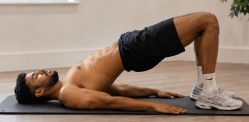
Shoulder Bridge

An excellent move for opening up the hips and strengthening the glutes, hamstrings, and lower back.
How to do it
- Lie on your back with your knees bent and feet flat on the floor, hip-width apart. Rest your arms by your sides.
- As you exhale, peel your spine off the floor, lifting your pelvis and hips until your body forms a straight line from your shoulders to your knees.
- Inhale at the top, and exhale as you slowly lower back down, one vertebra at a time. For an added challenge, extend one leg straight up at the top of the bridge.
The Swan

This exercise is fantastic for counteracting the forward-hunch posture many of us adopt from sitting at desks. It strengthens the entire back of the body.
How to do it
- Lie on your stomach with your hands placed under your shoulders, elbows tucked in close to your body.
- Keeping your abdominals engaged to protect your lower back, use your upper back muscles to lift your head, chest, and shoulders off the mat.
- Engage your glutes to keep your feet on the floor.
- Hold for a breath before slowly lowering back down.
Leg Pull Front

This is a more challenging exercise that builds shoulder stability and incredible core strength.
How to do it
- Start in a high plank or press-up position.
- Ensuring your core is braced and your body is in a straight line, inhale as you lift one leg a few inches off the mat.
- Exhale as you point your foot and shift your bodyweight back slightly, then inhale to shift forward again. Complete your repetitions on one side before switching to the other.
Side Bend

A great way to work the obliques and improve lateral (side-to-side) stability of the spine.
How to do it
- Sit on one hip with your knees bent and legs stacked. Place one hand on the floor for support.
- As you exhale, press through your supporting hand and feet to lift your hips off the floor, creating a rainbow shape with your body.
- Inhale to return to the start. Complete all reps on one side before switching.
It is wrong to assume Pilates is a “women’s workout”.
It’s a full-body conditioning system that builds strength, flexibility and focus.
Forget the stereotypes. Whether you prefer the mat or the machine, Pilates will challenge your limits, support your joints, and reshape how your body moves.
The benefits extend far beyond the studio; it improves how you perform in sport, how you recover from injury, and how you function every day.
It’s time to stop overlooking Pilates. Your body and mind will thank you.