


















































There are two forms of the routine.
When it comes to major Indian classical dances, Kuchipudi has a pride of place among them.
Similar to other classical dances, Kuchipudi originated as a religious dramatisation of choreography.
It often depicted odes to spiritual and mythological beings.
Containing roots in the Sanskrit text Natya Shashtra, the routine has become a widespread extravaganza of dance and drama.
The dance uses a vibrant array of instruments, and depends significantly on energy and charisma.
DESIblitz invites you on an exciting journey as we take a closer look into the history of Kuchipudi.
Origins
 According to etymology, Kuchipudi derives its name from the village in the Krishna district of Andhra Pradesh.
The word is the shortened form of Kuchelapuram or Kuchilapuri.
The village comes from the Sanskrit phrase “Kusilava-puram”, which in turn references a “village of actors”.
‘Kusilava’ is a term that is found in Sanskrit texts and has connotations of a travelling bard, a dancer, or a newsmonger.
Like other classical dances in India, the Kuchipudi dance has origins in the Natya Shashtra, which contains 6,000 verses divided into 36 chapters.
It describes the Tandav dance and the theories of Indian classical dance, which include expression, gestures, and acting.
In Andhra, this performance developed into Kuchipudi. The dance sequence was aided by Vaishnavism, a spiritual ode that grew in the second millennium.
The modern version of the dance is attributed to Tirtha Narayanayati, who was a 17th-century hermit.
He introduced rhythmic dance symbols at the end of the cantos.
During the medieval period, Kuchipudi was initially popular in the 16th century.
However, wars and tensions led to its decline. In 1678, a Sultan named Abul Hasan Tana Shah saw a performance of Kuchipudi.
He subsequently granted the dancers land to continue their art.
Colonial Rule
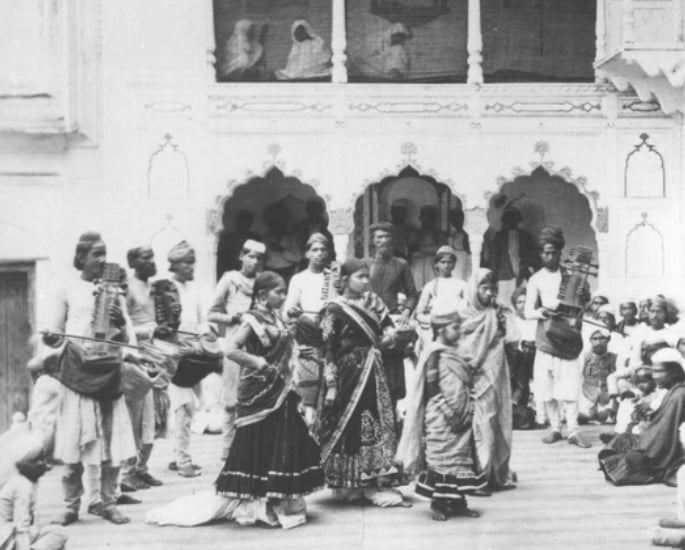 After the Mughal Empire collapsed in the 18th century, the East India Company formed the Madras Presidency.
During this time, Indian dance was frowned upon, and in 1892, the anti-dance movement began.
This movement labelled Indian classical dance as a facade for prostitution.
In 1910, the Madras Presidency banned dancing in temples. This had a negative impact on Kuchipudi.
Consequently, Indian people began protesting against the ban. As a result, from the 1920s, classical dance saw a renaissance.
Key figures who were instrumental in restoring the art were Vedantam Lakshminarayana Sastri.
How is it Performed?
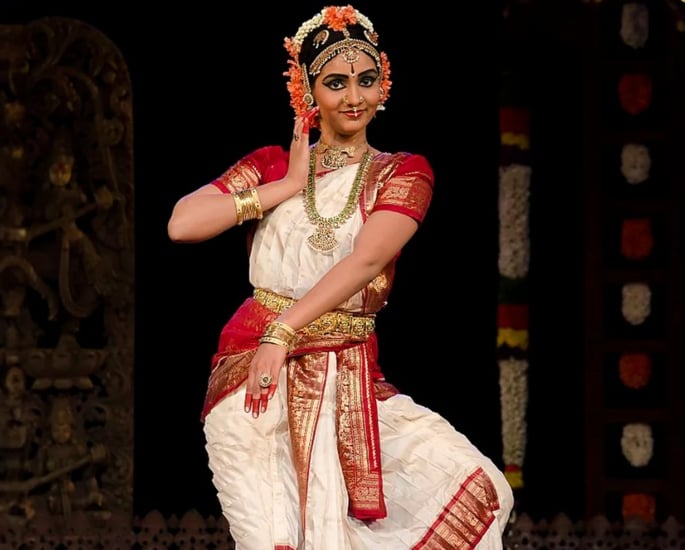 Kuchipudi was originally a male-orientated routine. By the 20th century, it became a classical solo dance sequence.
There are two forms of the routine: the musical dance-drama and the solo dance.
The dancers typically perform at night, and they are revealed via a curtain. A conductor is usually present throughout the routine.
They direct the sequence, and they may also interact and humour the audience.
After the introduction, the ‘nritta’ part of the performance begins. The dancers present a pure dance which is performed rhythmically.
Kuchipudi is adorned with unique hand and foot movements, showcasing agility and skill.
After the ‘nritta’ comes the ‘nritya’. The performers intertwine footwork and facial expressions to create an intricate routine.
If the sequence has a solo part to it, this is known as a ‘Shabdam’, which may be set to a poem, verse, or prose.
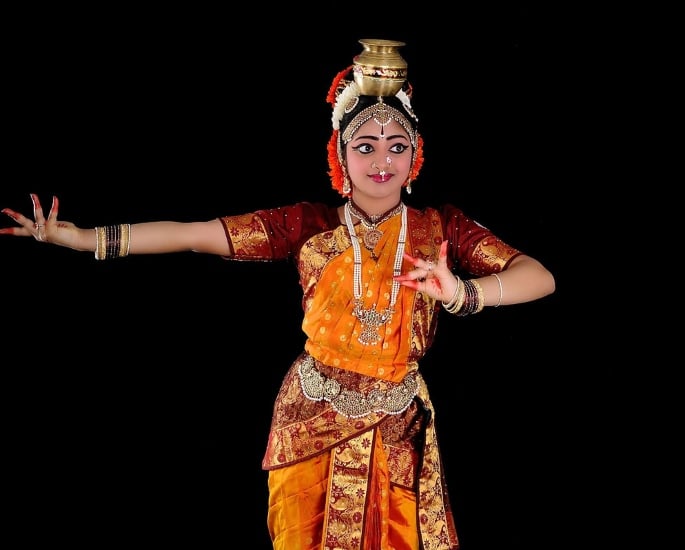
Another aspect of the performance is ‘Kavutvams,’ where the dancers implement acrobatics into the performance.
This may be done as the dancer performs while balancing pots on their head or holding divas in their hands.
The performers might dance rhythmically on white paper and rice powder before ending the routine with a scene or connotation of nature.
Costumes
 Like all vibrant Indian dances, costumes and attire are imperative in Kuchipudi.
When the dance routine was initially performed by male dancers, the men wore traditional dhotis.
In more modern versions, the women wear beautiful sarees with stitches and embroideries.
The end of the saree is tightened by a light, golden, and metallic belt at the waist.
In their hair and jewellery, the embedded elements symbolise things, including the sun, moon, the soul, and nature.
The jewellery can include anklets, piercings, bracelets, and necklaces.
Foreheads can be decorated with a red bindi with the eyes ringed with black collyrium.
Musical Instruments
 As previously mentioned, Kuchipudi encompasses a diverse collection of instrumentation.
These instruments include cymbals, violins, tambura, and flutes.
The conductor usually handles the cymbals and sings out the story of the performance.
If the conductor does not narrate the story, the violinist can do this.
Other less common instruments in the orchestra can include drums and clarinets.
Professional Thoughts
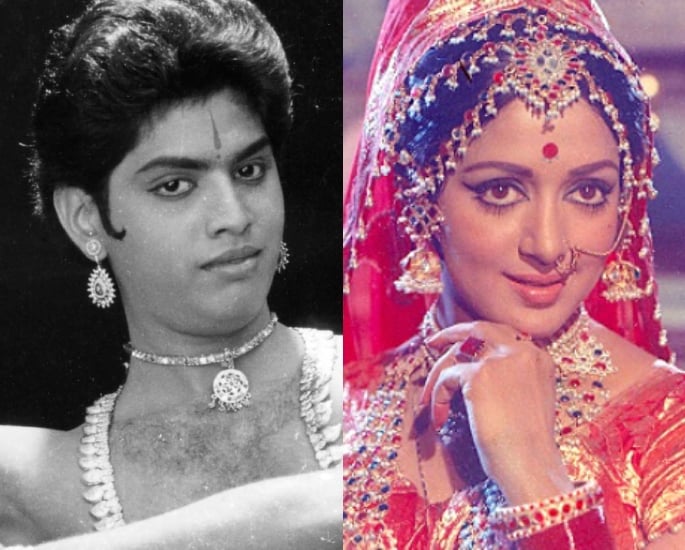 The respected choreographer Vempati Shankar Sharma is a Kuchipudi enthusiast.
In an interview, he delves into the innovation of the dance form:
“First of all, you must never cross the boundaries of the Kuchipudi style–the movements and way of interpretation that are unique to this dance.
“In the Natya Sastra, there are so many elements of dance delineated along with their dramatic value.
“Just for the sake of innovation, one must not create something with no meaning.”
In 2021, the veteran Bollywood actress Hema Malini highlighted Kuchipudi on International Dance Day.
She said: “It is special for me, as looking back, I realise that dance has dominated my entire life.
“From classical dance forms including B Natyam, Kuchipudi, Mohiniyattam, Kathak, to Bollywood dance, I’ve performed them all.”
These thoughts illustrate the talent that is required to perform Kuchipudi in a captivating way.
Kuchipudi remains one of the most effervescent and dynamic Indian classical dances.
Its rich origins and history demonstrate its uniqueness and brashness.
When it is performed, the dancers shine with colour, talent, and agility.
The art makes for a thrilling and satisfying dance sequence that will be celebrated for years to come.



