
















































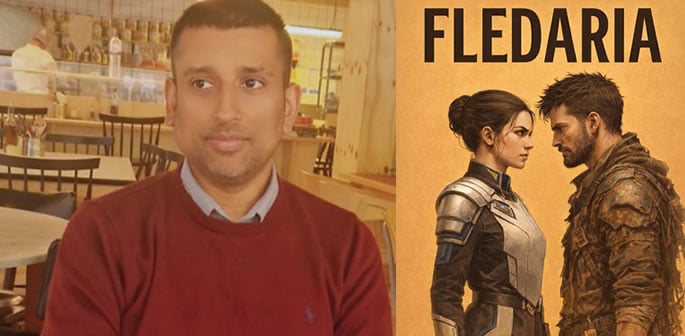
“The idea for Fledaria grew slowly over years"
Fledaria, the debut novella by Kashif Imdad, is set in a dystopian future where an unexplained inferno has left Earth scorched, fractured, and on the edge of extinction.
In the aftermath, scattered human settlements struggle to survive across poisoned wastelands, while armed Slavers roam abandoned industrial zones and ruined highways, turning survival into a constant negotiation with violence.
At the centre of the story is Emma, a young woman trapped in an oppressive home life on the outskirts of a ruined city, long before she even steps into the wider world of collapse.
Her existence is defined by control, fear, and a longing for something beyond the wastelands she can only see from her window.
That distant hope takes shape in her mind as Fledaria, a matriarchal society she believes offers safety and freedom from the brutality surrounding her.
In an interview with DESIblitz, Kashif Imdad reflects on the ideas and influences behind the novella.
A World shaped by Dystopian Warning Signs

Kashif Imdad’s Fledaria sits at the intersection of post-apocalyptic fiction and political reflection, shaped by years of engagement with dystopian storytelling.
The idea was developed gradually through exposure to influential works that interrogate power and collapse.
Imdad explains: “The idea for Fledaria grew slowly over years of reading works like George Orwell’s 1984, and watching post-apocalyptic films.
“Though these stories are fictional, I’ve always felt they gesture toward possible futures, especially in a world where proliferation of weapons of mass destruction is becoming more common.”
Rather than using dystopia as spectacle, Imdad anchors the story in a sense of unease that feels increasingly familiar.
The narrative reflects on how quickly global systems can destabilise when power becomes concentrated and unchecked, a theme that runs beneath the surface of the entire novella.
That influence of political literature is not decorative here; it forms the structural backbone of the world he builds.
A World without Safety Nets

The early chapters of Fledaria introduce Emma within an oppressive domestic environment before the narrative expands into the wastelands.
That shift is deliberate, positioning control as something that exists long before society officially breaks down.
Imdad draws a direct line between private and public forms of oppression, suggesting they often reinforce each other rather than exist separately.
“I wanted to keep the story as true to life as possible.
“In a post-apocalyptic world, where society has collapsed and no laws remain to protect the vulnerable, I believe the social order would likely harden into an even more brutal form of patriarchy.
“That idea was shaped not only by the logic of the world I was building, but also by my own South Asian background.
“Across South Asia and other parts of the world, progress on women’s rights is still uneven and often painfully slow.”
“But my personal experience was different. The women in my family are the ones who truly wore the trousers, and I was raised to respect women.
“That contrast, between the harsh realities many women face and the strength I saw at home, deeply influenced how I approached the world of the book.”
Emma’s early experiences are therefore not isolated character details but part of a wider commentary on how gendered power structures adapt rather than disappear during collapse.
The absence of formal law in the wastelands does not create freedom; instead, it intensifies existing hierarchies.
This approach also grounds the fiction in recognisable emotional terrain.
By connecting the narrative to lived realities, he avoids abstraction and keeps the focus on how power is experienced on an individual level, particularly for women navigating hostile environments.
Fledaria as Refuge, Ideology, and Contradiction

At the centre of the novella is Fledaria itself, a matriarchal society that contrasts sharply with the world Emma is forced to survive in.
“It functions both as a narrative destination and a conceptual challenge to the norms of power embedded throughout the story.
Imdad says: “Emma was raised in a rigidly patriarchal society where men set the rules and women are expected to obey: rules designed, always, to serve male power.
“To her, Fledaria represents everything her world is not: a safe haven, a place she imagines as free, fair, and led by women who shape their own destiny.”
That idea of Fledaria as aspiration is central to how the story maintains tension.
It is not simply presented as an idealised alternative but as something filtered through Emma’s understanding of oppression and possibility.
The contrast between her lived experience and imagined refuge shapes the emotional direction of the narrative.
The structure of the world also resists easy categorisation.
While Fledaria represents empowerment and reorganisation of power, the wastelands outside it remain defined by brutality, slavery, and survival logic.
Imdad places these extremes in deliberate opposition to highlight how systems of governance shape lived reality.
This tension becomes one of the novella’s defining features: the coexistence of hope and control, safety and exclusion, freedom and the boundaries required to maintain it.
Survival, Representation & Rewriting Familiar Narratives
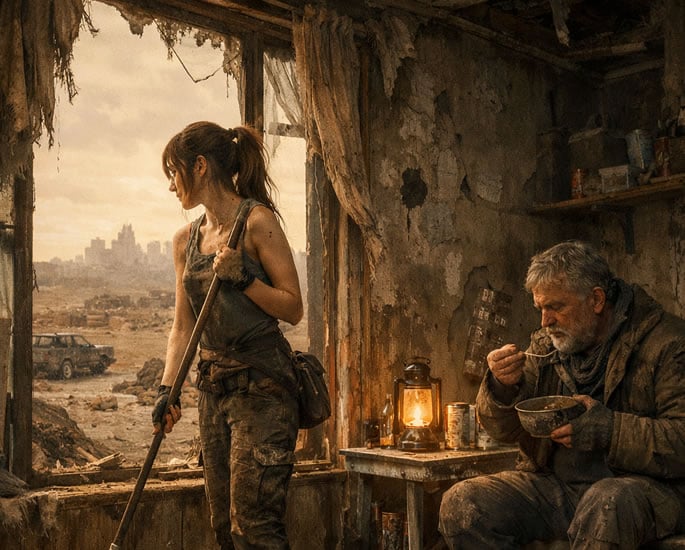
Much of Fledaria is built around survival, but Kashif Imdad is careful about how that survival is depicted.
Rather than relying on exaggerated violence or spectacle, he focuses on how power operates in everyday conditions of fear, scarcity, and coercion.
He explains: “I wanted to build a world that feels genuinely real, one that doesn’t gloss over the harsher truths of survival the way some post-apocalyptic films do, trading complexity for spectacle.
“Instead of leaning on exaggerated violence or gore, I focused on what life in such a world would truly mean for a woman navigating its dangers, its power structures, and its quiet, everyday brutality.”
That focus on realism extends into how female leadership is positioned throughout the narrative.
Early sections of the book introduce a female-led political movement that is dismissed by others, a detail that echoes real-world patterns of marginalisation, as Imdad elaborates:
“I believe the world, particularly the West, has made significant progress on women’s rights. Yet we still live in a society shaped more by patriarchal structures than genuine equality.
“Women remain underrepresented in positions of power, and as a result, those who do reach leadership roles are too often overlooked, dismissed, or sidelined.
“I believe a female-led society will be better for everyone.”
That perspective also connects to Imdad’s past work published on DESIblitz Arts, where he explored similar themes through short fiction.
Those stories provided an early platform for experimentation, particularly around representation in genres where South Asian characters are often absent.
He says: “Growing up with science fiction and post-apocalyptic books and films, I rarely saw meaningful representation of the South Asian community. We were almost invisible in the genres I loved.
“DESIblitz became the perfect platform for me to reach British South Asian readers directly. Zara and the Matriarchy began as short stories about a British South Asian woman navigating a post-apocalyptic Britain, something I had never seen portrayed with a South Asian protagonist at the centre.
“Although when I wrote those stories, they were quite rough around the edges, the feedback helped me develop my writing and storytelling skills. With Fledaria, I want to reach a more mainstream audience.”
In Fledaria, Emma does not appear until Chapter 4, a decision that deliberately shifts focus away from the conventional central-hero framing.
Instead, the opening establishes the conditions that shape the world she enters, including the political and existential forces that contribute to its collapse.
Imdad says: “I wanted the story to grow from a place of realism, grounded in the world we live in today.
“It felt essential to explore what could truly end our civilisation, to confront the modern forces that might push humanity toward ruin.
“For me, that meant acknowledging the escalating dangers of war and the unchecked proliferation of weapons of mass destruction.”
“By weaving these realities into the narrative, I hoped not only to build a more believable post-apocalyptic world, but also to remind readers of the fragility of our own.
“I wanted to tell a story of a woman who knew very little of the old world and her struggle to survive in a post-apocalyptic society.”
Across these structural choices, Fledaria builds a layered interrogation of power, visibility, and survival, positioning Emma’s journey within a broader critique of who gets to define heroism and whose stories are usually left untold.
At its core, Fledaria explores survival in its harshest forms, from the collapse of civilisation to the intimate violence of control within the home.
Through Emma’s journey and the fractured world around her, Kashif Imdad builds a story shaped by resilience, resistance, and the possibility of alternative systems of power.
The novella ultimately uses its dystopian setting to question how societies break down, who is left vulnerable in that collapse, and what visions of hope emerge from the ruins.