








































"I hope this piece of writing challenges those norms."
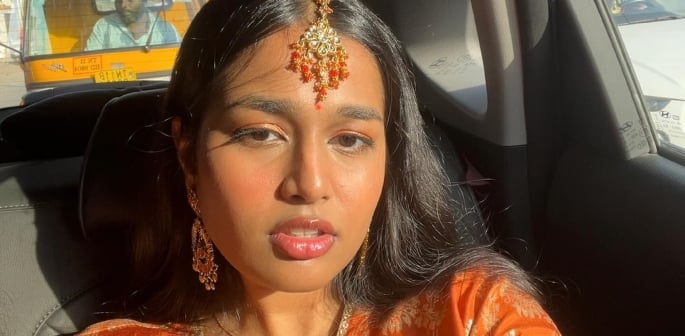
When it comes to fresh, young voices in writing, Shwetha Bai is an enigmatic talent.
At the 2024 Creative Future Writers’ Awards (CFWA), Shwetha won the Silver Award in the category of ‘Creative Non-Fiction’.
This was for her story, Flowers Don’t Wither, Portraits Don’t Bleed.
Shwetha is also fascinated by poetry and prose that explore Indian culture with a unique meld of magic realism.
Through a unique lens, she also intertwines Indian culture with womanhood in her writing.
DESIblitz spoke to Shwetha Bai about her writing. She shared some insights into Flowers Don’t Wither, Portraits Don’t Bleed and her writing journey.
She also delved into the themes that interest her and shared some valuable advice for others.
Can you tell us a bit about Portraits Don’t Wither, Flowers Don’t Bleed?
 Flowers Don’t Wither, Portraits Don’t Bleed is a short memoir that deals with this young girl becoming a woman.
It also deals with how social and religious factors influence her coming of age.
The story also involves this sense of soft rebellion that she has within herself and how it fights against the social stigma that surrounds her.
What was your reaction when you won the Silver Award?
When I read the email, I was completely ecstatic. First of all, I couldn’t believe it.
I was just happy and grateful and because I’m an amateur writer, it is just a sense of validation that you get from this prize.
As a writer, it has made me more confident and open to trying new things.
Can you delve into your poetry, and what inspired you to explore it?
 Poetry was one of the first things that I started to write.
It is just something that I write until I get my thoughts in order.
Sometimes, a poem could also lead to a lengthier form of writing. Poems are sometimes the start of a short memoir or short fiction.
The main poetry I write is narrative poetry because I like the idea of having a story within a poem and the trajectory that it takes a reader on.
I also write a lot of prose poetry because I like the free flow of it. There’s not a lot of restriction in terms of structure.
I guess the method I use to write prose poetry is that I do a lot of free-association writing.
When I put pen to paper without a pause, it helps me get my thoughts in order and sometimes make a whole poem out of it.
What attracts you to the themes of Indian culture and womanhood?
 Like every young writer, I had my insecurities. Because foreign media and literature are so influential in third-world countries, it’s sometimes easy to write for a foreign audience.
When I was doing my undergraduate, I read a speech and it said:
“I don’t know if writers have a foreign audience in mind when writing but they don’t have to.”
I felt like it was talking to me when I was reading that and I read a lot of Indian literature that year.
That’s when I realised that that was what I wanted to write about.
It helped me understand myself more and come to terms with my identity.
I would say that all that self-discovery and self-exploration that I get out of writing about Indian culture and womanhood is what attracts me the most.
Can you detail what magic realism is?
 Magic realism is a literary technique where the line between reality and fantasy is blurred.
These magical, fantasy elements become one with the reality that the writer creates in that world.
There is not a lot of magic realism in Flowers Don’t Wither, Portraits Don’t Bleed apart from when the mother brings the aarti.
I think magic realism is good for me in that I use the technique to write the everyday life I grew up in where all these elements would not be encountered with shock.
It’s just what I grew up believing in and it is just easy to translate it into writing.
What advice would you give other young people who want to explore writing?
For young writers who want to take up writing, I would tell them to start writing and that’s definitely a starting point.
If you write and read every day, that’s going to make you better.
I would say to write what you’re most passionate about and it’s just about honesty.
Which writers have inspired you in your journey?
 So many! The first person who comes to mind is Salman Rushdie.
I’ve been reading him for my dissertation. I’ve been reading Midnight’s Children.
The way Salman writes is so witty, and he also writes a lot of magic realism.
Of course, Arundhati Roy. Reading God of Small Things is an experience that I think everybody should have.
There’s a short story writer named Mahasweta Devi. Some of her short stories just leave you speechless and a bit traumatised.
That’s a good reaction to have after reading something because it just means that it’s more impactful and effective.
In terms of poetry, I read a lot of Kamala Das who writes a lot about women empowerment and culture.
What do you hope readers should take away from Flowers Don’t Wither, Portraits Don’t Bleed?
 I think the main thing that I want people to have is awareness of the stigma associated with menstruation and how it is a taboo subject matter in certain Indian communities.
In the family I grew up in, it was something that was supposed to be hidden away and not talked about.
I hope this piece of writing challenges those norms and breaks those barriers.
If any young woman reading this is going through the same thing, I want to tell her that it’s okay to have that sense of rebellion.
That’s how you combat it and rise above what you’re facing.
In your opinion, what can be done to combat the taboo of menstruation?
Proper education would be the first step towards raising awareness.
It’s also about making helpful products that are easily available which there is a shortage of in India.
This is a serious issue and not something toned down because of bigotry.
Education is definitely one of the main things that would combat this.
What themes and ideas do you hope to explore in the future as a writer?
 I definitely want to explore more of womanhood.
I’m currently editing a short story that deals with womanhood, intuition, and marriage.
I want to talk about all these issues and highlight how it affects young women and I definitely want to incorporate more magic realism in my writing.
Shwetha Bai is evidently a powerful, fearless writer who is unafraid to tackle taboo areas in her writing.
Her zeal for evocative material, her inspiration for her material, and her passion for her craft are all aspects to seek inspiration from.
She is undoubtedly on her way to becoming one of the best writers in contemporary literature.
It is all upwards for her from here and we are waiting to see what she accomplishes next.