


















































India ranks below nations like El Salvador
Global AI adoption in 2025 was defined by a stark digital divide.
While the UAE and Singapore lead with adoption rates exceeding 60%, South Asian nations like India (15.7%), Pakistan (10.3%), and Bangladesh (7.1%) lag significantly, despite providing the core technical talent that fuels Western AI development.
According to research from the Microsoft AI Economy Institute, Global AI Adoption in 2025 – A Widening Digital Divide, one in six people worldwide now uses generative AI tools.
This represents a monumental shift in how humanity works, learns, and communicates, yet the benefits of this revolution are being distributed with startling inequality.
For many observing from the perspective of the South Asian diaspora, the most jarring revelation is the disconnect between those who build the technology and those who use it.
7 Facts about Global AI Adoption
- Professionals from India, Pakistan, and Bangladesh make up a large share of elite engineering teams in Silicon Valley.
- DeepSeek gained major traction in underserved regions.
- India ranked below El Salvador (16.2%) and China (16.3%) in AI adoption.
- India’s AI adoption rate was 15.7%.
- Pakistan’s AI adoption rate in 2025 was 10.3%.
- Bangladesh had an AI adoption rate of just 7.1%.
- One in six people worldwide used generative AI in 2025.
We look at the widening gap, the surprising stagnation of the United States, and the urgent need for a more inclusive digital future.
The South Asian Paradox
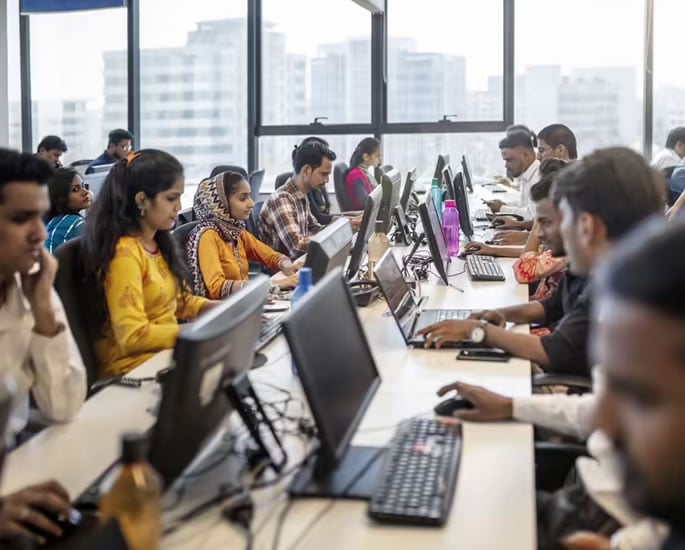
Perhaps the most significant finding in the report is the “South Asian Paradox”.
It is an established reality in the global tech sector that the workforce in the United States, particularly within the elite programming and engineering teams of Silicon Valley, is heavily comprised of professionals from India, Pakistan, and Bangladesh.
These individuals supply the technical, mathematical, and programming skills that have developed the world’s most advanced frontier models.
However, the data reveals that these contributors’ home countries are being left behind in terms of domestic adoption.
The statistics are sobering.
The second half of 2025 showed that India‘s AI diffusion rate was just 15.7%. While this is a modest increase from 14.2% in the first half of the year, it remains far below the global leaders.
Pakistan and Bangladesh face even steeper climbs, with adoption rates of 10.3% and 7.1%, respectively.
To put this in perspective, India ranks below nations like El Salvador (16.2%) and China (16.3%), while Bangladesh sits near the bottom of the global table, alongside nations with far fewer technical resources.
This creates a scenario where the architects of the AI era are effectively “exporting” their intelligence to the West, leaving their domestic populations to navigate a widening digital divide.
The report notes that “global diffusion of AI is influenced by accessibility factors”, which include infrastructure, cost, and linguistic relevance.
For the subcontinent, the challenge is clear: it is no longer enough to be the world’s “back office” for code; these nations must find a way to integrate AI into their own schools, workplaces, and public services to avoid a permanent economic disadvantage.
Why does Innovation Not Equal Usage?

If the South Asian numbers are a cause for concern, the data regarding the United States is nothing short of a wake-up call.
Despite being the undisputed home of the world’s leading tech firms, Microsoft, Google, and OpenAI, the US is struggling to convert its innovation leadership into broad domestic adoption.
In 2025, the United States actually fell in the global rankings, dropping from 23rd to 24th place.
With an AI usage rate of just 28.3% among the working-age population, the US lags significantly behind smaller, more agile, and highly digitised economies.
The Microsoft report is blunt in its assessment: “Leadership in innovation and infrastructure, while critical, does not by themselves lead to broad AI adoption.”
This plateau suggests that while the “technological elite” in America are pushing the boundaries of what is possible, the average worker is either hesitant to adopt these tools or finds them less integrated into their daily life than their counterparts in more proactive nations.
This American stagnation serves as a fascinating counterpoint to the South Asian situation.
While the US possesses the infrastructure and the models, it lacks the universal adoption found in the Middle East or Scandinavia.
Conversely, South Asia possesses the human talent but lacks the domestic infrastructure and accessibility.
Both regions are, in different ways, failing to maximise the potential of the technology being built on their own soil or by their own people.
The DeepSeek Phenomenon

2025 saw the rapid rise of DeepSeek, an open-source AI platform that has fundamentally reshaped the landscape in markets underserved by traditional Western providers.
By releasing its model weights under an MIT License and offering a completely free chatbot, DeepSeek removed the primary barriers to entry: cost and technical exclusivity.
DeepSeek’s strongest adoption has emerged in regions where Western services face restrictions or where “credit card barriers” (the requirement for paid upgrades) prevent widespread use.
The report highlights that in Africa, DeepSeek usage is estimated to be 2 to 4 times higher than in other regions. It has also gained significant traction in China, Russia, Iran, and Belarus.
For South Asian nations, including India and Pakistan, the rise of DeepSeek represents a potential lifeline.
Because it is open and free, it allows developers to inspect, adapt, and build upon its core engine without the heavy subscription fees associated with US-based models.
This shift highlights how open-source AI can function as a geopolitical instrument, extending influence in areas where Western platforms cannot easily operate.
If the “next billion AI users” are to come from South Asia or Africa, they may very well enter the ecosystem through open-source gateways rather than the walled gardens of Silicon Valley.
Lessons from the Leaders

To understand how to bridge the divide, one must look at the nations that topped the 2025 rankings.
The United Arab Emirates (UAE) extended its lead as the number-one ranked country, with a staggering 64% of its working-age population using AI.
This success was not an accident of history but the result of a deliberate, decade-long strategy.
As early as 2017, the UAE appointed the world’s first Minister of State for Artificial Intelligence, establishing a governance framework years before the rest of the world began to take the technology seriously.
However, the clearest “success story” of 2025 is South Korea.
It surged seven spots in the global rankings, climbing from 25th to 18th in just six months.
South Korea’s growth was driven by a unique combination of government policy, improved linguistic capabilities in models, and a “viral cultural moment”.
In April 2025, AI-generated Ghibli-style images went viral across Korean social platforms, introducing millions of first-time users to the technology.
More importantly, the release of models like GPT-4o and GPT-5 significantly improved AI performance in the Korean language.
GPT-5’s performance on the Korean SAT benchmark rose from a score of 16 (GPT-3.5) to a perfect 100.
This shift, from “below adult reading proficiency” to “top-tier college student” performance, is the key to mass adoption.
For South Asian countries, the lesson is clear: adoption will skyrocket only when AI can speak Hindi, Urdu, Bengali, and Punjabi with the same nuance and accuracy it brings to English.
Bridging the Gap

The data make it clear that we are at a crossroads.
The digital divide is no longer just about who has an internet connection; it is about who has the “intelligence” to process information and solve problems at scale.
As the Microsoft report concludes: “The challenge ahead is ensuring that innovation spreads in ways that help narrow divides rather than deepen them.”
For the countries of South Asia, reclaiming their digital future requires a transition from being a “labour provider” to an “AI-enabled society.” This involves:
- Linguistic Localisation: Investing in Large Language Models (LLMs) that reflect the linguistic and cultural nuances of the subcontinent.
- Removing Financial Barriers: Embracing open-source models like DeepSeek to provide free or low-cost access to students and small businesses.
- National AI Strategies: Moving beyond high-level “visions” to concrete, institutionalised actions, such as the UAE’s regulatory sandboxes or South Korea’s education-focused science high schools.
The brilliance of the South Asian programmer has already built the AI of the West. Now, that same brilliance must be harnessed to build an AI future that serves the streets of Delhi, Karachi, and Dhaka.
2025 proved that while technology advances, human progress is often hindered by the same old geographic and economic barriers.
The Microsoft AI Economy Institute shows both the remarkable progress of the human race and the work that remains to be done.
We see a world embracing AI at a speed that was unthinkable five years ago, yet the “widening digital divide” threatens to leave billions in a state of technological servitude.
The paradox of the South Asian talent pool, building tools they do not use, is the ultimate symbol of this imbalance.
Now in 2026, the global tech community must ensure that the next wave of innovation is not just smarter, but more equitable.
The future of AI should not be a luxury for the few, but a utility for the many, regardless of where they live or the language they speak. Only then can we truly say the digital divide has been closed.