

















































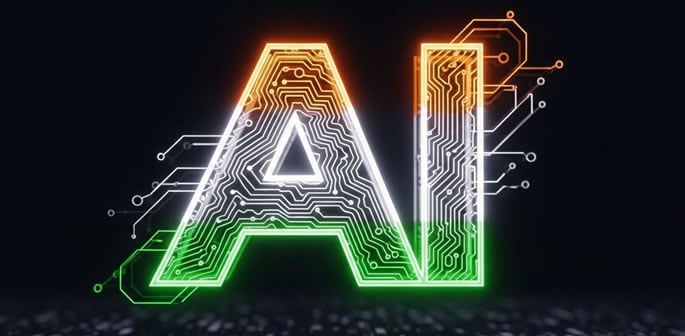
The goal is "to help build the infrastructure"
Tech giants Amazon and Microsoft invested a $50 billion-plus combined investment in India, putting AI in the spotlight.
The investment comes at a fascinating juncture for the global technology market.
But with fears of an AI bubble sweeping the globe, a critical question emerges.
Can India truly keep pace in this demanding and competitive AI race?
We delve into the nation’s ambitious journey, exploring the immense investments, the sovereign AI goals, and the unique challenges ahead.
The Billion-Dollar Bet

Tech titans are making a significant wager on India’s AI potential.
Microsoft’s Satya Nadella announced a $17.5 billion investment, his company’s largest in Asia.
The goal is “to help build the infrastructure, skills, and sovereign capabilities needed for India’s AI-first future”.
Amazon followed, committing over $35 billion by 2030, with a large portion dedicated to boosting AI capabilities.
Yet, this optimism isn’t shared by all financial experts.
Christopher Wood of Jefferies called India’s stocks a “reverse AI trade”, suggesting India might outperform other markets “if the AI trade suddenly unwinds”.
HSBC held a similar view, seeing Indian equities as a “hedge and diversification”.
This cautious stance comes as Mumbai stocks have lagged, with investors pouring billions into Korean and Taiwanese AI firms instead.
Dreams & Hurdles

India is determined to create its own sovereign AI model.
About 18 months ago, the government launched an AI mission. It began supplying startups and researchers with high-end computing chips.
The goal is to develop a homegrown AI model like OpenAI or China’s DeepSeek. The government says the model, supporting over 22 Indian languages, is imminent.
However, India is playing catch-up as competitors launch newer variants.
The nation’s $1.25 billion sovereign mission is a shadow of France’s $117 billion or Saudi Arabia’s $100 billion programmes.
Global consultancy EY highlights numerous other hurdles.
These include semiconductor availability, a lack of skilled talent, and fragmented data ecosystems. India currently lacks the vast computational power that gave the US and China a head start.
A Unique Edge

Despite challenges, India has a powerful asset: its talent pool.
The country has 2.5 times more AI-skilled professionals than the global average. The difficulty lies in retention.
An EY report states, “attractive policy incentives need to be put in place to incentivise relocation to India.”
China, for instance, offers financial support, tax breaks, and special talent visas.
India’s true advantage may lie in using AI, not just building it.
Shailendra Singh of Peak XV Partners told the BBC: “AI will have a massively democratising effect on the creation of new companies.
“The downstream effect will be amazing for places like India.”
We are already seeing a surge in AI-powered consumer apps. Startups are tackling real-world challenges for millions.
For example, MahaVISTAAR, an AI app, delivers vital agricultural information to over 15 million farmers.
Nandan Nilekani, the architect of India’s biometric programme, wrote in The Economist magazine:
“The hardest places to make artificial intelligence work are also the places where it matters most.
“If AI can serve India’s classrooms, clinics and farms, it can serve the world.”
This practical focus is reflected in investment data.
India ranks in the top five globally for new AI companies receiving funding. However, these startups raised just $1.16 billion, compared to over $100 billion in the US.
But this new AI wave could disrupt India’s vital IT services sector. This industry has powered the economy for 30 years.
Jefferies warns that these billion-dollar firms are now a key area of “vulnerability”. The impact is already showing.
Growth in IT back offices is slowing, hiring has shrunk, and wages have stagnated.
India stands at a pivotal moment in the global AI landscape.
Enormous investments provide a powerful catalyst for growth and innovation. However, the nation faces significant hurdles in sovereign AI development and talent retention.
Its unique path may be defined by its ability to apply AI to solve grassroots problems.
This strategy holds immense promise but also threatens to disrupt the very industry that built India’s tech reputation.
The next decade will be crucial in determining if this high-stakes gamble pays off.