


















































"Then the pattern repeats for 30 consecutive days.”
Sash Jayasinghe is preparing to run the entire coastline of Sri Lanka in a 30-day continuous effort that will cover around 1,400km.
The challenge begins on July 1 and will see him move through every major stretch of the island.
At 21, and raised in the UK after his parents relocated from Sri Lanka to build a new life, he is framing the run as more than an endurance feat.
The project is designed to connect communities across the island while establishing youth running clubs in regions he passes through, supported by local partners and running groups.
It also doubles as a filmed documentary, documenting the journey in real time as he moves through each stage of the coastline.
In an interview with DESIblitz, Sash Jayasinghe breaks down what each day will look like and the deeper meaning behind his run.
Choosing Sri Lanka
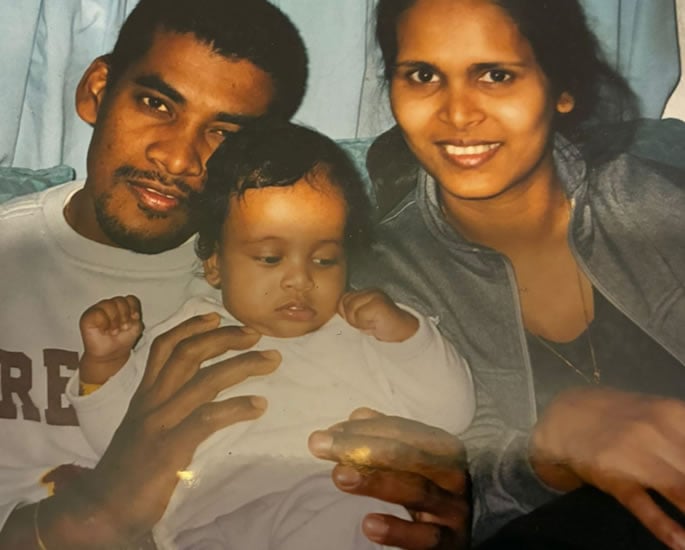
Running 1,400km in 30 days is not a conventional endurance challenge, and Sash Jayasinghe is clear that was never the intention.
He says: “My parents are from Sri Lanka. They left everything they had to give me a life in the UK – first Rome, then London at 13.
“I grew up always the outsider, always between cultures. The island was always this idea, not a real place I understood.”
That sense of distance from heritage becomes the framing device for the run itself.
Instead of choosing a standard marathon or staged ultra, Jayasinghe opted for a route that forces engagement with the full geographical and cultural spread of the island.
He continues: “The question I asked myself was: what’s the most honest thing I can do that will make people pay attention?
“The answer kept coming back to Sri Lanka. Not a marathon. Not a race. The whole island.”
The coastline route takes in the north, south, east and west, moving through Tamil and Sinhala regions without omission.
“A full lap means I run through Jaffna and Matara and Batticaloa and everywhere in between. Tamil and Sinhala communities. North and south. You can’t skip any of it.
“That’s what made me choose the coastline. Not the distance, the fact that the distance forces the whole story.”
The Structure behind 30 Consecutive Days
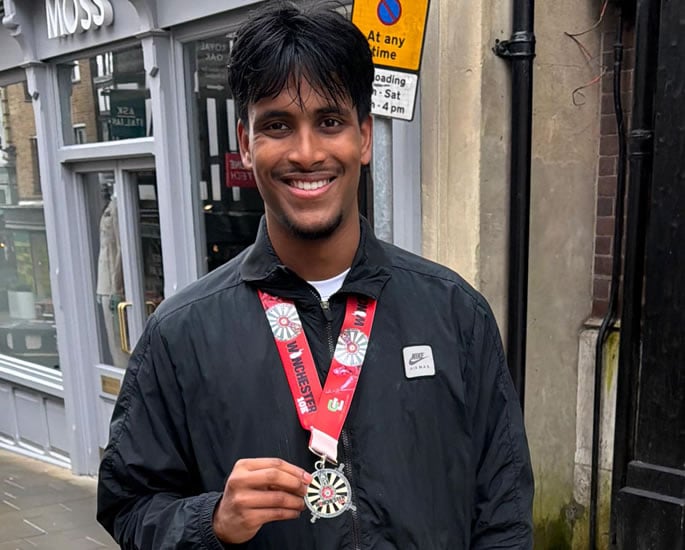
The scale of the attempt is matched by a tightly controlled daily routine, designed to manage extreme heat, fatigue and recovery over a month-long effort.
The structure leaves little room for deviation, especially in Sri Lanka’s coastal climate, where humidity compounds physical strain.
Revealing what each day will look like, Jayasinghe says:
“Up at 5:30. Hydration, electrolytes, light food. Running by 6.
“25-30km in the morning before the heat hits. The Sri Lankan coast in July is 30-35 degrees and humid. That first run has to happen early.”
Midday will be treated as a controlled recovery window.
A support caravan will follow Jayasinghe, providing rest points that allow his body to reset before resuming his run.
He says: “The caravan meets me at a checkpoint. I eat, rest, sometimes sleep for 90 minutes if the body needs it.”
The second half of the day will be equally disciplined, as Jayasinghe says:
“Back out at 3 pm for the final 15-20km. Arrive around 6. Shower, full meal, review the day’s footage with the content team. Plan the next morning’s segment.
“In bed by 9. Every 5 nights there’s a hotel stop – that’s for proper recovery, laundry, and genuine rest. Then the pattern repeats for 30 consecutive days.”
Jayasinghe’s routine is designed to remove decision fatigue, ensuring energy is preserved for the physical output rather than logistics.
The Challenges that Come with the Run
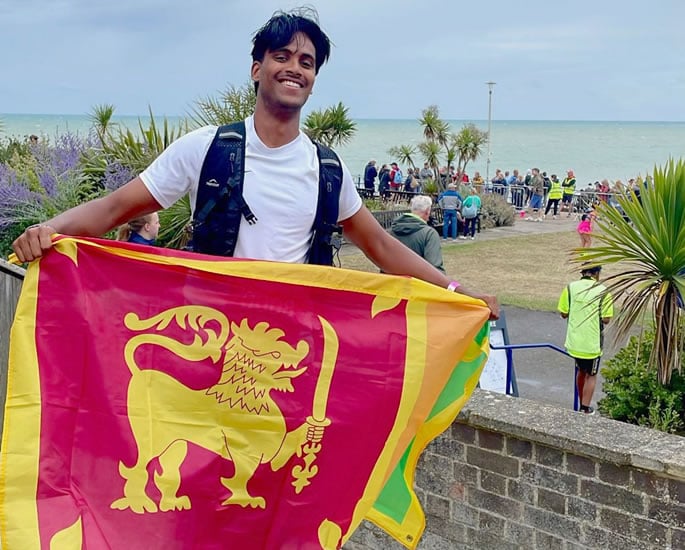
While the physical demands are significant, Sash Jayasinghe is more focused on the psychological deterioration.
The most immediate pressure point is timing within the month.
Identifying a specific window, Jayasinghe explains:
“Physically, days 15 to 25 are the window I’m most focused on. By then, you’re deep into the East Coast. The distances don’t get shorter. The body has already taken a lot.”
Sri Lanka’s environmental conditions will add an extra layer of strain.
“The heat is constant. 30-35 degrees on a coastal road, with humidity doesn’t reset overnight. Every morning, you start from a slightly worse position than the day before.
“Mentally, the danger is when the suffering becomes ordinary.”
“When you stop caring, that’s the moment I’m preparing for more than any physical challenge. You can manage pain. Numbness is harder.”
Even so, the motivation is positioned as something that exists within communities rather than apart from them, which alters its emotional weight.
He adds: “What will carry me through is knowing this isn’t just a challenge to complete.
“There are people in those communities who will see someone show up in their town and run through their street. That changes what it is. It stops being about me.”
Building a Route through Communities
The route itself is carefully engineered, both geographically and socially.
The run begins from Colombo, moving through the south before heading east and north, eventually returning along the west coast.
Sash Jayasinghe details: “Anti-clockwise from Colombo. South coast first – Galle, Matara, Hambantota – then east, north, and back down the west coast to finish where I started.”
Behind the scenes, logistics are being handled by a dedicated support team to ensure safety and continuity.
“Desh, my partner on the ground who runs a social enterprise called Nul, has been checking road viability for each segment.
“Some sections in the north and east need specific assessment, particularly around Mullaitivu.”
But the route is not solely defined by terrain or infrastructure.
Local running communities have played a defining role in shaping the journey’s structure, anchoring it to real points of connection rather than arbitrary distances.
Alongside the physical planning is a deliberate focus on narrative. Jayasinghe is explicit that this is not about curated imagery of the island, but about documenting everyday life and overlooked perspectives.
“The people who don’t usually get filmed. Not the tourist Sri Lanka. The fishermen in Batticaloa at 5 am. The kids in Jaffna who have discipline, drive, and no access to what I had growing up.
“My parents left that place and worked themselves to nothing so I could have a different life.
“I want to go back and actually understand what they left. What they gave up.”
That extends into cultural understanding, particularly around Tamil history.
He concludes: “There’s also the Tamil story. My father has Tamil roots and I didn’t grow up understanding it properly.
“Harren, who leads the Aram Initiative, was direct with me: if you want to claim this run unites the island, you have to understand Tamil history first. He was right.
“That process is ongoing and it’s going to be part of what we document.”
The scale of the run is measured in distance, but its intention is rooted in connection.
Over 30 days, the coastline becomes a continuous thread linking regions, communities and personal history.
The focus remains on building something that lasts beyond the final kilometre, particularly through the establishment of local running clubs and ongoing community structures.
It is also a return of sorts, shaped by questions of identity, migration and understanding the places that sit behind family history.
As Sash Jayasinghe’s run gets closer, it sits at the intersection of endurance sport, cultural exploration and long-term community building.