

















































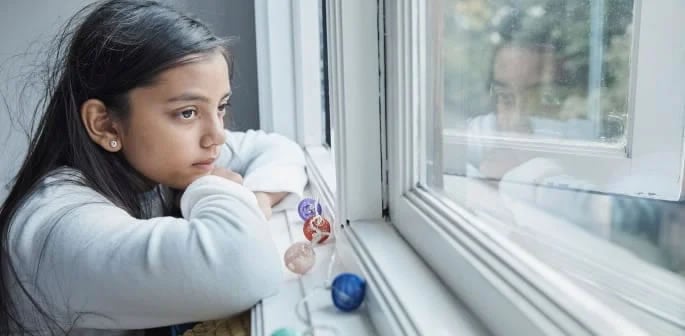
the research found smacking "does not help children"
Smacking children as a form of punishment could be linked to lower GCSE attainment and a greater likelihood of engaging in risky behaviour during adolescence, according to new research from University College London (UCL).
Researchers examined data from around 19,000 children born in the UK between 2000 and 2002 to assess the long-term impact of physical punishment during early childhood.
The study tracked children at the ages of three, five and seven, with researchers concluding that smacking “does no good whatsoever”.
They have renewed calls for England and Northern Ireland to follow Scotland and Wales in banning the practice.
The Department for Education said it has no plans to change the law in England, although it stressed that protecting children’s safety and wellbeing remains a government priority.
Lead researcher Associate Professor Anja Heilmann said the findings showed no evidence that physical punishment benefited children.
She said: “My hope is that smacking stops in the UK so children have the same protection from physical assault that adults have.”
As part of the research, the team analysed educational outcomes for 7,559 pupils in England by linking data to the National Pupil Database.
The findings showed that children who had been smacked were 5.7 percentage points more likely to fail to achieve five GCSE passes at grades A*-C, including English and Maths.
Researchers also found that children who experienced physical punishment in early childhood were 33% more likely to engage in risky behaviours by the age of 14, including bullying.
Heilmann said the research found smacking “does not help children and all the effects that we did find were in the direction of a harmful outcome”.
The study was observational and relied on questionnaires completed by families of children who had experienced physical punishment.
Researchers acknowledged that the findings do not prove a direct causal relationship between smacking and later outcomes, as other factors may have influenced children’s development over the course of the study.
Professor Ellie Lee, a family and parenting researcher at the University of Kent, said the findings appeared credible but warned against attributing child development outcomes to a single factor.
Lee said: “It would be great if we could just be nice to children and think they would just be nice back.
“But the reality of it is, is that in order for children to understand the rules of society, and to learn how to behave in a way that is moral, and that is good, we have to have boundaries, and boundaries have to be backed up.”
Lee, who is also part of the Be Reasonable England campaign, which supports the use of smacking, added that child development is influenced by multiple factors and there is often a “rush to try and find silver bullets and single causes”.
The debate over physical punishment continues across the UK, where laws differ between nations.
Scotland became the first part of the UK to outlaw physical punishment of children under 16 when legislation came into force in 2020. Wales introduced a similar ban in 2022.
However, smacking remains legal in England and Northern Ireland under certain circumstances.
Supporters of a ban argue that children should receive the same legal protection from assault as adults. Opponents have raised concerns that criminalising smacking could lead to parents facing prosecution for disciplining their children.
Among those backing a ban is Amy Woods, owner of Baby College in Salford, who said she was surprised one had not already been introduced in England.
She said: “Children need warmth, they need responsive relationships and they need play to thrive, definitely not violence at a young age.”
The research also highlighted changing attitudes towards physical punishment.
It found that one in five 10-year-olds monitored in 2021 had experienced some form of physical punishment, while mothers with higher levels of education were less likely to use it.